
Setting up a heavy-duty punching bag at home is a major step toward building a dedicated combat sports training space. However, hanging a heavy, swinging object inside a residential structure is not as simple as finding an open corner and drilling a hole. To train safely and avoid costly structural damage, you must carefully evaluate your home’s physical dimensions and structural integrity.
To safely accommodate a heavy-duty punching bag, you generally need a clear floor radius of at least 1.5 to 2 meters from the hanging point, a ceiling height of at least 2.4 meters to allow for the bag and its mounting hardware, and a structural support system capable of bearing three to four times the bag’s static weight. Failing to verify these requirements before installation can result in severe structural failure, compromised training biomechanics, or serious personal injury. Equipment cannot replace proper structural judgment, and understanding your home’s limits is your first line of defense.
Calculating Floor Space and Swing Radius
When planning your home boxing corner, the most common error is measuring space based solely on the static footprint of the heavy bag. A heavy-duty punching bag is designed to move, absorb impact, and swing. To determine the actual floor space required, you must calculate the dynamic swing radius of the bag combined with your own movement needs.
Products mentioned in this guide
![[2023 New] EVERLAST Boxing Punching Bag for Adults Black PU Leather Heavy Duty MMA Training With Free Gloves](https://img.lazcdn.com/g/p/d30681ff0343b6c727f903cea5a0c6f2.jpg_400x400q80.jpg_.webp)
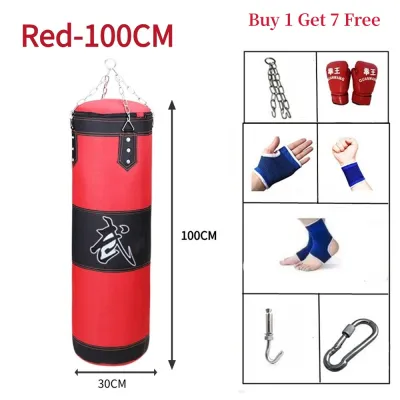
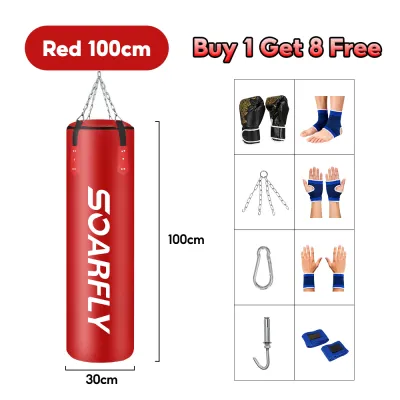
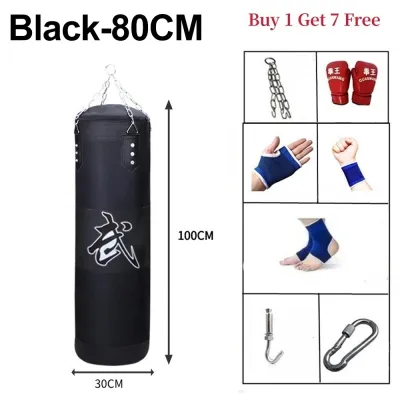

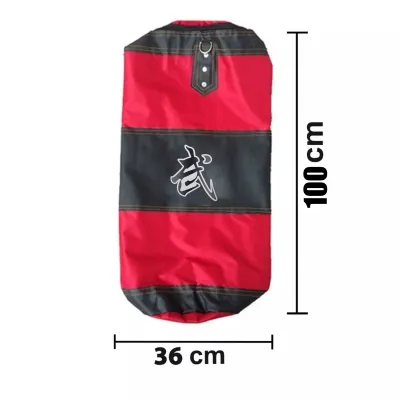
Prices are valid at publication and may change. Please refer to the product page for the latest price.
The Swing Radius Factor
To find the minimum safe training area, you must factor in the bag’s diameter, its maximum swing distance under full-force impact, and your own maximum arm and leg reach. A standard heavy-duty punching bag typically has a diameter of 30 to 40 centimeters. When struck with high-velocity punches or kicks, the bag can easily swing 1 meter or more in any direction from its resting center.
To calculate your safe swing zone, use this basic formula:
Total Clearance Diameter = Bag Diameter + (Maximum Swing Distance x 2) + (User Reach x 2)
For an average adult with a reach of 75 centimeters, this means you need a clear, unobstructed circle with a diameter of at least 3 to 4 meters. If the bag swings toward a wall or a piece of furniture while you are stepping forward to strike, you risk jamming your wrist, stubbing your toes, or colliding with the surrounding environment.
Movement and Footwork Clearance
Effective heavy bag training requires constant movement. You must be able to pivot, step laterally, circle the bag, and retreat during combinations to simulate a realistic opponent. This requires a complete 360-degree clearance zone around the entire swing path of the bag.
If you position the bag too close to a wall, you limit your training to static, linear punches. This not only diminishes the quality of your workout but also encourages poor habits, such as standing flat-footed. Ensure that your footwork path is entirely free of cords, rugs, or uneven floor transitions that could cause slips or trips during high-intensity training.
Common Space-Measurement Mistakes
Many homeowners measure their space by simply standing in a room, stretching out their arms, and deciding the area is sufficient. This subjective assessment ignores several critical hazards.
- Ignoring the Swing Arc: Forgetting that a hard kick can send the bag into a wide, unpredictable arc that can easily shatter nearby windows, dent drywall, or knock over electronics.
- Overlooking Overhead Obstacles: Failing to account for low-hanging light fixtures, air conditioning units, or ceiling fans. In tropical climates like the Philippines, ceiling fans are common fixtures; hanging a heavy bag within the swing path of an active fan is an immediate safety hazard.
- Blocking Doorways and Walkways: Placing the bag in a spot where its swing blocks a doorway or a high-traffic hallway, creating a collision risk for other household members.
Evaluating Ceiling Height and Hanging Clearance
Vertical clearance is just as critical as floor space. If your ceiling is too low, the bag will drag on the floor, ruining its swing mechanics and causing premature wear on the base of the bag. If the ceiling is exceptionally high, you will need extra-long chains that can create excessive lateral sway, making the bag difficult to control.

Determining Ideal Hanging Height
To train with proper form, the target area of the heavy bag must align correctly with your body. For traditional boxing, the top third of the bag should be level with your eyes and forehead. This ensures you are throwing punches at a realistic head-and-chest level, which prevents shoulder strain and neck fatigue.
If you are training in kickboxing, Muay Thai, or MMA, the bag must hang slightly lower to accommodate low kicks and knee strikes. However, it must still remain high enough that your high punches do not strike the thin hanging straps or metal D-rings at the top of the bag.
Accounting for Hardware Length
When measuring your ceiling height, do not assume a 1.2-meter bag will fit perfectly in a room with a 2.4-meter ceiling. You must subtract the combined vertical length of all mounting hardware from your total ceiling height. This hardware stack typically includes:
- The ceiling mount plate or joist hanger
- The heavy-duty spring (used for shock absorption)
- The swivel connector (to prevent chain twisting)
- The hanging chains or nylon straps attached to the bag
This hardware assembly can easily take up 30 to 50 centimeters of vertical space. If you subtract this from a standard 2.4-meter ceiling, a 1.2-meter bag will hang only 70 to 90 centimeters off the floor. Always measure your hardware stack first to ensure your bag hangs at the correct ergonomic height.
Top Clearance for Vigorous Swings
When a heavy bag is struck with force, the top of the bag tilts upward as it swings. You must leave a vertical buffer zone of at least 15 to 20 centimeters between the top of the bag’s hardware and the ceiling. Without this buffer, the metal chains, D-rings, or the top collar of the bag can scrape, dent, or repeatedly strike the ceiling surface during high-impact training, causing cosmetic and structural damage over time.
Assessing Ceiling Strength and Structural Load Capacity
Hanging a heavy-duty punching bag is a structural modification that requires a safety-first approach. Before drilling any holes, you must understand the difference between static weight and dynamic force, and you must verify that your ceiling can handle the load.
Static Weight vs. Dynamic Force
A heavy-duty punching bag that weighs 45 kilograms (approximately 100 pounds) does not exert only 45 kilograms of downward force on your ceiling. When you strike the bag, you transfer kinetic energy into the system. This movement, combined with gravity, creates dynamic forces that multiply the load on the mounting point.
During intense training sessions, the dynamic force exerted on the ceiling joist can reach three to four times the static weight of the bag. Therefore, a 45-kilogram bag requires a mounting point rated to support a dynamic load of at least 135 to 180 kilograms. Planning only for the static weight of the bag is a recipe for structural failure.
Identifying Safe Mounting Points
You must anchor your heavy bag mount directly into a solid structural element of your home.
- Wooden Joists: In timber-framed ceilings, use a high-quality stud finder to locate the exact center of a solid wooden ceiling joist. Always pre-drill pilot holes to prevent the wood from splitting, and use heavy-duty steel lag bolts (typically 10mm to 12mm in diameter) that penetrate at least 75mm into the center of the joist.
- Concrete Slabs: In modern concrete homes or high-rise condominiums, you can mount the bag directly into the reinforced concrete ceiling slab using heavy-duty steel expansion anchors or sleeve anchors. Always check with your building's administration or HOA before drilling into structural concrete, as you must avoid hitting internal tension cables or conduit pipes.
- Strict Warnings: Never, under any circumstances, mount a heavy punching bag directly to drywall, plaster, plasterboard, or suspended drop-ceiling grids. These materials are purely cosmetic and have zero structural load-bearing capacity for dynamic forces. Attempting to mount a bag to these surfaces will result in the immediate collapse of the ceiling material, causing severe injury and expensive property damage.
Safety Boundaries and Professional Consultation
If you cannot locate a solid wooden joist, if the joist shows signs of rot, termite damage, or splitting, or if you are unsure of the material and thickness of your concrete slab, stop immediately. Do not attempt the installation.
Always consult a licensed structural engineer or professional contractor to verify your ceiling’s load capacity and perform the installation. If you live in a multi-story building or rental property, check your lease agreement or building management guidelines. Drilling into structural elements without authorization may violate safety codes or void your insurance policy.
Vibration and Noise Transfer
When you strike a heavy bag mounted to a ceiling joist, the impact vibrations travel directly through the wooden or concrete structure of your home. This can create a loud, low-frequency thumping noise that resonates through adjacent rooms and neighboring units.
To minimize this disturbance, always install a heavy-duty compression spring between the ceiling mount and the bag’s chains. These springs are designed to absorb peak kinetic forces, dampening the vibration before it can travel into the joists. Additionally, using specialized rubber-isolated ceiling mounts can significantly reduce acoustic transfer, keeping your training sessions quiet and neighbor-friendly.
Alternative Setups for Limited or Weak Spaces
If your home lacks the ceiling strength, vertical clearance, or overall space required for a traditional hanging heavy bag, you do not have to abandon your training. There are several highly effective alternative setups that bypass the need for ceiling drilling.
Freestanding Heavy Bag Stands
A freestanding heavy bag stand (typically an A-frame or C-frame steel structure) allows you to hang a traditional heavy bag without touching your ceiling. These stands are excellent for rental properties where drilling is prohibited.
However, they come with distinct trade-offs. Freestanding stands require a massive floor footprint, often taking up a 1.5-meter by 2-meter area just for the steel base. Furthermore, the steel legs and support braces can act as tripping hazards, severely limiting your ability to move 360 degrees around the bag. You will generally be restricted to striking the bag from a semi-circle in front of the stand.
Wall-Mounted Bag Arms
A wall-mounted bracket uses a triangular steel arm that bolts directly into a vertical wall. This setup is highly stable and keeps the ceiling completely free of load.
To install a wall mount safely, you must anchor it into solid wooden wall studs or solid masonry, such as reinforced concrete walls. In the Philippines, many interior partition walls are constructed from non-load-bearing concrete hollow blocks (CHB) or light drywall. Mounting a heavy bag to a standard CHB wall without proper steel backplates or structural reinforcement can cause the blocks to crumble under lateral dynamic forces. Additionally, remember that the bag will still swing outward, meaning you must maintain the same floor clearance in front of the wall.
Freestanding Punching Bags (Water/Sand Filled)
Freestanding punching bags feature a heavy plastic base filled with water or sand, supporting a flexible vinyl striking column. These require zero mounting hardware and can be easily rolled into a corner when not in use, making them ideal for apartments or multi-purpose rooms.
While highly convenient, freestanding bags offer a different strike feel compared to hanging bags. They tend to wobble, slide, or tilt under heavy impact, especially when placed on tiled floors common in tropical homes. To prevent sliding, you may need to place a non-slip rubber mat beneath the base. Additionally, the wide base cylinder can get in the way of your feet, preventing you from stepping close to the bag to throw tight hooks or uppercuts.
Frequently Asked Questions (FAQ)
Can I hang a heavy-duty punching bag in a room with a drop ceiling?
No, you cannot hang a heavy-duty punching bag directly from a drop ceiling or suspended grid system. Drop ceilings are purely cosmetic and cannot support the static weight or dynamic forces of a heavy bag. To install a bag in a room with a drop ceiling, you must mount the hardware directly to the true structural ceiling (such as wooden joists or concrete slabs) located above the suspended grid. This requires cutting a clean opening in the drop ceiling panel, using extended heavy-duty chains or a custom steel drop-bracket, and ensuring that the swinging chains do not rub against or damage the fragile metal grid system. This type of installation should always be evaluated and completed by a professional contractor.
Do I need a shock-absorbing spring or swivel for a heavy bag?
While not strictly mandatory for hanging the bag, using both a heavy-duty swivel and a shock-absorbing spring is highly recommended for safety, structural protection, and equipment longevity. A heavy-duty swivel allows the bag to spin freely when struck, preventing the chains from twisting, binding, and placing uneven torque on your ceiling mount. A shock-absorbing spring acts as a mechanical damper, absorbing the sharp peak forces generated by high-impact punches and kicks. This significantly reduces the vibration and dynamic stress transferred to your ceiling joists, protecting your home’s structure and reducing the low-frequency noise that travels through your walls.
Community discussion
Share your experience or ask a question. Comments are reviewed before publication.