
Setting up a home boxing training corner is an excellent way to build cardiovascular endurance, sharpen your reflexes, and hone your defensive movement. Among the various training tools available, the boxing spinning bar—often referred to as a sparbar or reflex bar—is highly effective for developing head movement, slipping, ducking, and hand-eye coordination. However, unlike a static heavy bag that swings predictably, a spinning bar rotates rapidly and unpredictably on a 360-degree axis. To train safely without risking injury or damaging your home, you must accurately calculate both the physical footprint of the equipment and the dynamic clearance zone required for your body’s movement.
As a general rule, you need a minimum clearance of a 2.0-meter to 2.4-meter radius from the center of the spinning bar, which translates to an unobstructed circular training zone of 4.0 to 4.8 meters in diameter. This space allows you to fully extend your punches, step laterally, and roll under the bar without colliding with walls, furniture, or household hazards. Before installing or using any boxing spinning bar, always check the applied product’s label and the treated item’s manufacturer instructions. If instructions conflict, the item is unidentified, or the use is not covered, stop and consult the manufacturer or a qualified professional.
Boxing training involves high-velocity movements and rapid physical reactions. A boxing spinning bar is a high-speed training tool that requires proper timing, coordination, and spatial awareness. Equipment cannot replace professional training or sound defensive judgment. Always perform a pre-training equipment check, ensure your hands are properly wrapped and gloved, and stop training immediately if you experience dizziness, joint pain, or loss of balance.
Products mentioned in this guide
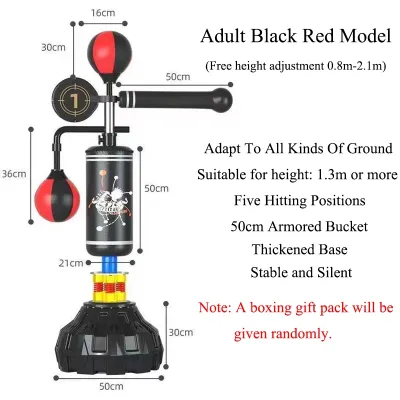
Prices are valid at publication and may change. Please refer to the product page for the latest price.
Understanding the Footprint and Clearance of a Boxing Spinning Bar
When planning your home boxing corner, it is easy to confuse the static footprint of the equipment with the dynamic clearance required during active training. The static footprint refers to the physical space the unit occupies when it is idle. For wall-mounted models, this footprint is minimal, often consisting of a small metal wall bracket. For freestanding models, the footprint is determined by the diameter of the base, which typically ranges from 50 to 70 centimeters.
However, the dynamic clearance zone is the actual space you need when the bar is spinning at high speeds and you are actively moving around it. To calculate your minimum safe clearance, use the following practical framework:
Total Clearance Radius = Bar Rotation Radius + Maximum Arm Reach + Footwork Buffer + Safety Margin
- Bar Rotation Radius: This is the length of the spinning arm itself, which typically ranges from 60 to 90 centimeters. Because the bar rotates 360 degrees, this length forms the inner core of your clearance circle.
- Maximum Arm Reach: To throw proper straight punches (like jabs and crosses) without smothering your shots, you must stand at a distance where your arm can fully extend. For most adults, this adds another 60 to 80 centimeters to the radius.
- Footwork Buffer: Boxing requires constant movement. You cannot stand static in front of a spinning bar; you must step backward, pivot, and slip laterally. A realistic footwork buffer requires at least 60 to 80 centimeters of clear space in all directions.
- Safety Margin: A buffer of 30 centimeters is highly recommended to ensure that if you lose your footing or slip a punch too aggressively, you will not strike a wall or a piece of furniture.
A complete 360-degree movement area is crucial. While some beginners attempt to place the unit in a corner to save space, limiting yourself to a 180-degree semi-circle severely restricts your defensive training. Without a full circle of movement, you cannot practice pivoting away from the bar’s rebound, which can lead to poor habits and a higher risk of getting hit by the bar.
Ceiling Height and Vertical Space Requirements
Vertical clearance is another critical dimension that home gym planners often overlook. Whether you are installing a ceiling-mounted unit or using a tall, adjustable freestanding model, you must ensure your ceiling height can accommodate both the equipment and your physical reach.

To determine the minimum ceiling height required for your setup, apply this vertical space formula:
Required Ceiling Height = User Height + Maximum Overhead Reach + Mounting Hardware Clearance + Safety Buffer
Most standard home spinning bars are designed to be highly adjustable, allowing you to position the rotating arm at eye or shoulder level. Before finalizing your purchase, check the specific product’s adjustable height range and verify its minimum and maximum extension limits. For optimal training, the bar should be easily adjustable to match your height as well as the heights of any other household members who plan to use it.
Structural safety is paramount when dealing with overhead installations. If you opt for a ceiling-mounted spinning bar, you must verify the load-bearing capacity of your ceiling joists before drilling. Standard drywall, plaster, or drop ceilings (which are common in modern apartments and offices) cannot support the dynamic, multi-directional forces generated during training. When you strike the bar, the impact forces are transferred directly to the mounting hardware. Over time, these dynamic loads can cause screws to loosen or pull out of weak materials, resulting in the equipment falling and causing severe injury. Always use a stud finder to locate solid timber joists. If your home features concrete ceilings, ensure you use high-quality expansion bolts designed for solid masonry. If you are uncertain about the structural integrity of your ceiling, stop and consult a qualified structural engineer or licensed contractor before proceeding.
Additionally, check your ceiling for potential hazards. In tropical climates like the Philippines, ceiling fans are a staple in almost every room to manage heat and humidity. You must ensure that the spinning bar’s rotation path is completely clear of ceiling fans, low-hanging light fixtures, exposed wooden beams, or utility pipes. A fast-moving metal or padded bar colliding with a spinning ceiling fan can cause catastrophic damage to both the fan and the training equipment, alongside significant physical risk to the user.
Floor Space and Base Dimensions for Freestanding Models
Freestanding boxing spinning bars are incredibly popular for home use because they do not require permanent mounting to walls or ceilings. However, their stability relies on a large, heavy base that must be filled with water or sand, which introduces unique spatial and structural considerations.
The physical diameter of a typical freestanding base ranges from 50 to 70 centimeters. While a wider, heavier base provides superior stability and prevents the unit from sliding or tipping over during intense workouts, it also consumes a significant amount of floor space. You must maintain a completely clear perimeter around this base. If your training area is too tight, your feet will constantly clip the edge of the base during footwork drills, which can cause tripped steps, stubbed toes, or rolled ankles.
Floor protection is another critical factor. A fully filled base can weigh anywhere from 60 to over 120 kilograms. The combination of this heavy static weight and the high-frequency vibrations generated by repeated punches can easily damage your home’s flooring. Ceramic tiles can crack or chip, especially if the subfloor is uneven, while hardwood and laminate surfaces can suffer deep scratches or warps from the friction of the plastic base shifting slightly during use.
To protect your floors, place a high-density rubber gym mat (at least 12mm to 15mm thick) underneath the base. This mat helps distribute the weight, absorb vibrations, and prevent the unit from sliding across the room. In the highly humid climate of the Philippines, moisture can easily become trapped underneath dense rubber mats laid on concrete or tiled floors. To prevent the growth of mold, mildew, and unpleasant odors, it is wise to periodically lift the mat, clean the floor underneath, and allow the area to dry completely.
Finally, consider the logistical challenge of moving a filled base. Once you fill the base with water or sand, moving it becomes an arduous task. Sand is heavier and provides better stability but is incredibly difficult to empty. Water is easier to fill and drain but can slosh around and potentially leak if the base is damaged. Because of this weight, you should always finalize the equipment’s placement and thoroughly test your physical clearance before filling the base.
Wall-Mounted and Foldable Options for Compact Rooms
If your home has limited floor space, a wall-mounted or foldable boxing spinning bar can be an excellent space-saving alternative. These models utilize heavy-duty wall brackets to suspend the spinning arm, leaving your floor completely clear.
Many modern wall-mounted units feature foldable arm mechanisms. When you are finished training, you can simply fold the rotating bar flat against the wall, reclaiming the room’s floor space for daily activities. This makes them highly suitable for multi-purpose spaces, such as home offices, bedrooms, or garage gyms.
However, wall-mounted options come with strict structural requirements:
- Solid Anchoring: Wall mounts must be secured directly into solid wood studs, solid concrete, or brick masonry.
- Hollow Wall Warning: Never install a wall mount on hollow drywall, plasterboard, or weak partition walls. The dynamic shear forces from punching will quickly tear the anchors out of the wall, causing severe structural damage and potential injury.
- Philippine Concrete Hollow Blocks (CHB): Many interior walls in Philippine homes are built using hollow concrete blocks. Standard plastic wall plugs are insufficient for these walls. You must use specialized heavy-duty sleeve anchors or chemical anchors to ensure the bracket remains securely fastened under dynamic loads.
When planning the space for a wall-mounted unit, you must calculate the swing radius when the bar is fully deployed. Ensure that when the bar is extended, you still have the necessary 2.0-meter to 2.4-meter clearance circle around your training position. Additionally, check that when the bar is folded flat, it does not protrude into high-traffic walkways or block the path of opening doors. Always follow the manufacturer’s installation manual strictly and use the provided heavy-duty mounting hardware. If you are unsure of your wall’s material or load capacity, consult a professional installer.
Common Space Planning Mistakes to Avoid
Avoiding common spatial mistakes during the planning phase will save you from frustration, equipment damage, and painful injuries.
- Mistake 1: Relying on Static Dimensions: The most common error is measuring only the physical length of the spinning bar and assuming that is all the space you need. Always remember to add your arm reach, footwork steps, and a safety buffer to the equation.
- Mistake 2: Placing the Bar Too Close to a Wall: If you stand too close to a wall while training, a missed punch or a fast rebound from the bar can force you to step back abruptly. If your space lacks a safety buffer, your elbows, knuckles, or shoulders can strike the wall, leading to painful joint hyperextensions or soft-tissue injuries.
- Mistake 3: Ignoring Door and Window Paths: Ensure your training zone does not overlap with the swing paths of doors or the opening space of windows. A family member unexpectedly opening a door while you are mid-combination can cause a serious accident.
- Mistake 4: Failing to Account for Tapered Bases: Some freestanding bases have a flared or tapered shape that is wider at the bottom than at the top. If you stand too close to the center pole to practice short-range hooks or uppercuts, you can easily stub your toes or trip over the flared edge. Keep your feet clear of the base's footprint.
Frequently Asked Questions (FAQ)
Can I use a boxing spinning bar in a room with a low ceiling?
Yes, but you must carefully cross-reference your room’s exact ceiling height with the manufacturer’s minimum height requirements before purchasing. If your overhead space is strictly limited, avoid ceiling-mounted options. Instead, look for compact freestanding models that feature a lower adjustable height range. Ensure that even at its lowest setting, the bar can still be positioned safely at your shoulder or eye level without the top of the center pole touching the ceiling.
How do I know if my wall or ceiling is strong enough for a mounted spinning bar?
The weight and impact limits of any wall or ceiling mount depend entirely on the specific building materials of your home and the mounting hardware used. To verify structural strength, start by using a stud finder to locate solid timber studs or joists. If your walls or ceilings are made of concrete, they are generally strong enough, provided you use the correct masonry expansion bolts. Never rely on visual guesses or tap on drywall to estimate strength. Because dynamic punching forces multiply the static weight of the equipment, you should strongly advise consulting a licensed contractor or structural engineer to verify the load-bearing capacity before drilling.
Community discussion
Share your experience or ask a question. Comments are reviewed before publication.