
Selecting the correct taekwondo mat thickness and density is a critical safety decision that directly impacts a practitioner’s joint health, balance, and fall protection. To balance shock absorption with joint stability, a high-density Ethylene-Vinyl Acetate (EVA) or Cross-linked Polyethylene (XPE) foam mat is required. For forms (poomsae) and light footwork, a thickness of 2.0 cm is ideal to provide a stable, non-slip surface that prevents ankle rolling during rapid pivots. For sparring and high-impact kicking, a thickness of 2.5 cm to 3.0 cm is necessary to absorb repetitive landing impact. For throwing, self-defense, and breakfall drills, a minimum thickness of 4.0 cm is mandatory to prevent severe impact injuries. Regardless of the thickness, the mat must feature a high density—typically measured by a Shore A hardness rating of 45 to 55—to ensure the foam does not compress completely to the hard subfloor under weight.
In tropical environments like the Philippines, high humidity and ambient heat accelerate sweat accumulation on training surfaces. This moisture significantly reduces traction, making the choice of mat density, slip-resistant surface textures, and proper moisture maintenance vital for preventing slips, hyperextensions, and joint injuries during explosive maneuvers.
Why Thickness and Density Matter for Martial Arts Safety
Every dynamic movement in taekwondo—from the explosive pivot of a roundhouse kick (dollyo chagi) to the high-altitude landing of a jumping back kick (twio dwit chagi)—generates immense kinetic force. When a practitioner lands, this force must be dissipated safely. A high-quality taekwondo mat acts as a deceleration medium, extending the time over which the body slows down to minimize the peak impact force transmitted to the bones, ankles, knees, and spine. However, achieving this protection requires a precise biomechanical balance between cushioning and structural stability.
Products mentioned in this guide
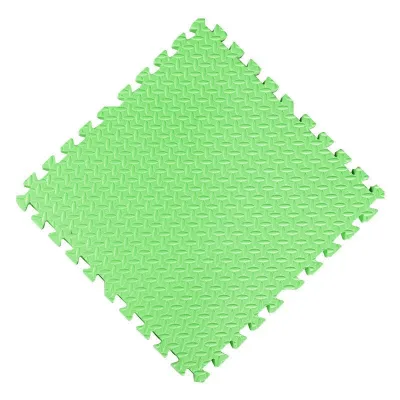
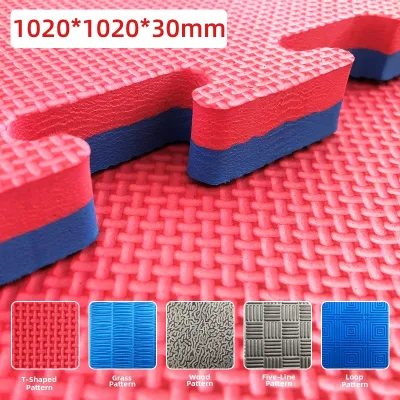
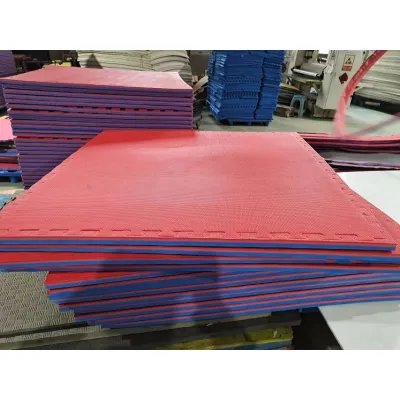
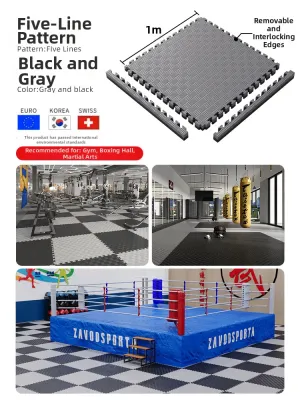
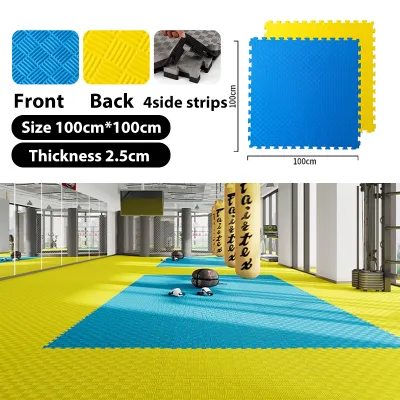
Prices are valid at publication and may change. Please refer to the product page for the latest price.
If a training mat is too thin or lacks sufficient density, the foam will fail to absorb the kinetic energy, leading to joint impact injuries. Over time, training on inadequate surfaces can cause chronic conditions such as shin splints, patellar tendonitis, and heel bruises. Conversely, if a mat is too thick or overly soft, the foot sinks too deeply into the material. This sinking traps the foot during rapid lateral movements or rotational pivots, placing extreme torsional stress on the anterior cruciate ligament (ACL) and medial collateral ligament (MCL), while increasing the risk of severe ankle sprains.
This physical limitation introduces the critical safety concept of “bottoming out.” Bottoming out occurs when a mat compresses entirely to the hard subfloor under the concentrated impact of a foot strike or a fall. When a mat bottoms out, its effective shock absorption drops to zero, and the practitioner experiences the full force of landing directly on concrete or hardwood. Thickness alone cannot prevent this hazard; a mat must possess adequate density to resist complete compression under the dynamic weight of an active adult.
Safety specifications must always be matched to the practitioner’s weight, age, and training style. Children and lighter athletes generate less kinetic energy and can train safely on slightly lower-density surfaces. In contrast, adult practitioners require significantly firmer, denser mats to achieve the same level of deceleration and support. Before purchasing, verify the manufacturer’s weight-capacity recommendations and density ratings to ensure they align with the physical profiles of the users.
Recommended Thickness Based on Training Intensity
Matching mat thickness to specific training activities is essential for mitigating injury risks. Different taekwondo disciplines place distinct physical demands on the feet and joints, requiring specialized surface profiles.

Poomsae (Forms) and Light Footwork
For poomsae and technical footwork drills, stability and precise ground feedback are the primary safety requirements. Practitioners must execute sharp pivots, deep stances (such as ap koobi), and single-leg balance postures with absolute control. A thinner mat profile of 2.0 cm is highly recommended for these activities. This thickness provides a firm, responsive base that allows the ball of the foot to maintain close contact with the solid subfloor, facilitating clean rotations without foot displacement.
Using thick, plush mats for technical forms training is highly discouraged. When a practitioner attempts a rapid 180-degree pivot on an overly soft surface, the foam compresses unevenly under the heel and forefoot. This instability compromises balance, forces the stabilizer muscles of the ankle and knee to overwork, and significantly increases the likelihood of joint strain or a fall.
Full-Contact Sparring and High-Impact Kicking
Full-contact sparring (kyorugi) and high-impact kicking drills involve continuous jumping, rapid footwork shifts, and heavy landing forces. To protect the knees, heels, and shins from repetitive impact stress, mats must have a medium thickness of 2.5 cm to 3.0 cm. This thickness provides the necessary depth to cushion the skeletal system during high-frequency plyometric movements while retaining enough structural integrity to support quick directional changes.
When selecting mats for sparring zones, check the manufacturer’s technical specifications for impact-absorption ratings. Look for dual-layer or multi-density constructions. These advanced mats feature a firmer, high-density base layer that prevents bottoming out, topped with a slightly resilient upper layer that cushions the bare feet from raw impact and reduces joint fatigue during long training sessions.
Falling, Throwing, and Self-Defense Drills
Self-defense drills (hosinsul) and breakfall practice (nakbup) involve throwing, sweeping, and high-impact body drops. For these high-risk activities, standard sparring mats are insufficient. A minimum thickness of 4.0 cm is mandatory to safely disperse the high kinetic energy of a falling human body and protect vulnerable areas such as the spine, head, shoulders, and hips.
Practicing throws on thick but low-density mats is a severe safety hazard. Low-density foam (often found in cheap, generic gym mats) lacks the compressive strength to slow a falling body down gradually. Under the concentrated impact of a shoulder or hip land, the foam collapses instantly, causing the practitioner to bottom out against the hard floor. For any training involving throws, verify that the mats are specifically rated for takedowns and possess high-density cores.
The Role of Mat Density in Preventing "Bottoming Out"
To understand how density protects martial artists, it is helpful to look at the physical mechanics of foam compression. Foam density refers to the mass of the material per unit volume, typically measured in kilograms per cubic meter (kg/m³). In a high-density mat, the microscopic air cells within the foam are tightly packed and highly resistant to deformation. When force is applied, these cells compress progressively, absorbing energy gradually rather than collapsing all at once.
If you place a 75 kg adult on a low-density 4.0 cm mat, their concentrated weight during a single-leg landing can easily compress the foam down to less than a centimeter. This offers a false sense of security; the mat looks thick, but under dynamic load, it behaves like a much thinner surface. A high-density 2.5 cm mat, however, will resist deep indentation, maintaining its structural thickness and keeping a protective barrier of air and polymer between the foot and the subfloor.
Evaluating density can be challenging because manufacturers do not always publish exact density metrics. When shopping, look for specific technical terms on product labels, such as “high-density EVA,” “compression-resistant closed-cell foam,” or “dual-density.” Another reliable specification to verify is the Shore A hardness rating, which measures the surface’s resistance to indentation. For taekwondo training, a Shore A hardness of 45 to 55 is the industry standard, offering the ideal balance of firm footing and impact absorption.
Dual-layer or multi-density mats represent the pinnacle of modern mat safety. By combining a softer, lower-density top layer (approximately 5 mm to 8 mm) with a highly rigid, high-density bottom layer, these mats provide a comfortable surface for bare skin and light foot strikes while ensuring that heavy impacts are stopped by the firm base before bottoming out occurs.
Surface Texture and Material Safety Considerations
Beyond thickness and density, the chemical composition and surface finish of a taekwondo mat play a critical role in preventing skin injuries, slips, and respiratory issues.
Common mat materials include Ethylene-Vinyl Acetate (EVA) foam, Cross-linked Polyethylene (XPE), and standard Polyethylene (PE). High-grade EVA is highly resilient, offers excellent memory retention (returning to its original shape quickly), and is highly durable. XPE is an premium alternative that features a completely closed-cell structure, making it exceptionally lightweight, highly resistant to moisture absorption, and structurally stable over years of heavy use. Cheap, low-quality foams can release volatile organic compounds (VOCs) and chemical odors. In poorly ventilated training spaces, which are common in tropical climates, this off-gassing can cause respiratory irritation. Always check for non-toxic, low-VOC, and phthalate-free certifications (such as CE or RoHS compliance) before installation.
The surface texture of the mat directly affects traction and skin safety. The two most common textures are the traditional tatami weave and the checkered or T-pattern finish:
- Tatami Weave: This texture features a traditional cross-hatch pattern that mimics woven straw. It provides exceptional barefoot grip, preventing slips during explosive, high-speed kicks. However, because the texture is relatively aggressive, it can cause severe friction burns ("mat burns") during ground work, self-defense drills, or breakfalls.
- T-Pattern or Checkered Finish: These textures feature raised, repeating geometric patterns that are slightly smoother than tatami. They offer excellent multi-directional traction for footwork while being significantly gentler on bare skin, reducing the risk of friction scrapes during falls.
In the humid climate of the Philippines, sweat does not evaporate quickly and can pool on non-porous foam surfaces, transforming the training area into a slipping hazard. Worn-out, smooth mats lose their micro-texture and become highly dangerous when wet. To mitigate this risk, ensure your mats feature a high-traction texture and check that the interlocking puzzle teeth or the mat’s rubberized under-surface provide secure floor adhesion. If mats slide or separate during a high-speed pivot, the gap can catch a toe, leading to severe joint dislocation or fractures.
Safety Inspections and When to Replace Your Mats
Even the highest-quality taekwondo mats degrade over time under the stress of daily training, heat, and humidity. To prevent injuries caused by worn-out equipment, establish a routine safety inspection protocol.
Perform a thorough visual and physical check of your mats at least once a month, looking for three primary warning signs:
- Seam Separation: Inspect the interlocking puzzle edges or vinyl seams. If the teeth are warped, chipped, or lifting, they create gaps and uneven edges. These uneven surfaces are severe trip hazards that can catch a sliding foot during sparring.
- Permanent Compression Indentations: Look for "dead spots" where the foam has collapsed permanently and no longer rebounds. These indentations are common in high-traffic areas, such as directly beneath heavy punching bags or in the center of the sparring ring. These spots have lost their shock-absorbing capacity and will cause bottoming out.
- Surface Tearing and Texture Wear: Examine the surface for deep gouges, tears, or areas where the non-slip texture has worn completely smooth. Tears can trap toes during footwork, while smooth patches create unpredictable slipping zones.
Establish strict stop-use conditions for your training area. If a mat fails to rebound instantly after being firmly pressed with the thumb, it must be retired. If practitioners begin experiencing unexplained joint aches in their shins, ankles, or knees after standard training sessions, it is a strong indicator that the foam has fatigued internally and is no longer absorbing shock. Finally, if the non-slip backing or interlocking system fails to keep the mats completely stationary during rapid pivots, suspend training immediately until the floor is secured.
To maximize the lifespan of your mats, implement safe cleaning protocols that do not degrade the foam’s molecular structure. Avoid harsh chemical solvents, highly concentrated chlorine bleach, or abrasive scrubbing tools, as these chemicals strip the non-slip textured coating and make EVA foam brittle. Instead, use a mild, pH-neutral soapy solution or specialized, non-corrosive martial arts mat disinfectants. After cleaning, ensure the mats are completely dry before stacking or locking them together. In tropical climates, trapping moisture between mats leads to rapid mold and mildew growth, which degrades the foam and poses significant health risks to practitioners.
Frequently Asked Questions (FAQ)
Can I use standard children's puzzle mats for adult taekwondo training?
No, standard children’s play mats are highly dangerous for adult taekwondo training. Children’s puzzle mats are typically very thin (often 1.0 cm or less) and are manufactured from low-density, highly compressible foam designed only to cushion light play. When an adult practitioner, who weighs significantly more, attempts to execute jumping kicks or rapid pivots on these mats, the foam will bottom out instantly. This lack of support transfers the full force of impact directly to the joints, leading to heel bruises, shin splints, and severe ankle or knee sprains. Children’s mats also lack the high-traction surface textures and structural interlocking strength required to stay secure under the shearing forces of martial arts footwork.
Do I need a subfloor or underlayment beneath my taekwondo mats?
Whether you need an underlayment depends entirely on the existing subfloor material and your training intensity. If you are installing your mats directly over a solid concrete floor—which is highly common in many residential garages and commercial spaces in the Philippines—adding a professional underlayment is highly recommended. Concrete has zero natural give, meaning any impact that penetrates the mat is transferred directly back into the body. A thin, high-density rubber roll underlayment or a specialized plywood spring subfloor can significantly enhance overall shock absorption and extend the life of your mats. However, you must avoid creating an overly soft, unstable surface. Never stack high-density mats on top of thick carpet padding or soft, low-density foam sheets, as this will cause the training surface to wobble, dramatically increasing the risk of ankle rolls and knee injuries.
Community discussion
Share your experience or ask a question. Comments are reviewed before publication.