
Quick Answer: Why Running Demands More Than a Walking Treadmill
Running on a treadmill is not just faster walking; it is biomechanically distinct. When you run, your body generates impact forces up to three times your body weight, compared to just 1.5 times when walking. This elevated force, combined with a longer stride and faster belt speeds, places immense mechanical strain on fitness equipment.
If you attempt to use a basic walking treadmill for running, you will likely encounter rapid equipment failure. The most common issues include motor burnout from sustained high speeds, belt slippage during foot strikes, and joint pain caused by inadequate deck cushioning. To find a reliable treadmill for running, you must look past basic maximum speed numbers and verify specific, continuous-duty mechanical specifications.
Motor Power: Why Continuous Horsepower Matters in a Treadmill for Running
The motor is the heart of any treadmill, and its capacity determines whether the machine can handle the continuous friction of a running stride. When shopping, the most crucial specification to verify is Continuous Horsepower (CHP). Many budget-friendly machines advertise peak horsepower, which only represents the motor’s maximum output for a brief moment, not what it can sustain safely over a 30-minute run.
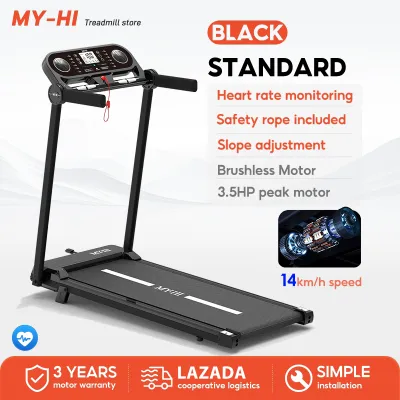
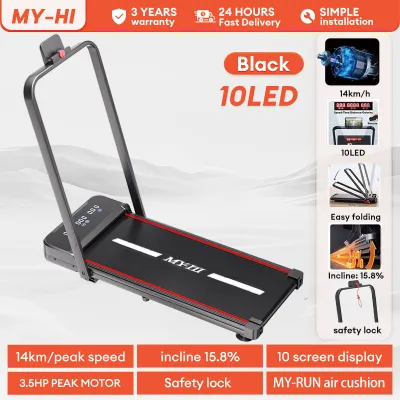
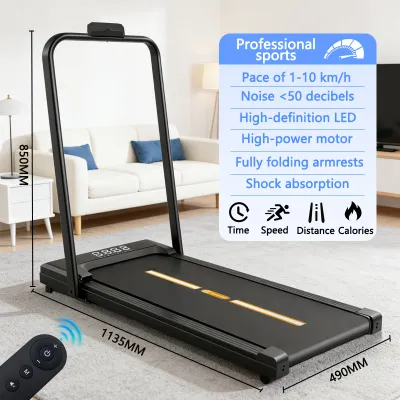
Products mentioned in this guide
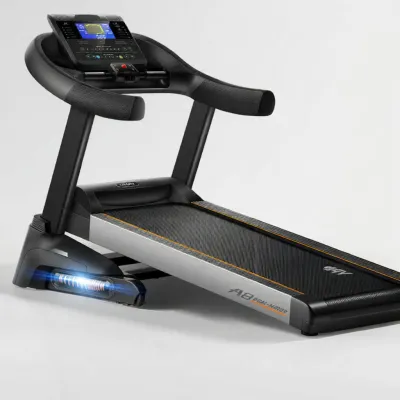
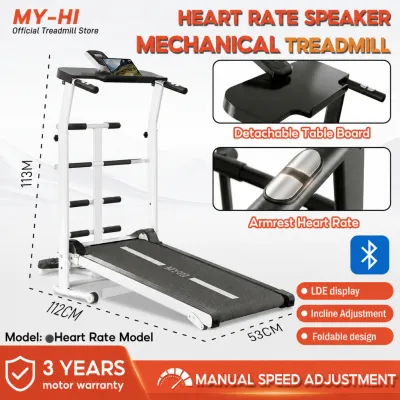
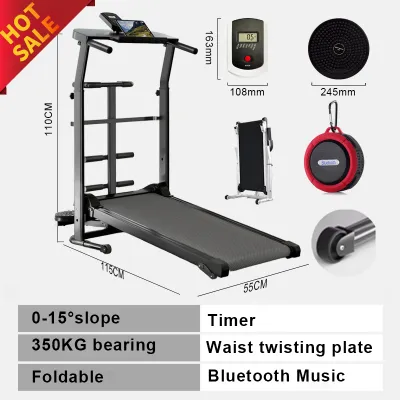
![[COD] Foldable Manual Home Treadmill with Adjustable Slope LED Display Anti-Slip Running Belt Free Twist Disc & Resistance Rope Space Saving Walking Machine for Home Fitness Exercise](https://img.lazcdn.com/g/p/1446617c7dcf63717d1a1640b68a647e.jpg_400x400q80.jpg_.webp)
Prices are valid at publication and may change. Please refer to the product page for the latest price.

For walking, a motor with 1.5 to 2.0 CHP is generally sufficient. However, running demands a minimum of 2.5 CHP for light jogging, and 3.0 CHP or higher if you plan to run regularly or at faster paces. If a runner weighs over 90 kilograms, they should look for at least 3.5 CHP to prevent the motor from straining under the increased drag of each foot strike.
In the warm and humid tropical climate of the Philippines, motor heat management is especially critical. High ambient humidity and temperature mean a treadmill motor will run hotter than it would in a climate-controlled environment. Look for motors equipped with internal cooling fans or larger casings that dissipate heat efficiently, and check the manufacturer’s warranty—a long-term motor warranty is a strong indicator of heavy-duty build quality.
Belt Dimensions and Speed: Accommodating Your Natural Stride
Your physical dimensions and running style dictate the size of the running surface you need. While a walker can comfortably use a belt that is 120 centimeters long and 40 centimeters wide, a runner requires significantly more space. As your pace increases, your stride naturally lengthens, and your lateral movement increases.
For a safe running experience, look for a belt that is at least 140 centimeters long—or 150 centimeters if you are taller than 180 centimeters. This extra length prevents you from accidentally stepping off the rear roller during a hard sprint. The belt width should be at least 50 centimeters to provide a comfortable margin of error when your stride sways slightly from side to side.
Maximum speed is another key factor. While walking pads often top out at 6 to 8 kilometers per hour (km/h), a dedicated running treadmill should reach at least 16 to 20 km/h. Even if you do not plan to run at top speed, having a higher maximum speed ensures the motor does not have to run at 100% capacity during your moderate runs, reducing wear and tear.
Additionally, examine the belt’s construction. Running belts should ideally be multi-ply (2-ply or 3-ply) to withstand high friction and prevent stretching. Thicker belts also run quieter and require less frequent lubrication, which is helpful in dusty or humid environments.
Cushioning Systems: Managing High-Impact Joint Stress
Every time your foot strikes a treadmill deck, a ground reaction force travels up your legs. Without proper shock absorption, this repetitive impact can lead to shin splints, knee strain, or joint fatigue. Running generates much higher impact forces than walking, making the deck’s cushioning system a primary safety feature.
Treadmills utilize several methods to absorb shock, most commonly elastomer rubber pucks located beneath the deck. Some models feature spring-based systems or multi-zone variable cushioning, which provides a softer landing zone at the front of the deck and a firmer push-off zone at the rear.
To verify cushioning quality, look for manufacturer specifications detailing shock absorption percentages or adjustable cushioning systems. If possible, test the deck in person: a good running deck should flex slightly under impact without feeling spongy or bouncy.
Keep in mind the trade-off between comfort and outdoor simulation. A highly cushioned deck is excellent for joint protection and recovery runs, but a firmer deck better simulates the feel of outdoor asphalt or concrete, which is beneficial if you are training for local road races.
Specs You Can Safely Compromise On to Save Money
If you are shopping on a budget in the Philippines, where high-end running treadmills can easily exceed ₱80,000, you can save money by skipping non-essential features. You do not need a premium machine to get a great workout if you focus purely on mechanical durability.
First, you can compromise on built-in high-definition touchscreens and smart consoles. These features add significant cost and often require ongoing subscription fees. A simple LCD console with a sturdy tablet holder allows you to use your own smartphone or tablet for entertainment or training apps at a fraction of the cost.
Second, extreme incline and decline ranges are rarely necessary for average runners. While a 10% to 12% maximum incline is standard and useful for hill intervals, machines offering 15% to 40% incline or steep declines carry a heavy price premium that most runners will rarely utilize.
Finally, do not pay extra for thousands of pre-programmed workouts. Most runners prefer to control their speed and incline manually or follow their own structured training programs, making complex built-in software libraries redundant.
Frequently Asked Questions (FAQ)
Can I safely run on a walking pad or under-desk treadmill?
No, running on a compact walking pad or under-desk treadmill is highly unsafe and will likely damage the machine. Walking pads are engineered with lightweight frames, lack safety handrails, and typically feature small motors under 1.5 CHP that overheat quickly under running loads. Furthermore, their short belts (often under 110 centimeters) do not accommodate a running stride, presenting a severe tripping hazard at high speeds. Reserve these compact devices strictly for walking paces under 6 km/h.
Does a heavier treadmill frame always mean it is better for running?
Generally, yes. A heavier frame—often constructed from welded steel rather than bolted aluminum—provides the structural stability needed to prevent shaking, wobbling, and squeaking when you run. However, a heavy frame is not a standalone guarantee of quality. It must be paired with an adequate motor (at least 2.5 to 3.0 CHP) and a sufficiently long belt; a heavy machine with an underpowered motor will still fail under the demands of regular running.

Community discussion
Share your experience or ask a question. Comments are reviewed before publication.