
Quick Answer: Which Cable Attachment to Buy First?
Selecting your first cable attachment gym accessory depends heavily on your primary training goals, joint mobility, and the exercises you perform most frequently. If you want a highly versatile tool that is gentle on your wrists and elbows, the Tricep Rope is generally the most practical starting point. It allows your hands to move independently, accommodating your natural joint path and reducing strain.
However, if your routine prioritizes heavy compound movements like lat pulldowns or straight-arm pulldowns, a Straight Bar offers the rigid stability needed to handle heavier loads. Meanwhile, the V-Bar serves as an excellent middle ground, providing a semi-pronated grip that reduces wrist strain during heavy triceps extensions and close-grip pulling exercises. Assessing your physical comfort, joint health, and workout style will point you toward the right initial investment.
Understanding the Contenders: Rope, Straight Bar, and V-Bar
To make an informed choice, you must understand how the physical design of each attachment alters your biomechanics and muscle recruitment.
Products mentioned in this guide
Prices are valid at publication and may change. Please refer to the product page for the latest price.

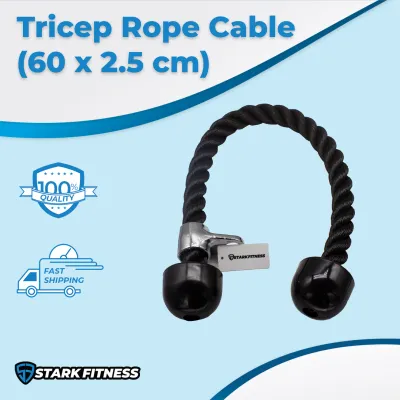
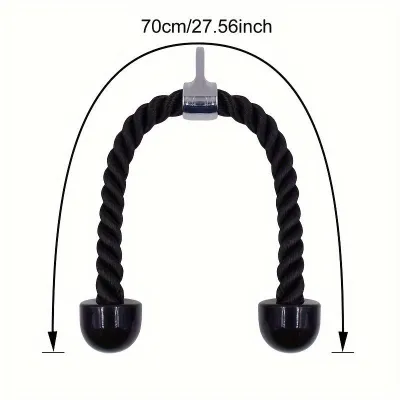
Tricep Rope The Tricep Rope is typically constructed from thick, heavy-duty braided nylon, capped with large rubber or plastic stoppers to prevent your hands from slipping. Because it is flexible rather than rigid, it does not lock your wrists into a single plane. This flexibility allows you to rotate your wrists naturally from a neutral grip to a pronated position at the bottom of a movement. The braided texture also provides a secure surface to hold, though it can feel abrasive on bare skin during heavy sets. It is highly favored for exercises like triceps pushdowns, face pulls, overhead cable extensions, and cable crunches.
Straight Bar The Straight Bar is a solid steel rod, often featuring textured knurling or a rubber coating for grip. It connects to the cable machine via a central revolving hanger, or swivel, which allows the bar to rotate smoothly as the cable angle changes. Because the bar is completely rigid, your hands remain in a fixed, fully pronated (overhand) or fully supinated (underhand) position throughout the entire lift. This design is highly efficient for transferring maximum force, making it the standard choice for heavy lat pulldowns, straight-arm pulldowns, and cable bicep curls.
V-Bar (Angled Bar) The V-Bar, sometimes referred to as an angled pushdown bar, features a rigid steel construction bent into an inverted ‘V’ shape. This design provides a semi-pronated grip, where your palms face slightly inward toward each other. This angled position strikes a balance between the complete freedom of the rope and the strict rigidity of the straight bar. It is primarily used for heavy triceps pushdowns and close-grip cable rows, offering a highly stable platform for pushing heavy weight without forcing the wrists into an awkward, flat angle.
Key Comparison Dimensions for Your Workouts
When deciding which attachment to buy first, evaluating how they perform across key training dimensions will help you maximize your gym budget.
Versatility and Exercise Variety The Tricep Rope is the clear leader when it comes to the sheer variety of exercises it can support. Because the two ends of the rope move independently, you can perform bilateral movements like face pulls, where you pull the rope toward your ears, or single-arm variations of pushdowns and curls. It is also excellent for core work like cable woodchoppers and lower-body movements like cable pull-throughs. A straight bar is highly effective but limited to linear, fixed-path movements. The V-Bar is even more specialized, focusing primarily on pushing movements and narrow-grip pulling variations. If you want to perform the widest range of exercises with a single purchase, the rope offers the most utility.
Range of Motion and Muscle Contraction A major advantage of the flexible rope is the extended range of motion it provides at the end of a repetition. During a triceps pushdown, a rigid straight bar or V-Bar will eventually hit your thighs or hips, stopping the movement. With a rope, you can pull the ends past your hips, allowing your triceps to reach a fully shortened position and achieve a deeper peak contraction. This extra range of motion is highly beneficial for muscle engagement, even if it requires you to use slightly less weight than you would on a rigid bar.
Grip Comfort and Joint Stress Joint comfort is a critical factor, especially during long-term training. Fixed straight bars force your wrists into a flat, rigid position. If you have limited mobility in your wrists or elbows, this can cause your elbows to flare outward, placing unwanted stress on the joints. In warm, humid tropical climates where sweat can make metal surfaces slippery, maintaining a tight grip on a straight bar can further strain your forearms. The V-Bar mitigates this by angling the hands, which aligns better with the natural anatomy of the forearm. The Tricep Rope offers the highest level of joint comfort, as your wrists can freely rotate to find the most pain-free path.
Load Capacity and Stability If your primary goal is to lift as heavy as possible, rigid metal attachments are superior to flexible ropes. The Straight Bar and V-Bar provide a solid, unyielding connection to the cable system. This stability means you do not have to expend energy stabilizing a wobbling attachment, allowing you to focus entirely on pushing or pulling maximum weight. Ropes, by contrast, require significant stabilizer muscle activation to keep the hands steady. At very heavy loads, the rope can twist or bend, which may limit the amount of weight you can safely manage.
Decision Framework: Which Attachment Fits Your Routine?
To finalize your choice, match these characteristics to your specific training style, physical needs, and budget. Whether you are budgeting around ₱500 for a basic rope or ₱1,500 for a heavy-duty steel bar, selecting the right tool ensures you get the most value out of your investment.
Choose the Tricep Rope if:
- You want to maximize the number of exercises you can perform with a single attachment.
- You prioritize joint longevity and want to avoid wrist or elbow discomfort.
- Your training focuses on high-repetition, controlled movements with a deep peak contraction.
- You want a lightweight, highly portable option to throw into your gym bag.
Choose the Straight Bar if:
- Your routine heavily features compound back movements like lat pulldowns and straight-arm pulldowns.
- You prefer lifting heavy loads and want absolute stability during your sets.
- You have excellent wrist and elbow mobility and do not experience joint discomfort during fixed-grip movements.
Choose the V-Bar if:
- You want to perform heavy triceps pushdowns but find that a straight bar hurts your wrists.
- You want a durable, rigid metal attachment that offers a more natural grip angle than a flat bar.
- Your training is focused primarily on arm development and close-grip pulling movements.
Verify First if:
- You have a history of wrist, elbow, or shoulder injuries. If so, consult a physical therapist or fitness professional to determine which grip angle is safest for your joints before purchasing any equipment.
What to Verify Before Buying a Cable Attachment
Before finalizing your purchase on any online marketplace, take a few minutes to verify the technical specifications of the attachment to ensure it is compatible with your setup and built to last.
Pin Size and Carabiner Compatibility Most home gym cable machines and commercial gym setups use standard carabiners to connect attachments. However, you should always measure the diameter of your machine’s connection pin and check the attachment’s eyelet hole size. Ensure the metal ring or eyelet on the attachment is large enough to accommodate your carabiner without binding or sticking.
Material and Build Quality Look for attachments made from high-quality materials. For metal bars, solid steel construction is highly recommended over hollow tubes, as it offers better durability and a more substantial feel. Check the quality of the welds around the connection eyelet. For ropes, ensure the braided nylon is thick and tightly woven, and that the end caps are securely fastened with heavy-duty bolts rather than cheap glue. In humid environments, powder-coated or polyurethane finishes can help prevent rust compared to cheap chrome plating.
Grip Texture and Knurling In warm, humid environments, sweaty hands can easily slip off smooth metal. If you are buying a straight bar or V-Bar, verify that it features deep, high-quality knurling or a textured rubber coating. This ensures you can maintain a secure grip during intense workouts without needing to constantly apply chalk.
Weight Capacity Limits Always check the manufacturer’s stated maximum weight capacity. While most solid steel attachments can handle far more weight than a standard cable stack provides, some budget-friendly or lightweight options may have lower limits. Verifying this specification prevents equipment failure and ensures your safety during heavy lifts.
Frequently Asked Questions (FAQ)
Can I use a straight bar for triceps pushdowns if I don't have a rope?
Yes, you can use a straight bar for triceps pushdowns. However, because the straight bar locks your wrists into a fixed, flat position, you must pay close attention to your form. If you experience wrist discomfort or notice your elbows flaring excessively outward, try widening your grip slightly or stepping back from the machine to alter the angle of pull. If joint pain persists, switching to an angled bar or a rope is highly recommended.
Do I need to buy a specific brand of cable attachment for my home gym?
No, you do not need to buy a specific brand. Most cable attachments are designed to be universal and will connect to any standard cable machine using a simple carabiner. Instead of focusing on brand names, prioritize verifying the attachment’s physical specifications, such as the eyelet size, material durability, and weight capacity, to ensure it matches your existing equipment.
Community discussion
Share your experience or ask a question. Comments are reviewed before publication.