
An upright twin fin is a specialized surfboard fin design characterized by a vertical template and minimal sweep. By reducing the backward curve—known as the rake—of the fin, this setup allows surfers to experience exceptional speed, a tight turning radius, and quick release off the top of the wave. If you want to transform a sluggish board into a highly responsive, fast-turning machine, understanding how these fins interact with the water is the first step.
Choosing the right fin setup is just as critical as selecting the board itself. For surfers navigating the diverse beach breaks and reef passes of the Philippines, matching your equipment to both your skill level and the daily wave conditions is essential for safety and performance. While high-performance fins can enhance your board’s capabilities, they cannot replace proper training, ocean reading skills, and sound wave-riding judgment.
Decoding the Design: What Makes a Twin Fin "Upright"?
To understand the performance of an upright twin fin, you must first look at its physical geometry. The defining characteristic of this design is its minimal sweep, or rake. Rake refers to how far the tip of the fin curves backward relative to its base. While traditional fins sweep back dramatically, an upright fin stands almost perpendicular to the bottom of the surfboard, presenting a highly vertical profile.
Products mentioned in this guide
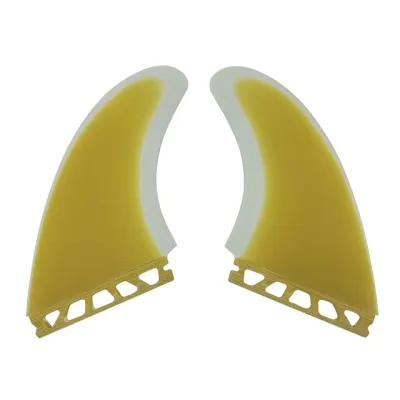

Prices are valid at publication and may change. Please refer to the product page for the latest price.
This vertical stance is supported by specific dimensional measurements. Upright twin fins typically feature a narrower base width compared to classic keel fins. This reduced base area minimizes drag as water flows around the fin. To compensate for the narrower base and ensure the board still has enough grip, upright templates are designed with greater depth, meaning they reach deeper into the water column to find clean, undisturbed water.
Another critical element is the foil, which is the aerodynamic cross-sectional shape of the fin. Upright twin fins commonly utilize a flat inside foil, which maximizes speed and provides direct, instantaneous feedback to the rider. Some modern variations incorporate a subtle curved or foiled inside face to smooth out water flow and prevent sudden cavitation during high-speed transitions.
These design choices set the upright template apart from other common configurations. Standard thruster side fins are designed to work in tandem with a center fin, meaning they have different cant angles and foils that do not perform well in a dual-fin setup. Meanwhile, heavily raked keel fins feature massive bases and low profiles, prioritizing down-the-line stability over the quick, vertical pivot that defines the upright design.
On-Water Performance: Speed, Pivot, and Wave Interaction
Translating these physical design traits onto the water reveals a highly dynamic riding experience. The combination of a vertical template and a dual-fin configuration fundamentally alters how water forces act on your surfboard, changing how the board accelerates, turns, and holds in the wave face.

Speed, Drive, and Release
Without a center fin dragging through the water, a twin fin setup inherently offers less resistance. The upright twin fin capitalizes on this by channeling water directly down the center of the board, resulting in rapid acceleration right from the take-off. This design excels at maintaining momentum through flat, slow sections of a wave where a standard thruster might bog down.
This lack of drag translates into a loose, “skatey” sensation underfoot. When you approach the lip of a wave, the vertical profile allows the tail of the board to release with minimal effort. This makes quick snaps, tail-slides, and progressive maneuvers highly accessible, as the fins do not fight against the release of the tail.
Pivot and Turning Radius
Because the fins stand straight up, they act as a direct pivot point. Instead of drawing out a long, sweeping arc, the board is capable of rotating sharply on a dime. This tight turning radius is incredibly useful when surfing in tight pockets or trying to fit multiple turns into a short wave section.
This sharp pivot contrasts sharply with the drawn-out, carving turns associated with heavily raked fins. While raked fins require you to lean heavily on your rail and commit to a long, continuous arc, upright twins allow for sudden, angular adjustments. You can change your line instantly, making them highly responsive to quick shifts in the wave’s shape.
Hold and Limitations in Critical Sections
While the looseness of an upright twin fin is highly enjoyable, it introduces distinct performance trade-offs in critical wave sections. Without a center fin to anchor the tail, and with minimal rake to hold the line, the board can easily slide out or drift when subjected to heavy lateral pressure on steep wave faces.
Managing this inherent looseness requires an intermediate-to-advanced skill level and precise rail control. If you push too hard on the tail in a steep, hollow pocket, you risk losing traction entirely. Surfers must learn to use their board’s rails, rather than relying solely on the fins, to maintain hold in high-consequence sections.
Where They Shine: Ideal Wave Conditions and Board Pairings
To maximize the strengths of an upright twin fin, you must pair it with the right wave conditions. These fins are highly effective in smaller, weaker, or mushy beach breaks—such as the gentle rollers of San Juan, La Union, or the softer peaks of Baler during the shoulder season—where generating speed is a constant struggle. They also perform exceptionally well on fast, crumbling reef peaks that require rapid, reactive turns to stay ahead of the breaking section.
Board compatibility is equally crucial to achieving a balanced ride. Upright twin fins are best suited for modern twin-fin shortboards, high-performance retro fish, mid-lengths, and hybrid shapes. Investing around ₱3,500 to ₱6,500 in a quality set of fiberglass or composite upright twin fins can completely revitalize these board types.
However, the board’s physical characteristics must complement the fins. A wider tail block, such as a swallow tail or a wide squash tail, provides the necessary surface area and leverage to engage the fins effectively. If the board’s tail is too narrow, the upright fins will feel overly sensitive and unstable, as there is not enough board width to support the lateral forces of your turns.
Upright vs. Keel Fins: Choosing the Right Twin Setup
Choosing between these two primary twin fin styles depends on your preferred surfing style and the design of your surfboard. While both setups offer the speed benefits of removing the center fin, they deliver vastly different sensations on the wave face.
Upright twins focus on pivot, quick release, and modern performance maneuvers, making them ideal for modern performance twins. Keel fins, with their wide bases and swept-back profiles, prioritize down-the-line speed, stability, and long, sweeping carves, making them the classic choice for traditional retro fish.
To help you decide which setup fits your surfing style, consider the following comparison framework:
- Pivot vs. Hold: Upright twins offer high pivot and moderate hold, allowing for sharp, angular turns. Keel fins offer low pivot and high hold, excelling at drawing long, stable lines.
- Drag: Upright twins feature a narrower base, resulting in very low drag. Keel fins have a much larger surface area, which creates more drag but provides excellent projection down the line.
- Ideal Board Type: Upright twins suit modern performance shortboards and hybrid twins. Keel fins are best paired with wide-tailed retro fish and traditional shapes.
- Turn Style: Upright twins favor quick, snappy turns off the top. Keel fins favor smooth, flowing, rail-to-rail carves.
Frequently Asked Questions (FAQ)
Can I put upright twin fins on a standard thruster shortboard?
To use upright twin fins, your board must have compatible fin boxes, such as a dedicated twin-fin setup or a five-box configuration. While you can physically install them in the side boxes of a five-box system, a standard narrow-tailed thruster shortboard is not designed for this. Without the wider tail and specific volume distribution of a dedicated twin-fin shape, the board may feel unstable, lose drive, and fail to perform as intended.
Do I need to add a trailer fin to my upright twin setup?
Adding a small trailer fin (often called a 2+1 setup) is an excellent way to increase hold, tracking, and stability, especially when the waves get steeper or more powerful. While this small center fin helps prevent the tail from sliding out, it does slightly reduce the raw speed and loose, pivotal feel of a pure twin setup. It serves as a valuable tuning option, allowing you to customize your board’s performance based on the daily surf conditions.
Community discussion
Share your experience or ask a question. Comments are reviewed before publication.