
Choosing the right fin setup can completely transform how a surfboard behaves on the water. Among the various configurations available to modern surfers, the upright twin fin has emerged as a highly popular choice for those looking to maximize speed and agility. An upright twin fin setup consists of two vertical fins placed near the board’s rails without a central trailer fin. This design dramatically reduces drag, allowing the board to glide effortlessly across flat sections while offering an incredibly sharp, pivot-focused turning radius.
Understanding how this specific geometry interacts with water flow is key to unlocking its potential. By eliminating the center fin, you remove the primary source of directional resistance, resulting in a loose, fast, and highly responsive ride. However, this freedom comes with distinct trade-offs in traction and stability that every surfer must consider before paddling out.
What Defines an Upright Twin Fin Setup?
To understand the performance of an upright twin fin, it helps to break down its physical geometry. The “twin” aspect refers to a two-fin configuration where each fin is positioned close to the outer rails of the surfboard. Unlike a traditional three-fin thruster setup, there is no center fin trailing behind. This open center channel allows water to pass under the board with minimal obstruction, significantly reducing drag and giving the board a highly free, skittery release when transitioning between turns.
Products mentioned in this guide
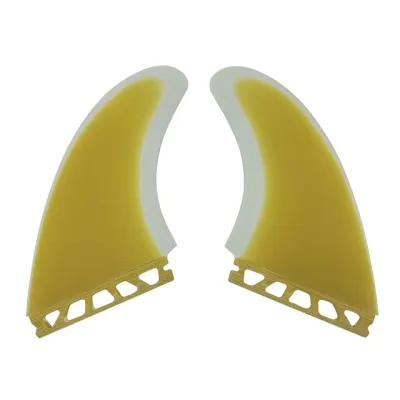

Prices are valid at publication and may change. Please refer to the product page for the latest price.
The “upright” designation describes the sweep, or rake, of the fin template. Rake refers to how far the tip of the fin curves backward relative to its base. A highly raked fin sweeps backward like a dolphin’s dorsal fin, whereas an upright fin stands almost vertically from the surfboard’s bottom contour. This minimal rake means the trailing edge of the fin is positioned closer to the physical base, concentrating the surface area directly beneath the surfer’s back foot.
When browsing fins at a local surf shop or online marketplace, you will typically encounter three primary geometric specifications on the product packaging: base length, depth, and rake angle. The base length is the horizontal measurement where the fin meets the board, which dictates forward drive. Depth measures how far the fin penetrates down into the water column, influencing overall grip. The rake angle determines the turning arc. In an upright twin, a short rake angle is paired with a relatively deep template to balance the lack of a center trailer.
How Upright Twin Fins Influence Surfboard Performance
The physical shape of an upright twin fin translates directly into how a surfboard feels underfoot. By altering how water flows along the bottom of the board, this setup changes your speed generation, turning mechanics, and overall control on the wave face.

Speed and Drive
Without a center fin acting as a rudder, water resistance under the tail of the board drops dramatically. This reduction in drag allows the surfboard to plane quickly, maintaining its momentum even through weak, mushy sections of a wave where a thruster might bog down. You will notice an immediate glide the moment you pop up.
Additionally, the vertical profile of an upright fin provides immediate, direct drive when pumping. When you compress and push against an upright fin, the energy transfer is instantaneous, propelling the board forward along the line. This contrasts sharply with highly raked fins, which require a longer, more drawn-out projection before delivering their acceleration.
Pivot and Turning Radius
The defining characteristic of the upright twin fin is its tight, snappy turning radius. Because the fins stand vertically, they act as a clean pivot point. When you initiate a turn, the board rotates sharply around the active fin, allowing you to change direction almost instantly in the pocket of the wave.
This vertical orientation makes the setup highly effective for quick, vertical snaps and tight pocket turns. However, the trade-off lies in the carving arc. While upright twins excel at sudden, angular direction changes, they do not hold long, sweeping rail-to-rail carves as securely as raked fins do. If you try to force a wide, high-speed carve on an upright setup, the tail may break free prematurely.
Wave-Catching and Hold
During the paddle-in phase, the lack of center-fin drag gives you a noticeable glide advantage, helping you match the speed of the wave earlier and catch weaker swells with less effort. This makes the setup highly efficient for maximizing your wave count on smaller days.
However, surfers must recognize the traction boundaries of this configuration. Because there is no center fin to anchor the tail, and because the upright template has less swept-back surface area to hold the line, the board can be prone to sliding out or drifting on steep, critical wave faces. If you do not weight your rails correctly or if you push too hard in a steep section, the tail can suddenly lose grip.
Matching the Setup to Wave Conditions and Skill Levels
The unique performance traits of upright twin fins make them highly suited for specific environments and experience levels. Knowing when and where to use this setup will prevent frustration and help you get the most out of your sessions.
In terms of wave conditions, upright twin fins perform exceptionally well in small, weak, or fast-breaking waves where generating speed and making quick adjustments are the main priorities. This makes them highly practical for the typical beach breaks and point breaks found across the Philippines. During the dry season, when swells tend to be smaller and softer, an upright twin can turn a mushy, frustrating day into an active, high-speed session. The setup allows you to pump through flat sections and snap quickly on close-out sections before the wave loses its power.
From a skill perspective, intermediate surfers will find the natural speed of this setup highly forgiving, as it helps maintain momentum without requiring perfect pumping technique. However, the reduced hold on steep faces demands precise rail control and careful weight distribution. Beginners may find the loose, skittery feel of a twin fin difficult to control, especially when trying to establish a stable bottom turn. Advanced surfers, on the other hand, can fully exploit the quick pivot to perform progressive maneuvers, sharp snaps, and aerial transitions.
When deciding on your equipment, use a simple framework. If your goal is to maximize flow, speed, and quick turns in soft, mushy, or average waves, the upright twin fin is an excellent choice. If you are preparing to surf heavy, powerful, or hollow barreling waves where maximum control and hold are non-negotiable, you should opt for a traditional thruster or quad setup instead.
Key Specs to Check Before Buying
Before purchasing a set of upright twin fins, it is essential to evaluate their specific measurements and construction to ensure they match your surfboard and riding style.
First, consider the relationship between base length and depth. A wider base length provides more forward drive and hold, helping you maintain speed when projecting down the line. Greater depth provides more vertical traction, keeping the tail anchored during turns. For an upright twin, finding a balanced base width is crucial; if the base is too narrow, the board can feel excessively slippery and difficult to control, even in small waves.
Next, examine the fin’s foil, which is the aerodynamic shape of its cross-section. Side fins typically feature either a flat foil or a curved, foiled inner edge. Flat foils, which are completely flat on the inside face, are the industry standard for twin setups because they offer a highly predictable, consistent release when turning. Foiled inner edges can generate extra lift and speed, but they can also make the board feel overly sensitive or twitchy if you are not accustomed to the sensation.
You should also look at the flex pattern and material construction. While premium materials like stiff carbon fiber or lightweight fiberglass honeycomb alter how the fin loads up and releases energy during a turn, the physical geometry of the template (upright versus raked) has a far more dominant impact on your board’s turning radius. If the template does not suit your style, expensive materials will not fix the ride. Do not overpay for high-end carbon layups if you are still experimenting with the basic shape.
Finally, always verify your surfboard’s fin box system before buying. Fins are designed to fit specific boxes, such as Futures or FCS II systems, and they are not cross-compatible without specialized adapters. Check your surfboard’s existing plugs to ensure a secure, flush fit.
Frequently Asked Questions (FAQ)
Can I use upright twin fins in big, powerful waves?
While you can ride them in larger surf, upright twin fins lack the central traction of a thruster, making them prone to sliding out on steep, high-speed drops. They are best suited for small-to-medium waves. If you plan to use them in powerful surf, ensure you have highly developed rail-control skills to manage the loose tail.
Do upright twin fins feel looser than a thruster setup?
Yes, twin fins generally feel much looser and faster because they lack the drag of a center fin. The upright template specifically enhances this loose feeling by allowing the board to pivot and snap quickly, whereas a thruster setup provides more tracking, hold, and a wider, more drawn-out turning arc.
Community discussion
Share your experience or ask a question. Comments are reviewed before publication.