
Aggressive baseliners constantly seek ways to maximize ball rotation, aiming to hit heavy, diving shots that push opponents deep behind the baseline. The Volkl Cyclone has established a notable reputation among polyester strings, primarily due to its distinct 10-point gear-shaped profile designed to bite into the tennis ball. However, achieving high spin levels is not solely a product of string design; it is a dynamic interaction between string gauge, tension, racket path, and individual swing speed. No single string can guarantee a massive increase in spin for every player, as stroke mechanics play a fundamental role in how the string bed behaves. Evaluating this string against other popular polyester options requires looking beyond marketing claims to analyze physical profiles, playability feedback, and practical decision frameworks. By understanding these variables, players can make an informed choice that aligns with their specific style of play and physical capabilities.
Understanding Spin Potential: Shape, Gauge, and Stiffness
To understand how tennis strings generate spin, players must look at the physical forces at play during the fraction of a second the ball is in contact with the racket. Spin is primarily influenced by two factors: the mechanical bite of the string on the ball’s felt, and the lateral movement and subsequent snapback of the main strings. Shaped strings, featuring geometric profiles such as gears, hexagons, or octagons, are engineered with pronounced edges. These edges physically grab the ball’s surface, increasing the coefficient of friction between the ball and the string bed. This mechanical grip allows players to brush up on the ball more effectively, translating upward racket acceleration into rotational energy.
The gauge, or thickness, of the string also plays a critical role in this equation. Thinner gauges generally offer a deeper pocketing effect and lower string-to-string friction, which can enhance the snapback effect. When a player strikes the ball, the main strings deflect sideways and then rapidly snap back into place, imparting additional spin. However, thinner strings are inherently less durable and can notch quickly under the stress of heavy topspin. Thicker gauges provide the structural integrity required by heavy hitters who would otherwise break strings frequently, though they may offer a slightly stiffer feel and reduced lateral movement.
Products mentioned in this guide
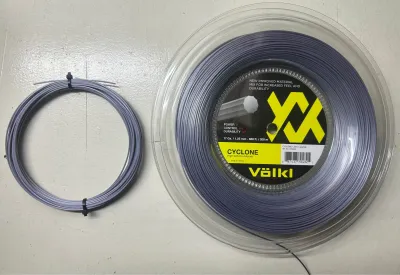
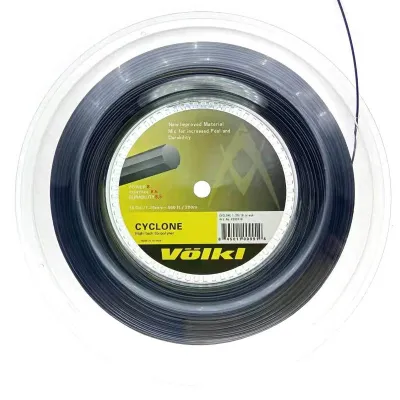
Prices are valid at publication and may change. Please refer to the product page for the latest price.
String stiffness is another vital variable that dictates playability and spin potential. Stiffer polyester strings require high racket head speed to deform upon impact. If a player cannot generate sufficient swing speed, a stiff string bed will feel like a board, reducing dwell time and limiting the player’s ability to control the ball’s trajectory. Conversely, a string with moderate stiffness can offer a more forgiving response, allowing the ball to sink into the string bed and giving the player more feedback to direct their shots.
Volkl Cyclone Profile: What to Expect on the Court
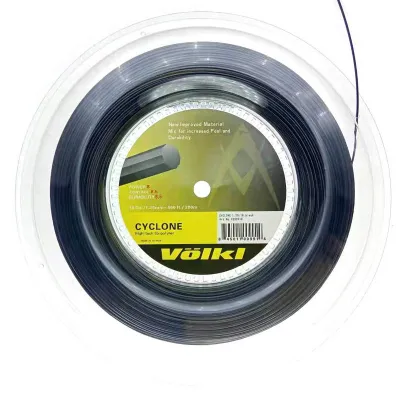
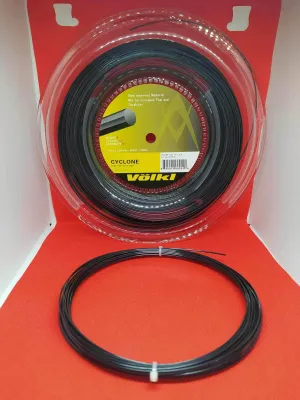
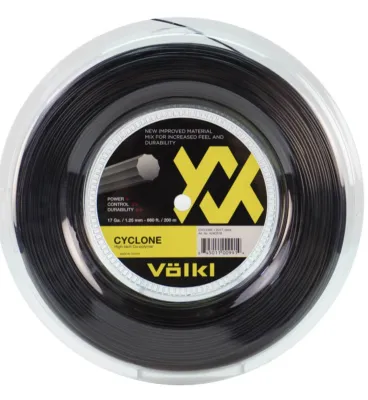
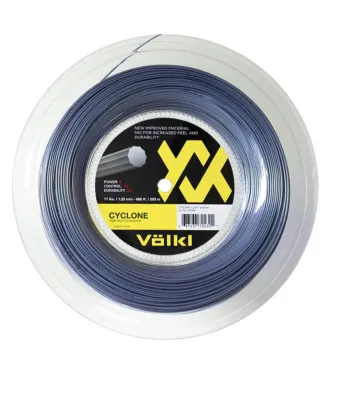
The defining characteristic of Volkl Cyclone is its 10-point gear shape, a design that features multiple sharp ridges running along the length of the string. This highly textured profile is engineered to maximize ball pocketing and surface friction, allowing players to feel the string bed grabbing the ball during aggressive upward swings. On the court, this translates to a highly predictable launch angle, giving players the confidence to swing at full speed without fear of the ball flying long. The directional control offered by this structured profile is particularly noticeable when hitting sharp angles or dipping passing shots.

In terms of playability, Volkl Cyclone is generally characterized as a control-oriented string with moderate power output. It does not provide significant free power, meaning the player must supply the energy and pace to drive the ball deep into the opponent’s court. The feel is relatively crisp and firm, offering direct feedback upon impact. This lack of elasticity is a deliberate design choice, ensuring that the string bed remains stable even during high-velocity rallies.
This profile is highly suited for players who possess fast, whippy swings and consistently strike the ball with an open racket face. Players who rely on a flatter hitting style may not fully utilize the gear-shaped design, as the benefits of the textured edges are most apparent when brushing up on the ball. Additionally, because the string requires active physical input to generate depth, it is best utilized by competitive players or advanced intermediates who have developed consistent stroke mechanics.
Comparing Cyclone to Other Popular Polyester Strings
When evaluating Volkl Cyclone against the broader market of polyester strings, it is helpful to categorize the alternatives into two distinct groups. The first group consists of other shaped or textured profiles, which compete directly with Cyclone’s mechanical bite. The second group comprises traditional round, smooth polyester strings, which rely on a completely different physical mechanism to generate spin and control.
Shaped vs. Shaped: Cyclone vs. Other Gear or Octagonal Poly
Comparing Volkl Cyclone to other shaped polyester strings reveals subtle differences in edge geometry and material composition. While Cyclone utilizes a 10-point gear design, other popular shaped strings on the market often feature four, five, six, or eight sides. The sharpness of these edges varies significantly; some strings have highly pronounced, knife-like ridges, while others feature more rounded geometric corners. A sharper edge generally provides a more immediate sensation of ball bite, but it can also lead to faster notching. Notching occurs when the main and cross strings wear grooves into each other, locking the string bed in place and reducing the snapback effect.
Tension maintenance is another critical point of comparison among shaped polyesters. Some co-polymer formulations are designed to hold their tension longer, preserving the string’s playability over several weeks. Other formulations may lose tension rapidly after the first few hours of play, resulting in a sudden increase in power and a loss of control. Players should check product specifications and labels to identify which shaped strings offer the specific gauge and tension stability that match their playing frequency.
Furthermore, the physical sensation of hitting with different shaped strings can range from extremely stiff and crisp to relatively soft and muted. A player looking for maximum feedback might prefer the sharp, rigid response of a gear-shaped string, while someone seeking a more comfortable response might opt for a hexagonal string made from a softer co-polymer blend.
Shaped vs. Round: Cyclone vs. Smooth Polyester
The choice between a shaped string like Volkl Cyclone and a traditional round polyester represents a fundamental decision in string bed setup. Round polyester strings lack the physical edges of shaped strings, meaning they offer less mechanical friction against the ball’s felt. Instead, round strings generate spin primarily through the snapback mechanism. Because the smooth surface of a round string minimizes string-to-string friction, the main strings can slide laterally upon impact and snap back with high efficiency. This snapback can produce a heavy, penetrating spin that behaves differently from the high-trajectory spin generated by shaped strings.
Round polyesters also tend to offer a more predictable and uniform launch angle across the entire string bed. Because there are no geometric edges to catch the ball at slightly different angles, players who hit with a mix of flat and spin shots often find round strings more versatile. Additionally, round strings generally experience less friction-induced wear at the intersections, which can prolong the useful life of the string bed before playability degrades.
Switching from a shaped string to a round string makes sense for players who find that shaped profiles cause their shots to launch too high or feel too erratic. Conversely, players who struggle to get enough grip on the ball with a round string, or those who play on high-bounce surfaces like clay and need a higher ball trajectory, may benefit from transitioning to a shaped profile like Cyclone.
Decision Framework: Which String Fits Your Aggressive Game?
To select the right string for your aggressive baseline game, consider the following conditional framework based on your physical needs, playing style, and performance priorities:
- Choose Volkl Cyclone if: You are an experienced player with fast, developed strokes who wants maximum control over the ball's trajectory. You prefer a crisp, firm feel that provides immediate feedback, and you rely on a highly vertical swing path to generate heavy topspin.
- Choose alternative shaped strings if: You want the mechanical bite of a textured profile but prefer a slightly softer feel, a different number of geometric edges, or a string that maintains its initial tension over a longer period.
- Choose round/smooth strings if: You prefer to generate spin through string snapback rather than surface friction, require a more consistent launch angle for a flatter hitting style, or want a string bed that is slightly more forgiving on off-center hits.
- Verify first if: You have a history of arm, elbow, or shoulder discomfort. Polyester strings are inherently stiff and transmit significant shock to the joints. Before committing to a full reel of any polyester string, consult a certified racket technician or professional stringer to discuss testing lower tensions, using a thinner gauge, or trying a hybrid setup. If you experience acute pain during play, stop immediately and seek advice from a medical professional.
Stringing Recommendations and Maintenance
Proper installation and maintenance are essential to preserve the playability of polyester strings and protect your physical health. As a general rule, polyester strings should be strung at a lower tension than nylon or multifilament strings—often 5% to 10% lower—to compensate for their inherent stiffness. Always consult your racket manufacturer’s guidelines and a professional stringer to determine a safe and effective tension range for your specific frame.
Unlike multifilament strings, which typically play well until they break, polyester strings “go dead” long before they snap. A dead polyester string has lost its elasticity and tension, resulting in a harsh feel, a loss of control, and a noticeably higher launch angle that causes balls to fly long. You can identify a dead string bed by looking for deep notches at the string intersections, checking if the mains no longer snap back into place, or noticing a sudden increase in arm fatigue.
In tropical climates like the Philippines, high heat and humidity can accelerate the degradation of polyester materials, both on the racket and in storage. It is advisable to store your rackets in thermally lined bags and check local pro shops or reputable online sports retailers for fresh stock. Avoid leaving your racket in hot environments, such as the trunk of a car, as extreme temperatures can rapidly ruin the tension and playability of your strings.
Frequently Asked Questions (FAQ)
Is Volkl Cyclone too stiff for players with tennis elbow?
All 100% polyester strings, including Volkl Cyclone, are inherently stiff and transmit more impact shock to the hand, wrist, and elbow than softer multifilament or natural gut strings. For players with a history of tennis elbow or joint discomfort, a full bed of stiff polyester is generally not recommended. If you wish to use Volkl Cyclone, you can mitigate the stiffness by selecting a thinner gauge, which offers more flex, or by lowering the tension significantly. However, if you experience persistent arm pain, you should stop using polyester strings entirely and consult a medical professional or a certified racket technician to find a safer alternative.
Should I use a hybrid setup with Volkl Cyclone?
Using Volkl Cyclone in a hybrid setup is an excellent way to balance the string’s spin potential with added comfort and power. A common configuration is to install Volkl Cyclone in the main strings to provide ball bite and control, while using a softer multifilament or synthetic gut in the cross strings to absorb shock and increase ball speed. While this setup can make the string bed much more forgiving on the arm, it does alter the overall playability. The softer cross strings will wear out faster due to the sharp edges of the Cyclone mains, which can lead to premature breakage. You should consult a professional stringer to test different hybrid combinations before purchasing bulk reels.
Community discussion
Share your experience or ask a question. Comments are reviewed before publication.