
Selecting the right dumbbell set for men is a critical decision when building a home gym. The ideal weight range is not a one-size-fits-all specification; it must align with your current fitness level, physiological capacity, and training goals. For beginners, a range of 2 kg to 10 kg per dumbbell provides the necessary lighter resistance to learn movement patterns safely. Intermediate lifters generally require a broader spectrum spanning 5 kg to 24 kg to accommodate progressive overload on both isolation and compound exercises. Advanced lifters often need heavy-duty sets reaching 40 kg or more to continue stimulating muscle growth. By calculating your personal weight floor and ceiling, you can make a smart, cost-effective investment that supports your fitness journey for years to come.
How to Assess Your Current Strength Baseline Safely
Establishing a realistic strength baseline is the foundation of any successful strength training program. Guessing your starting weight often leads to purchasing a dumbbell set for men that is too heavy, which increases joint strain, or buying a set that is too light, which fails to stimulate muscular adaptation. Before investing, you must conduct a practical, low-risk self-assessment using your own body weight and common household items to gauge your physical readiness.
To assess your upper body pressing strength, perform a standard bodyweight push-up test. Begin in a high plank position with your hands slightly wider than shoulder-width apart, your core braced, and your body forming a straight line. Lower your chest until it is a few centimeters off the floor, then press back up. If you can complete 15 to 20 continuous repetitions with strict form, you possess a solid baseline of relative upper body strength. If you struggle to complete 5 push-ups, your initial dumbbell pressing movements should utilize highly conservative weights, starting around 2 kg to 4 kg.
Products mentioned in this guide
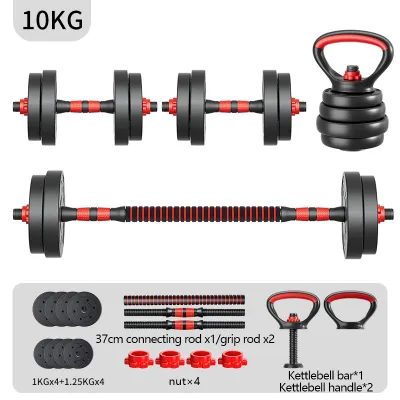
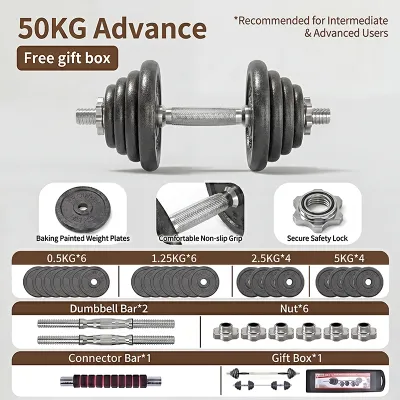
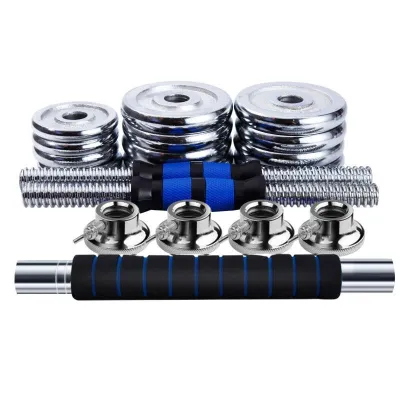
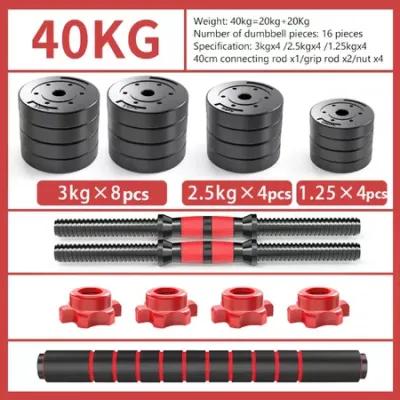
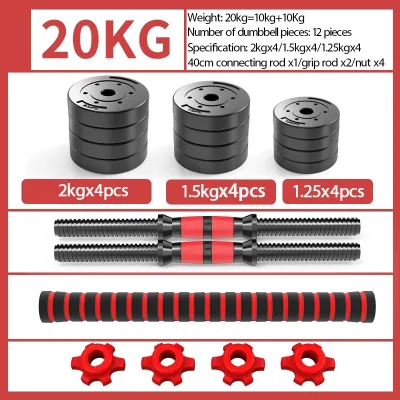
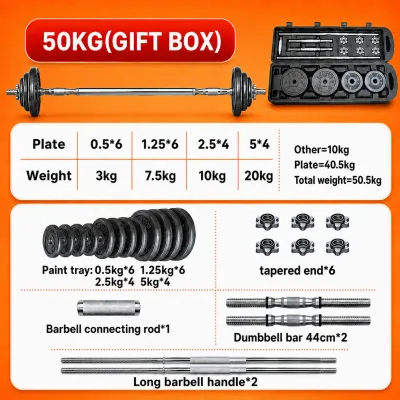
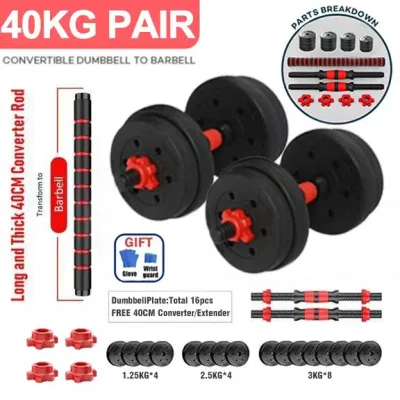
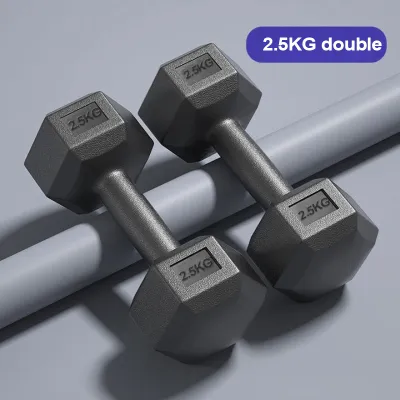
Prices are valid at publication and may change. Please refer to the product page for the latest price.
For lower body assessment, the bodyweight squat is an excellent indicator of foundational leg strength. Stand with your feet shoulder-width apart and lower your hips until your thighs are parallel to the ground, keeping your chest upright and your heels firmly planted. Perform 20 continuous repetitions at a controlled tempo. If you complete this test easily without your knees caving inward or your heels lifting, you are ready to introduce moderate dumbbell resistance for compound leg exercises. If you experience balance issues or joint discomfort, prioritize mastering bodyweight mechanics first.
To determine your starting point for smaller isolation movements like lateral shoulder raises, perform a simple test using a known light object. A standard 1.5-liter water bottle filled to the brim weighs approximately 1.5 kg. Hold the bottle and perform 10 slow, controlled lateral raises, lifting your arm out to the side until it is parallel with the floor. If you can complete all 10 reps with a slight burn in the shoulder muscle but absolutely no neck strain or momentum swinging, a 2 kg to 3 kg dumbbell is a safe starting floor weight for your isolation exercises.
Safety must remain your absolute priority during any physical assessment. Always perform a five-minute dynamic warm-up consisting of arm circles and bodyweight lunges to increase blood flow and lubricate your joints. If you feel any sharp joint pain, clicking, or sudden discomfort in your shoulders, elbows, or knees, stop the test immediately. Do not attempt to push through pain; physical testing is designed to identify your safe, pain-free functional limits.
How to Match Weight Ranges to Your Training Goals
Your training goals dictate the specific weight spectrum and repetition ranges you need, moving far beyond generic labels like “beginner” or “advanced.” To navigate this selection process, you must understand two primary training metrics: Repetition Maximum (RM) and Reps in Reserve (RIR). Your 1RM is the absolute maximum weight you can lift for a single repetition with perfect form. RIR measures how many additional repetitions you could have completed before reaching true muscular failure. For safe, productive home workouts, your training sets should generally target an intensity of 1 to 3 RIR, meaning you finish each set feeling as though you could have performed one to three more clean repetitions.

Training for Muscle Endurance
Muscular endurance training focuses on improving your muscles’ ability to exert force repeatedly over an extended period. This goal requires higher repetition ranges—typically 15 to 20 or more repetitions per set—using lighter loads that represent roughly 50% to 60% of your 1RM, paired with brief rest intervals of 30 to 60 seconds.
Because endurance training relies on high volume rather than heavy loads, you do not need a massive maximum weight ceiling in your dumbbell set. However, this training style benefits immensely from very small, precise weight increments. When working with lighter weights, a sudden 2 kg jump can represent a massive percentage increase that instantly disrupts your ability to hit high-repetition targets. Look for dumbbell sets that allow increments of 0.5 kg to 1 kg to facilitate smooth, gradual progression.
Training for Hypertrophy (Muscle Growth)
Hypertrophy training is designed specifically to maximize muscle size and definition. This objective is best achieved within a moderate repetition range of 6 to 12 reps per set, utilizing moderate to heavy loads representing 65% to 85% of your 1RM, with rest periods of 60 to 90 seconds between sets.
To trigger hypertrophy, you must train close to mechanical failure, ensuring the final reps of each set are highly challenging while maintaining strict form. This training goal requires a highly versatile, broad weight range in your dumbbell set. Your smaller muscle groups, such as the lateral deltoids and biceps, will require relatively light weights to avoid injury and momentum-assisted lifting. Conversely, your larger muscle groups, such as the pectorals, lats, and glutes, require significantly heavier loads to experience a growth stimulus. A complete dumbbell set for hypertrophy must bridge this gap seamlessly.
Training for Maximum Strength
Maximum strength training focuses on training your nervous system and muscle fibers to produce the absolute highest amount of force possible. This training style utilizes low repetition ranges of 1 to 5 reps per set, very heavy loads exceeding 85% of your 1RM, and long rest periods of 2 to 5 minutes to allow complete neurological recovery.
While dumbbells are highly effective for strength development, they present distinct safety limitations and grip constraints compared to barbells. Barbells allow you to distribute heavy loads across both hands along a stable, bilateral path. Dumbbells, however, require immense unilateral stabilization, meaning your smaller stabilizer muscles and grip strength often become the limiting factors before your prime movers reach failure. For home training, it is safer to set a realistic weight ceiling for your dumbbells rather than attempting absolute one-rep maximums. If your primary goal is maximum strength, ensure your dumbbell set features heavy options, but always prioritize safety over ego lifting.
How to Calculate the Ideal Weight Range for Your Dumbbell Set
To translate your baseline strength and training goals into a smart purchase, you must calculate three critical parameters: your weight floor, your weight ceiling, and your ideal weight increments.
Your weight floor is the absolute lightest setting in your dumbbell set. This weight is essential for warming up your joints, performing physical rehabilitation exercises, and executing small isolation movements like rear delt flyes or rotator cuff rotations. For most men starting their fitness journey, a floor weight of 2 kg to 4 kg is highly recommended. Even highly experienced lifters frequently utilize 5 kg dumbbells to perform lateral raises with perfect, momentum-free control. Investing in a set with a sufficiently low floor ensures you do not compromise your joint health on smaller exercises.
Your weight ceiling represents the heaviest weight in your set, which is reserved for large compound movements like goblet squats, dumbbell deadlifts, flat chest presses, and bent-over rows. To calculate your ideal ceiling, identify your current estimated capacity for a compound movement and add a 20% to 30% buffer to accommodate future strength gains. For example, if you can currently perform a dumbbell chest press with a pair of 15 kg dumbbells for 10 reps, your dumbbell set should feature a ceiling of at least 20 kg to 24 kg per dumbbell. This buffer ensures you do not quickly “outgrow” your equipment, forcing you to buy a new set within a few months.
The size of the weight increments—the steps between each weight level—is just as vital as the total range. Your upper body isolation movements require small, precise steps. A jump from 8 kg to 10 kg is a 25% increase in load, which can instantly break your form on an overhead shoulder press. For these movements, look for increments of 1 kg to 1.5 kg. In contrast, your lower body compound exercises can tolerate larger jumps of 2.5 kg to 5 kg because your glutes and hamstrings are much larger and adapt more rapidly to significant load increases.
Before making a purchase, carefully review the manufacturer’s technical specifications rather than relying on generic marketing terms like “heavy-duty” or “pro-grade.” Verify the exact weight of each individual plate or selector setting, the total weight of the set, and the precise increment steps. Ensure there are no massive gaps in the middle of the range that would make progressing from one weight to the next nearly impossible.
Fixed vs. Adjustable Dumbbells: Choosing the Right Setup
Once you have determined your ideal weight range, you must choose the physical format of your dumbbell set: fixed or adjustable. Fixed dumbbells are solid, single-weight pieces of equipment. They are incredibly durable, have no moving parts to break, and allow you to switch weights instantly during a workout. However, a complete set of fixed dumbbells spanning from 2 kg to 24 kg requires a massive amount of physical space and a dedicated storage rack, which can be impractical for most home environments. Adjustable dumbbells consolidate an entire rack of weights into a single pair using dial, pin, or spinlock systems, making them highly space-efficient and cost-effective for wide weight ranges.
In the humid, tropical climate of the Philippines, environmental factors play a major role in equipment longevity. High humidity levels and sweat can cause rapid rust development on exposed cast iron or low-grade steel components. When selecting a dumbbell set for men, prioritize models featuring rust-resistant coatings, such as high-quality powder coating, chrome plating, or durable neoprene encasement. If you choose rubber-coated or urethane-finished dumbbells, be aware that intense heat and humidity can cause cheap rubber to degrade, resulting in a sticky texture, an unpleasant chemical odor, or cracking. To prevent this, wipe your dumbbells dry with a clean cloth after every workout to remove corrosive sweat, and store them in a well-ventilated indoor space away from direct sunlight.
For adjustable models, safety depends heavily on the structural integrity of the adjusting mechanism. Before every single workout, perform a quick physical check of the locking system. If you use spinlock dumbbells, ensure the collars are threaded tightly against the plates to prevent shifting during movement. If you use dial-style or selector-pin adjustable dumbbells, verify that the locking mechanism clicks firmly and securely into place before lifting the dumbbell from its cradle. A loose plate slipping off a dumbbell during an overhead movement can cause serious personal injury or property damage.
When to Increase Weight and How to Maintain Your Equipment
To ensure consistent, long-term progress without injury, you must apply a structured progression framework and maintain your equipment diligently. A highly reliable method for managing weight increases is the double progression system. Under this framework, you establish a target repetition range, such as 8 to 12 repetitions. Start with a weight that allows you to perform 8 clean, controlled reps. Over your subsequent workouts, focus on increasing your repetitions with that exact weight while keeping your form flawless. Once you can successfully perform 12 perfect repetitions across all of your scheduled sets, only then should you increase the weight to the next increment. Upon increasing the weight, your repetitions will naturally fall back to the lower end of the range (e.g., 8 reps), allowing you to repeat the cycle safely.
Regular maintenance is crucial for keeping your dumbbell set safe and functional. Perform a weekly visual and physical inspection of your equipment. Look for loose collars, cracked plastic components on adjustable dials, stripped threads on spinlock bars, or worn-out grip textures. Wipe down metal handles with a light coat of silicone spray or 3-in-1 oil occasionally to prevent rust formation in humid conditions.
If you discover any structural compromises, cracked welds, loose internal parts, or failing locking mechanisms, stop using the dumbbells immediately. Do not attempt temporary DIY repairs with tape or glue on load-bearing fitness equipment. Consult the manufacturer’s warranty guidelines or contact a qualified professional to secure proper replacement parts or service.
Frequently Asked Questions (FAQ)
How do I know when it is time to increase my dumbbell weight?
You know it is time to increase your dumbbell weight when you can complete the upper limit of your target repetition range (such as 12 reps) with absolute control and perfect technique across all of your working sets for two consecutive training sessions. If you finish your final set feeling as though you easily have 3 or more Reps in Reserve (RIR), the current load is no longer providing sufficient mechanical tension to stimulate further muscular adaptation. When you transition to the next weight level, aim for a small increment—ideally no more than a 10% increase for upper body movements—to ensure your form does not break down.
Can I build muscle effectively using only light dumbbells?
Yes, you can build muscle effectively using lighter dumbbells, provided you perform your sets close to muscular failure (1 to 2 RIR). Scientific research demonstrates that muscle hypertrophy can be achieved across a wide spectrum of loads, as long as the relative intensity of the set is high. However, relying solely on light weights has practical drawbacks. To reach muscular failure with light dumbbells, you must perform extremely high repetition ranges, often between 25 and 35 reps per set. This approach significantly increases cardiovascular fatigue, extends the duration of your workouts, and requires immense mental stamina, making a progressive dumbbell set with heavier options a far more efficient choice for long-term muscle growth.
Community discussion
Share your experience or ask a question. Comments are reviewed before publication.