
Choosing your first pair of rolllr skate shoes is an exciting step toward mastering a fun, active, and rewarding outdoor activity. For beginners, the sheer variety of wheels, boots, and frames can feel overwhelming. To ensure your safety and build confidence quickly, your initial purchase must prioritize stability, ankle support, and predictable speed control over advanced maneuverability or high-speed performance.
When shopping for your first rolllr skate shoes, several non-negotiable features will help you stay upright and avoid early injuries:
- High Ankle Support: A stiff, tall cuff that wraps securely above your ankle bone to prevent painful rolls and strains.
- Softer Wheels (78A to 85A): Wheels with a lower durometer rating that grip the ground and absorb vibrations from rough asphalt or concrete.
- Reliable Braking Systems: A high-quality heel brake for inline skates or an adjustable rubber toe stop for quad skates.
- Secure Closure Mechanisms: A combination of traditional laces and heavy-duty buckles or power straps to lock your foot in place.
As a beginner, remember that your first pair is a learning tool. Its primary role is to help you develop balance, learn how to stop safely, and build the foundational muscle memory required for more advanced skating styles.
Products mentioned in this guide
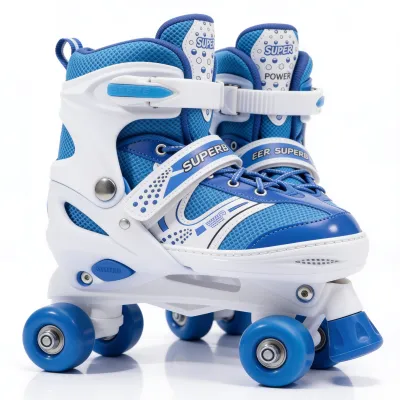
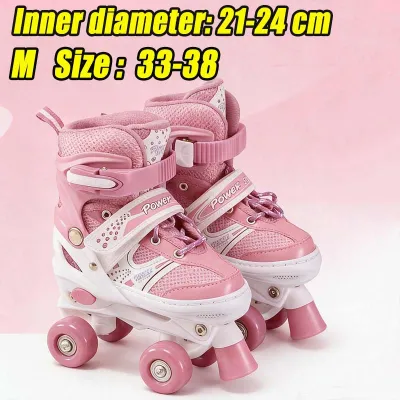
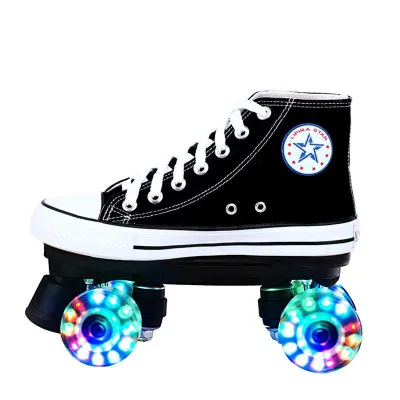
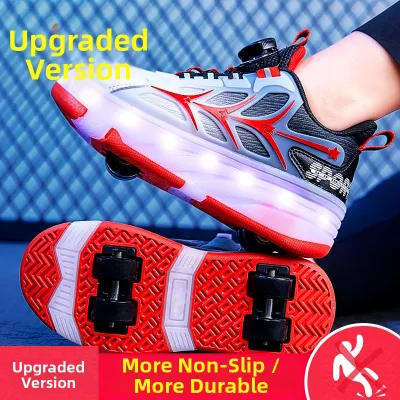
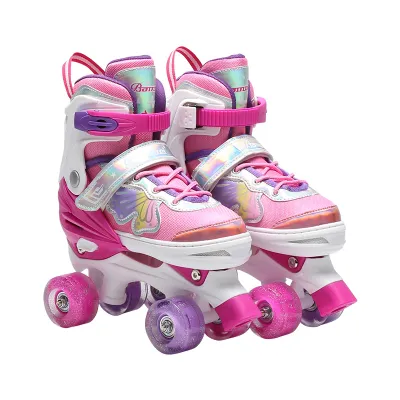
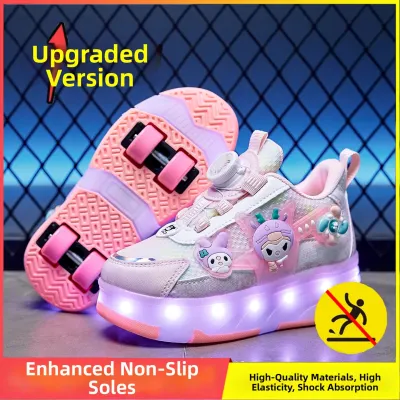
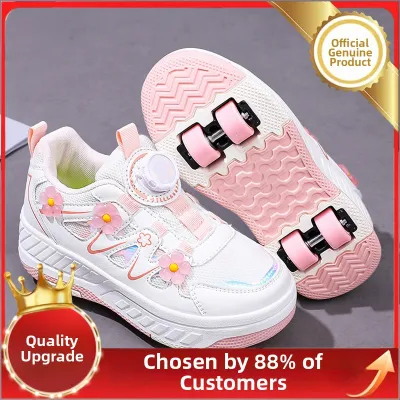
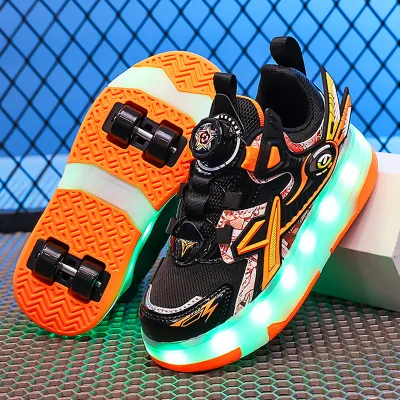
Prices are valid at publication and may change. Please refer to the product page for the latest price.
Quad Skates vs. Inline Skates: Choosing Your First Pair of Rolllr Skate Shoes
Before you can select specific features, you must decide between the two primary configurations of rolllr skate shoes: quad skates and inline skates. Each design interacts differently with your body’s natural balance and the surfaces you plan to skate on. Your choice should align with where you plan to practice, your current physical coordination, and your long-term fitness or recreational goals.
Quad Skates (Double Row)
Traditional quad skates feature four wheels arranged in a two-by-two grid, mimicking the stable base of a miniature car. This wider wheelbase provides excellent lateral stability, which makes standing completely still and finding your initial balance significantly easier for absolute beginners.
These skates are highly suited for indoor roller rinks, smooth concrete outdoor courts, and recreational activities like dance skating or jam skating. The double-row wheel configuration allows for responsive side-to-side weight transfers, which are essential for rhythmic movements.
However, quad skates present a unique learning curve when it comes to stopping and turning. Because the wheelbase is short from front to back, beginners must be careful not to lean too far forward or backward, which can cause the skates to slip out. Turning also requires a distinct shifting of body weight rather than the simple banking motion used on inline skates.
Inline Skates (Single Row)
Inline skates, often referred to as rollerblades, feature three to four wheels aligned in a single straight line. This design creates a much longer wheelbase from front to back, providing superior forward and backward stability compared to quad skates.
This long, narrow profile makes inline skates exceptionally good at handling outdoor terrains. They roll over pavement cracks, small pebbles, and textured asphalt with ease, making them the preferred choice for fitness skating, commuting, and navigating outdoor parks or trails.
The trade-off is that inline skates require stronger ankle muscles to keep the feet from pronating (rolling inward) or supinating (rolling outward). Beginners must choose a highly supportive, stiff-boot inline skate to compensate for this initial lack of muscle strength. Once the basics of balance are mastered, inline skates allow for higher speeds and a more natural gliding motion that closely mimics ice skating.
Adjustable vs. Fixed-Size Skates
When browsing the market, you will encounter both adjustable-size skates and fixed-size skates. Adjustable skates allow the user to expand or contract the boot across three to four shoe sizes, typically by pressing a button and sliding the toe box forward.
For children and teenagers whose feet are still growing rapidly, adjustable skates are an incredibly cost-effective option. They prevent parents from having to purchase a new pair of skates every few months, ensuring the child can continue practicing without interruption.
However, adjustable skates do come with notable limitations. The mechanisms required to make the boot adjustable add extra weight to the skate, which can tire out a beginner’s legs more quickly. Additionally, the interior liner of an adjustable skate must stretch or overlap, which can sometimes create minor pressure points or a less precise fit compared to a dedicated, fixed-size boot.
Adult beginners and skaters whose feet have stopped growing should always opt for fixed-size skates. Fixed-size boots offer superior heel lock, better power transfer, and a more uniform fit. You should plan to upgrade from an adjustable model to a fixed-size pair as soon as foot growth stabilizes or when you begin practicing intermediate skills that require precise edge control and subtle foot movements.
5 Key Features to Check for Safety and Comfort
Once you have decided on the style of skate, you must evaluate the specific physical components of the models you are considering. High-quality construction in these five key areas directly impacts how safe you will feel on the pavement and how quickly you will progress.

Boot Support and Material
The boot is the foundation of your skate, and its primary job is to protect your ankles from twisting under your body weight. Beginners should understand the difference between hard-shell boots and soft boots. Hard-shell boots feature a rigid plastic outer skeleton with a removable padded liner inside. They offer maximum ankle support, high impact protection, and excellent durability, though they are heavier and require a brief break-in period. Soft boots are constructed from fabric and mesh, making them lighter, more breathable, and comfortable right out of the box, but they require a very stiff internal or external cuff to keep a beginner’s ankle stable.
For any beginner, a high cuff that extends well above the ankle bone is an absolute necessity. When evaluating specific brands, such as Rolllr or other entry-level options, you must physically check the stiffness of the ankle cuff. Press inward on the sides of the cuff with your hands; it should resist collapsing. Additionally, ensure the closure system—which should feature a combination of traditional laces, a mid-foot power strap, and a top locking buckle—holds your heel firmly down into the pocket of the skate without allowing it to slip upward.
Wheel Hardness (Durometer) and Size
Roller skate wheels are rated for hardness using the durometer scale, which is indicated by a number followed by the letter “A”. Lower numbers represent softer wheels, while higher numbers indicate harder wheels. For beginners, wheel hardness dictates how much grip you have on the ground and how much vibration is transmitted to your feet.
If you plan to skate outdoors on typical Philippine roads, public parks, or barangay basketball courts, look for softer wheels rated between 78A and 85A. These wheels act like shock absorbers, gripping rough asphalt and rolling smoothly over small debris instead of bouncing or sliding out from under you. Harder wheels (86A to 101A) are designed for indoor rinks or skateparks and will slide too easily on dusty outdoor surfaces, increasing your risk of falling.
Wheel size, measured in millimeters (mm), also plays a critical role in your stability. For beginner inline skates, look for smaller wheels ranging from 70mm to 76mm. Smaller wheels keep your feet closer to the ground, lowering your center of gravity and making it much easier to maintain your balance. Avoid larger wheels (80mm and above) or three-wheel “triskate” setups initially, as these are designed for high speeds and require advanced balance to control safely.
Bearings and Frame Material
Inside every wheel are two bearings that allow it to spin. Bearings are often rated using the ABEC scale (1, 3, 5, 7, or 9), which measures manufacturing precision. While it might seem logical to buy the highest rating possible, beginners should actually look for standard ratings like ABEC 5 or ABEC 7. These ratings provide a smooth, reliable roll without spinning so freely that the skates roll away from under you at the slightest tilt.
The frame is the chassis that holds the wheels to the boot, and it must withstand significant forces. Frames are typically made of plastic (nylon/composite) or aluminum. Plastic frames are lightweight and inexpensive, but they can flex under heavier body weights or during hard pushes, which reduces your control and wastes your energy.
For adult beginners, an aluminum or high-grade reinforced composite frame is highly recommended. Aluminum frames are stiff, highly durable, and provide excellent power transfer from your legs to the wheels. This stiffness ensures that when you steer or push, the skate responds instantly and predictably, which is crucial for building confidence.
Braking Systems
A reliable braking system is your most important safety tool when learning to skate. You must never purchase a pair of skates that lacks a functional brake, and you should practice stopping before attempting to skate at higher speeds.
For inline skates, ensure the pair comes equipped with a standard heel brake, typically mounted on the right skate (though usually reversible to the left). Before buying, verify that the brake pad is made of a durable, high-grip rubber compound rather than cheap, slick plastic. The brake assembly should be securely bolted to the frame, and the manufacturer should offer easily purchasable replacement brake pads, as these will wear down with regular use.
For quad skates, look for an adjustable toe stop located at the front of the boot. Many budget quad skates come with hard, non-adjustable plastic toe stops that slide dangerously on smooth concrete. Instead, prioritize skates with adjustable, rubberized toe stops that allow you to fine-tune the distance between the stopper and the ground, providing reliable traction when you need to stop or push off.
Sizing, Fit, and Trying On Your Skates
Finding the correct fit is the single most important factor in preventing painful blisters, avoiding foot cramps, and maintaining precise edge control. Many beginners make the mistake of buying roller skates in their standard street shoe size, only to find the skates are either too loose or painfully tight.
Roller skate sizing is rarely identical to everyday shoe sizing, and variations exist between different brands. To get an accurate fit, you must measure your feet in centimeters or inches. Place your heel against a wall, mark the longest point of your toes on a piece of paper, and compare this measurement directly to the manufacturer’s specific size chart.
When trying on your skates, perform the “heel lock” test to ensure proper fit. Lace and buckle the skates completely, stand up, and bend your knees deeply into a skating stance. Your heel should remain locked firmly in the back pocket of the boot; if your heel lifts up more than a few millimeters, the skates are too large, which will cause blisters and reduce your ability to steer.
Pay close attention to your toe position. When standing completely straight, your toes should lightly brush the front of the inner liner. However, when you bend your knees into a proper skating stance, your toes should pull back slightly, leaving just enough wiggle room to prevent numbness.
Always try on new skates wearing the exact type of socks you plan to use while skating. In the warm, humid climate of the Philippines, heavy cotton socks will trap sweat and cause friction. Instead, invest in thick, moisture-wicking synthetic or merino wool athletic socks. Whether you are purchasing your skates from a local sports shop in Manila or Cebu, or ordering from an online marketplace, ensure the retailer has a reliable, hassle-free return and exchange policy so you do not get stuck with an ill-fitting pair.
Essential Safety Gear for First-Time Skaters
No matter how high-quality your rolllr skate shoes are, equipment cannot replace proper training, balance, and physical judgment. Roller skating is a high-risk sport that involves a steep learning curve, and falls are an inevitable part of the process. Before you take your first roll on the pavement, you must equip yourself with a complete set of certified safety gear.
Your safety gear setup must include the following non-negotiable items:
- Certified Helmet: Choose a helmet that meets recognized safety standards (such as CPSC or EN1078). Unlike standard bicycle helmets, a skating helmet should sit low on the brow and extend down to cover the back of your head, protecting you from backward falls.
- Wrist Guards: This is the most critical piece of protective gear for beginners. When falling, the human instinct is to reach out with open hands. Wrist guards feature rigid plastic splints on the palm and back of the hand to absorb impact and prevent hyperextension or fractures.
- Knee and Elbow Pads: Look for pads with thick, hard plastic caps and heavy-duty foam backing. The strapping system should hold the pads firmly in place without slipping down during a slide, while still allowing comfortable blood flow and joint movement.
Treat your protective gear as a mandatory, non-negotiable investment rather than an optional accessory. Wearing proper safety gear reduces the fear of falling, which in turn allows you to relax your muscles, maintain a better posture, and learn the sport much more quickly and safely.
Frequently Asked Questions (FAQ)
Can I use regular sneakers instead of specialized roller skate shoes?
No, you should never attempt to use regular sneakers attached to makeshift frames or sliding devices. Standard sneakers lack the rigid ankle support, specialized sole stiffness, and secure mounting points required to control wheels safely. Attempting to skate without a structured, integrated boot poses a severe injury risk, as your ankles can easily collapse under your body weight.
How often should a beginner replace their roller skate wheels?
Beginners generally do not need to replace their wheels frequently, as they are not performing high-impact tricks or skating at extreme speeds. However, you should regularly rotate your wheels—swapping the inner and outer positions—to ensure they wear down evenly. Replace your wheels when you notice flat spots, severe one-sided sloping (coning), or chunks of urethane missing from the wheel surface.
Is it better to buy roller skate shoes online or in a physical store?
For your very first pair, visiting a physical sports store is highly recommended. This allows you to physically test the ankle stiffness, perform the heel lock test, and ensure you get the correct size. If you choose to buy online due to better pricing or wider selection, make sure you measure your feet precisely in centimeters and buy from a retailer with a clear, flexible return policy.
Community discussion
Share your experience or ask a question. Comments are reviewed before publication.