
Choosing the right Arnis uniform set (traditionally referred to as the dobok or simply the Arnis uniform) requires balancing comfort, durability, and freedom of movement. Unlike empty-hand martial arts, Arnis involves constant weapon manipulation, rapid footwork, and high-intensity physical contact, often in warm, humid environments. A proper uniform must not only respect the traditions of the art but also withstand the unique physical demands of stick and blade training. To make an informed purchase, you must evaluate several critical factors: the climate of your training space, the weave and composition of the fabric, the specific cut of the garments, the quality of the construction, and the regulatory requirements of your school or association.
Assess Your Training Environment and Intensity
In the Philippines, martial arts training environments vary widely, and this variation should directly dictate your choice of uniform. Many traditional Arnis clubs, or haligi, practice in outdoor spaces, public parks, or open-air barangay covered courts. In these settings, you will face high ambient temperatures and intense tropical humidity, which accelerate sweating and physical fatigue. Conversely, some modern gyms and school-based clubs train in indoor, air-conditioned facilities. If you primarily train in non-air-conditioned or outdoor spaces, your priority must be maximum heat dissipation and moisture-wicking capabilities.
Beyond the physical venue, the intensity of your training sessions plays a massive role in selecting the right gear. Light drilling, which focuses on slow-tempo forms (anyo) and basic coordination exercises, places relatively low physical stress on the fabric. However, if your curriculum includes high-intensity sparring (laban) or tactical self-defense drills, your uniform will undergo significant strain. During full-contact sparring, you will wear heavy protective gear—including padded vests, arm guards, and headgear—directly over your uniform. This setup traps heat and subjects the fabric to intense friction. Understanding where and how hard you will train is the essential first step before looking at specific product features.
Products mentioned in this guide
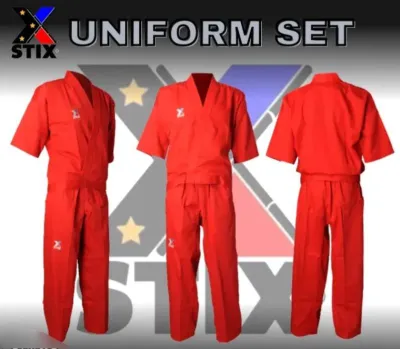
Prices are valid at publication and may change. Please refer to the product page for the latest price.
Select Breathable Fabrics for Tropical Climates
The fabric of your Arnis uniform set is your primary defense against heat exhaustion and premature wear. Traditional martial arts uniforms are often made of 100% cotton, poly-cotton blends, or specialized ripstop fabrics, each offering distinct advantages and drawbacks under tropical conditions.

- Cotton: While 100% cotton is highly breathable and soft against the skin, it is highly absorbent. In a humid climate, a cotton uniform quickly becomes saturated with sweat, making it heavy, clingy, and slow to dry. This added weight can drag down your speed and cause chafing during long training sessions.
- Poly-Cotton Blends: A blend of polyester and cotton (typically a 65/35 or 60/40 ratio) is often the most practical choice for FMA (Filipino Martial Arts) practitioners. Polyester adds lightweight durability, wrinkle resistance, and moisture-wicking properties, while the cotton content retains softness and breathability. Poly-cotton uniforms dry rapidly, maintain their shape after multiple washes, and do not trap sweat as easily as pure cotton.
- Ripstop Fabric: Originally developed for military use, ripstop is woven with a reinforcing technique that makes it highly resistant to tearing and ripping. It features a distinct crosshatch pattern of thicker threads. Ripstop uniforms are exceptionally lightweight yet highly durable, making them ideal for high-intensity training where friction from weapons and protective gear is constant.
Avoid heavy canvas fabrics (such as 12 oz or 14 oz cotton used in Judo or Brazilian Jiu-Jitsu), as they are far too insulating for the Philippine climate and will severely restrict your ability to cool down. When shopping, always check the manufacturer’s fabric composition label rather than relying on generic product descriptions like “lightweight” or “durable.”
Evaluate the Cut for Stick and Blade Mobility
The physical movements in Arnis are highly distinct from those in kicking or grappling arts. FMA relies heavily on continuous, fluid weapon patterns, including overhead strikes (lobtik), snapping strikes (witik), thrusts, and blocks. Consequently, the cut of your uniform must accommodate these specific upper-body mechanics.
The jacket or shirt must feature a generous cut around the shoulders and armpits. A tight shoulder seam will restrict your range of motion, preventing you from executing clean, full-extension strikes. Furthermore, the sleeves should be slightly shorter than those of a standard karate gi—ideally ending around the mid-forearm. Long, baggy sleeves are a safety hazard in Arnis, as the tip of your baston (rattan stick) or training blade can easily snag in the loose cuff during rapid transitions or close-quarters (corto) exchanges.
For the pants, the focus shifts to footwork and stance transition. Arnis requires rapid lateral movement, triangular footwork, and deep, low stances such as the straddle stance (haka) or forward stance. The pants must feature a wide, roomy gusset (the triangular panel of fabric sewn into the crotch) to allow your legs to split and bend without restriction. The pant legs should be tapered slightly or cut to sit just above the ankle. Excessively long or baggy pants can drag on the floor, causing you to trip during fast-paced footwork drills, or get caught on your training partner’s gear.
Inspect Stitching and Reinforcements for Durability
An Arnis uniform is an investment in your safety and performance, and its lifespan depends heavily on the quality of its construction. Because weapons training involves rapid, explosive movements and occasional grabbing or pulling, the seams of your uniform are constantly under tension.
Before purchasing or immediately upon receiving your uniform, perform a close inspection of the high-stress areas. The crotch gusset, the armpits, and the side slits of the jacket must feature double or triple stitching. Flat-felled seams, where the fabric edges are folded over and sewn flat, are highly preferred as they prevent fraying and lie flat against the skin to reduce chafing.
Additionally, examine the waistband construction of the pants. Most Arnis pants utilize an elastic waistband combined with a drawstring. Ensure the drawstring is made of a thick, flat-woven material rather than a thin, round cord, as flat drawstrings distribute pressure more evenly and are less likely to slip or untie mid-drill. Look for reinforced belt loops that can securely hold your belt (belo) without tearing away from the waistband. If you choose a ripstop uniform, verify that the reinforcing grid is tight and uniform throughout the garment. A quick tactile check—pulling firmly on the seams to see if the stitching gaps or slips—can save you from a mid-class wardrobe malfunction.
Check Design Elements and School Requirements
Arnis uniforms are not universally standardized; different schools, federations, and styles have distinct aesthetic and functional preferences. Traditional designs often feature a V-neck collar with contrasting trim (such as red, blue, or white against a black base), reflecting the colors of the Philippine flag. Some uniforms incorporate cultural design elements, such as Baybayin script, tribal patterns, or embroidered national symbols.
Before buying a uniform, it is imperative to consult your Guro or school administration regarding their specific uniform policy. Many formal organizations, such as the Philippine Association of Arnis Competitors or school-based athletic meets, mandate specific colors to denote rank or team affiliation. For instance, beginners may be required to wear plain black pants and a white shirt, while advanced practitioners or instructors wear red or full black sets.
Furthermore, if your school requires the placement of official patches (such as the school crest, federation logo, or national flag), you must plan for this customization. Ask where these patches should be positioned—typically on the left chest or the upper sleeves—and ensure the uniform fabric is sturdy enough to support heavy embroidery or sewn-on patches without puckering or tearing.
Test the Fit and Mobility Before Your First Class
Once you have purchased your Arnis uniform set, do not immediately head to class or wash it. First, conduct a thorough physical test at home to ensure it fits your body and allows for unrestricted movement.
Put on the entire uniform, tie the drawstring securely, and pick up your rattan sticks. Perform a series of basic Sinawali patterns, focusing on overhead strikes and diagonal cuts. Pay close attention to whether the jacket pulls tightly across your back or if the sleeves slide up past your elbows. Next, drop into a deep side lunge and a low straddle stance. If you feel any resistance or tightness in the thighs or groin, or if the pants pull down at the waist, the size is too small.
Keep in mind that cotton and cotton-blend fabrics are prone to shrinkage during their first few washes. Check the care label on your uniform; if it indicates a high percentage of cotton and does not specify that it is “pre-shrunk,” you should expect the uniform to shrink by about 3% to 5% after washing. If the uniform fits tightly during your initial dry test, it will almost certainly be too small after its first wash.
If the uniform restricts your movement, pinches your skin, or fails any of these basic mobility checks, do not wear it to training. A restricted range of motion not only hinders your technique but can also lead to muscle strains or accidents. Return or exchange the set for a better-fitting size immediately.
Frequently Asked Questions (FAQ)
Can I use a standard Karate or Taekwondo uniform for Arnis?
While absolute beginners can sometimes use a standard Karate or Taekwondo uniform (dobok) for their first few classes, it is not ideal for long-term Arnis training. Karate uniforms are often cut straight and made of heavier, stiffer canvas that restricts the rapid, multi-directional shoulder movements required for stick fighting. Taekwondo uniforms, particularly those with a closed V-neck, may lack the reinforced stitching needed to withstand the friction of Arnis body armor and weapons. An Arnis-specific uniform is tailored with shorter sleeves and a wider gusset to optimize weapon manipulation and fast footwork.
How should I wash and maintain my Arnis uniform to prevent shrinking?
To preserve the fit, color, and fabric strength of your Arnis uniform, always wash it in cold water on a gentle cycle. Avoid using bleach, as it weakens the fabric fibers over time, especially in lightweight poly-cotton or ripstop weaves. Hang the uniform to air-dry in a shaded, well-ventilated area rather than using a mechanical dryer, which can cause significant shrinkage and warp elastic waistbands. Air-drying in the shade also prevents the vibrant colors—such as deep reds and blacks common in Arnis gear—from fading under direct tropical sunlight. Always refer to the manufacturer’s care label for specific maintenance instructions.
Community discussion
Share your experience or ask a question. Comments are reviewed before publication.