
Selecting the right whistle for referee blazza models is one of the most critical decisions a football official can make, directly impacting how effectively you control a match. The ideal Blazza whistle model is the one that matches your specific officiating environment, balancing pitch frequency, physical comfort, and acoustic power to cut through the unique noise of your games. Because football matches range from quiet youth games on open fields to highly competitive, high-stakes matches in packed stadiums, a single whistle profile cannot serve every scenario perfectly. By understanding the mechanical advantages of Blazza’s specialized designs, you can select a tool that ensures your decisions are heard instantly and respected by players, coaches, and spectators alike.
Assessing Your Football Officiating Environment
Before looking at specific whistle specifications, you must analyze the physical and environmental conditions where you blow the whistle. Grassroots and youth matches require a different level of authority and sound projection compared to senior competitive leagues. In lower-tier games, a whistle that is too loud can startle young players and disrupt neighboring matches on adjacent fields, whereas high-level matches require a commanding, sharp tone to establish immediate control.
Environmental factors play a massive role in how sound travels across a football pitch. Outdoor pitches in the Philippines are often subject to challenging tropical conditions, including strong winds, sudden heavy downpours, and high humidity, all of which can damp or disperse sound waves. Open-field dispersion means your whistle’s sound must travel up to 110 meters to reach the far corners of the pitch, competing against ambient city noise, wind shear, and the passionate cheers or drumbeats of local spectators.
Products mentioned in this guide
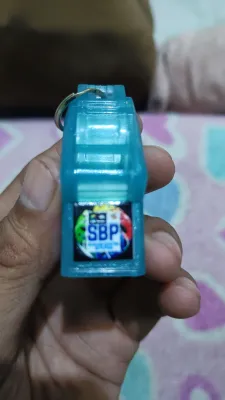
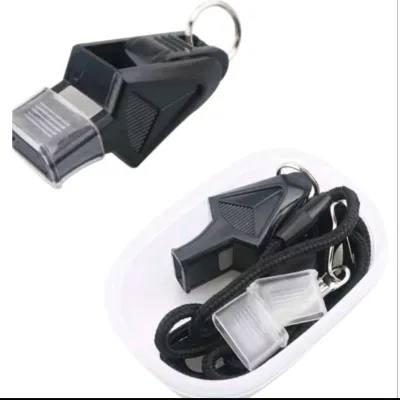
Prices are valid at publication and may change. Please refer to the product page for the latest price.
Physical demands on the referee also dictate your whistle choice. Running continuously for 90 minutes in hot, humid conditions causes physical fatigue, which directly affects your lung capacity and breath control. When you are winded after a long sprint to keep up with a fast counter-attack, you need a whistle that responds instantly with a sharp, clear tone even when you can only manage a quick, shallow burst of air.
Core Features to Evaluate in Blazza Whistles
To choose the best whistle for referee blazza options, you must evaluate the technical and design elements that define their performance. Blazza whistles are engineered specifically for football officiating, meaning their acoustic chambers and materials are optimized for the unique demands of the sport.

Pealess vs. Pea Whistles
Traditional whistles rely on a small internal ball, or “pea,” to create a trilling sound by rapidly interrupting the airflow. While effective in dry, quiet settings, pea whistles present significant risks during intense football matches. Moisture from your breath, heavy rain, or sweat can cause the pea to stick to the inner walls of the chamber, resulting in a muffled hiss or complete silence when you need to blow a critical foul.
Pealess whistles, which include the entire Blazza lineup, eliminate this moving part entirely. They utilize precisely engineered internal chambers that split the air stream into multiple paths, creating a consistent, high-decibel sound through pure aerodynamics. This design ensures absolute reliability in wet and humid tropical climates, as there is no physical component that can jam or freeze.
From a hygiene perspective, pealess models are vastly superior. Without an enclosed pea chamber, these whistles do not trap saliva, dirt, or bacteria in hard-to-reach crevices. They are exceptionally easy to rinse and sanitize, making them a much healthier choice for referees who use their equipment week in and year out.
Sound Projection and Frequency
The acoustic profile of a whistle is determined by its chamber shape and the frequency of the sound waves it generates. High-frequency tones, typically ranging between 3.5 kHz and 4.5 kHz, are highly effective at cutting through dense background noise, such as roaring crowds or traffic. This sharp, piercing sound immediately alerts players, even if they are focused on a high-intensity play at the opposite end of the pitch.
Conversely, lower-frequency tones provide a deeper, more resonant sound. While these tones do not cut through extreme stadium noise as easily, they are much less fatiguing to the ears of players and officials who are in close proximity to the whistle. When selecting a Blazza model, check the manufacturer’s specifications for the frequency layout, as some premium models feature dual-chamber designs that combine both high and low frequencies to achieve a balanced, multi-tonal projection.
A critical factor in player compliance is the whistle’s “attack”—the speed at which the sound reaches its maximum volume. A whistle with a sharp, immediate attack commands instant respect and halts play instantly, whereas a whistle that requires a gradual build-up of air pressure can lead to delayed reactions and potential player safety issues on the pitch.
Material, Build, and Ergonomics
The materials used in whistle construction affect everything from durability to comfort. High-impact ABS plastic is the industry standard for premium referee whistles, offering incredible strength, lightweight handling, and resistance to temperature fluctuations. Unlike metal whistles, ABS plastic will not heat up under the intense tropical sun or stick to your lips during wet weather, ensuring a comfortable experience throughout the match.
Mouthpiece ergonomics are a defining feature of the Blazza series. Many models incorporate soft silicone or rubber covers over the mouthpiece, providing a secure grip for your teeth without causing dental fatigue or discomfort. This bite-resistant design allows you to hold the whistle securely in your mouth during fast-paced play, keeping your hands free to signal advantages or direct players.
Safety is another paramount consideration, particularly regarding how you carry your whistle. Lanyard attachment points must be robust enough to withstand sudden tugs, but they should always be paired with a breakaway safety clasp. A breakaway mechanism ensures that if the lanyard is accidentally caught on a player’s jersey or pulled during a physical altercation, the clasp will release immediately, preventing neck injuries or choking hazards.
Matching Whistle Types to Specific Match Scenarios
Selecting the right Blazza whistle profile depends heavily on matching these technical features to the specific competitive tier and environment of your matches.
Grassroots and Youth Football
In grassroots, school, and youth football matches, the acoustic demands are generally moderate. Fields are often smaller, crowds are smaller, and the overall pace of the game is less intense. In these environments, using an extremely loud, stadium-grade whistle can be counterproductive, as it can startle young players, cause ear discomfort, and confuse players on adjacent pitches in multi-field sports complexes.
For these matches, prioritize lightweight, highly responsive Blazza models that require minimal lung capacity to operate. A whistle that produces a clear, authoritative tone with a gentle blow allows you to focus your energy on positioning, teaching the rules, and managing the game. These models are typically more cost-effective, falling into a budget-friendly price band of around ₱1,000 to ₱1,800, making them highly accessible for community volunteers and school referees.
Durability is also key in grassroots officiating, where gear is often tossed into bags, dropped on hard ground, or shared among colleagues. A solid ABS plastic construction without delicate external attachments ensures the whistle can withstand rough handling without losing its acoustic integrity.
Competitive and Adult Amateur Leagues
Adult amateur leagues and local competitive tournaments present a completely different set of challenges. These matches are played on full-sized 11-a-side pitches, where players are faster, more physical, and highly competitive. The crowd noise is louder, and the intensity of the game requires a whistle that delivers a sharp, unmistakable signal to stop play instantly.
To command respect in these leagues, you need a whistle with a high-frequency tone that projects clearly across a 100-meter field. Because these matches are often played in open community spaces or regional sports complexes in the Philippines, you must account for high humidity and sudden rain. A pealess Blazza model with an optimized airflow chamber is essential here, ensuring that even when you are physically exhausted and wet, the whistle delivers a consistent, high-volume blast.
Look for models that feature a hybrid design, combining a durable plastic body with a soft, integrated bite grip. This allows you to run comfortably with the whistle in your mouth, ready to blow the instant a foul occurs, without worrying about the whistle slipping or causing discomfort to your teeth during a sudden impact.
High-Intensity and Noisy Environments
For professional leagues, major cup tournaments, or matches played in large stadiums, the acoustic environment is intense. The combination of thousands of cheering fans, stadium acoustics, and high-stakes pressure means that standard whistles can easily be drowned out. In these scenarios, communication breakdown can lead to player frustration, loss of game control, and safety risks.
To handle these extreme environments, you must look to premium Blazza models engineered specifically for elite football officiating. These models typically feature dual-chamber acoustic designs that produce a unique, piercing, multi-tonal frequency. By blending two distinct pitches, the sound cuts through the deepest crowd decibels, ensuring that players, coaches, and assistant referees hear the signal instantly.
These high-end models often incorporate advanced materials, such as titanium-reinforced structures combined with high-impact plastics, providing maximum durability and a premium feel. They also come equipped with heavy-duty, adjustable lanyards featuring secure breakaway clasps. While these elite whistles sit in a higher price band, typically ranging from ₱2,500 to ₱4,500, they are an indispensable investment for referees operating at the highest levels of the sport.
How to Verify and Maintain Your Referee Whistle
A referee’s whistle is their primary tool of communication, and keeping it in peak physical and acoustic condition is vital for match day success. Developing a consistent inspection and cleaning routine ensures that your whistle performs reliably every time you step onto the pitch.
Before every match, perform a quick pre-match inspection. Hold the whistle up to the light and check the acoustic chambers for any dirt, lint, or dried saliva that could obstruct the airflow. Even a tiny piece of debris can alter the pitch or drastically reduce the volume of your whistle. Additionally, inspect the mouthpiece for any cracks or deep bite marks that could compromise its structural integrity, and pull gently on the lanyard and breakaway clasp to verify that the safety mechanism is functioning correctly.
Cleaning your whistle is a simple but critical process for hygiene and longevity. After every match day, wash the whistle thoroughly using mild dish soap and lukewarm water. Gently agitate the water through the internal chambers to flush out any accumulated spit or dirt. Avoid using harsh chemical cleaners, bleach, or boiling water, as extreme heat and strong solvents can warp the ABS plastic, degrade the soft silicone bite grips, and ruin the adhesive holding any components together.
Proper drying and storage are particularly important in the hot, humid climate of the Philippines. After washing, shake out any excess water from the chambers and lay the whistle on a clean towel to air-dry completely. Never store a damp whistle inside a sealed plastic bag or a dark, sweaty gear bag, as this creates the perfect environment for mold and bacteria to grow. Instead, keep your dry whistle in a breathable mesh pouch or a dedicated protective case to shield it from dirt and physical damage between matches.
Frequently Asked Questions (FAQ)
Can I use a Blazza football whistle for other sports like basketball or futsal?
While you can technically use a Blazza football whistle for other sports, it is important to consider the acoustic environment. Blazza whistles are specifically engineered to project high-frequency, high-decibel sounds across large, open outdoor football pitches. If you blow a powerful football whistle inside an enclosed gymnasium for basketball or futsal, the sound can bounce off the walls, creating an excessive echo that can cause severe ear fatigue and discomfort for players, coaches, and yourself. For indoor sports, it is generally recommended to use specialized indoor whistles that feature slightly lower-frequency tones or controlled volume levels designed for enclosed spaces.
How often should a referee replace their whistle?
There is no fixed expiration date for a referee whistle, but you should replace it immediately when you observe physical or acoustic signs of wear. Inspect the plastic body regularly; if you notice any visible cracks, deep teeth indentations that pierce the soft bite grip, or a loose lanyard attachment point, it is time for a replacement. Acoustically, if you notice a sudden drop in volume, a muffled tone, or if the whistle requires significantly more breath pressure than usual to produce a clear sound, the internal chamber geometry may be compromised. Active referees who officiate multiple matches a week typically replace their primary whistle every one to two seasons to ensure absolute reliability and hygiene.
Community discussion
Share your experience or ask a question. Comments are reviewed before publication.