
Selecting a golf bag is a critical decision that directly influences your physical comfort, pace of play, and club protection on the course. G/FORE has established a distinct niche in the premium golf market by blending bold, modern aesthetics with functional design. To find the right model, you must evaluate how you navigate the course, the typical weather conditions you face, and your storage requirements.
Whether you ride a motorized cart, rely on a caddie, or carry your own clubs, G/FORE offers three primary configurations: cart bags, stand bags, and Sunday bags. Each category caters to a specific style of play and carries distinct trade-offs in weight, storage capacity, and mobility. Choosing the ideal gfore golf bag requires looking past the striking colors and focusing on how the bag’s structural design matches your weekly routine.
Understanding Your Golf Bag Needs
Before looking at specific models, assess your typical weekly golf routine. Golfers who play almost exclusively from a motorized cart require a vastly different setup than those who prefer walking the fairways. If you frequently hire a caddie, as is common in premium clubs across the Philippines, the weight of the bag and the comfort of the strap system remain crucial considerations out of respect for your caddie’s physical endurance over an 18-hole round. A bag that is too heavy or awkward to carry can affect your caddie’s performance and, consequently, your overall experience on the course.
Products mentioned in this guide


Prices are valid at publication and may change. Please refer to the product page for the latest price.
Local climate conditions should also dictate your material choices. In tropical regions characterized by high humidity, intense afternoon sun, and sudden torrential downpours, a golf bag must offer exceptional weather resistance. Premium synthetic leathers, waterproof zippers, and sealed seams are essential to protect your expensive clubs, electronics, and spare apparel. A bag that absorbs moisture or lacks adequate ventilation can quickly develop mold, mildew, and unpleasant odors when stored in a locker or car trunk. Coastal courses also introduce salt air, which can accelerate the corrosion of metal hardware if the bag is not constructed with high-quality, treated components.
Finally, analyze your storage habits honestly. Some players carry multiple boxes of balls, rain gear, specialized training aids, rangefinders, and various personal items. Others prefer a minimalist approach, carrying only the absolute essentials to keep the bag light and tidy. Matching your storage needs to the correct bag size prevents you from carrying unnecessary weight or, conversely, running out of space for a rain jacket during a sudden monsoon shower.
G/FORE Cart Bags: Best for Riding and Maximum Storage
G/FORE cart bags are engineered specifically for golfers who prioritize maximum storage, pristine club organization, and structural stability. These bags are designed to spend their entire life on the back of a motorized golf cart or secured to a push cart. If you rarely walk the course and prefer to have every possible accessory, tool, and piece of apparel readily available, a cart bag is the logical choice.

The defining feature of a G/FORE cart bag is its organizational layout, typically centered around a 14-way top divider system. This design ensures that each club has its own dedicated slot, preventing shafts from tangling and minimizing the annoying clattering of club heads as the cart bounces along the path. Many models also feature a dedicated, oversized putter well to accommodate thick, modern grips. Because the bag remains upright on a cart, all pockets are positioned on the front and sides, allowing easy access to your rangefinder, insulated cooler pocket, and velour-lined valuables pocket while the bag is strapped down.
However, these premium features come with clear physical trade-offs. Cart bags are inherently heavier, often weighing significantly more than stand or Sunday bags even before you add clubs and accessories. Their bulkier footprint makes them more cumbersome to load into smaller car trunks and more tiring to lift. If you ever decide to walk a round without a cart, carrying a fully loaded cart bag over 18 holes is physically exhausting and highly impractical.
Before purchasing a G/FORE cart bag, perform the following verification checks:
- Base compatibility: Check that the bottom of the bag fits securely into the circular cart brackets of the motorized carts used at your local course to prevent twisting.
- Strap pass-through: Verify that the bag features a dedicated channel or pass-through sleeve for the cart strap, ensuring the strap does not block access to your primary zippers.
- Structural rigidity: Ensure the internal stay rods and outer materials maintain their shape when fully loaded, preventing the bag from sagging or leaning when standing on flat ground.
G/FORE Stand Bags: The Versatile Choice for Walking and Riding
For the golfer who values versatility above all else, G/FORE stand bags offer the ideal middle ground. These bags are designed for players who alternate between riding in a motorized cart, using a push cart, and walking the fairways. If you enjoy the physical exercise of carrying your own clubs but still want the option to ride when the tropical heat becomes too intense, a stand bag adapts seamlessly to both scenarios.
The key design elements of a G/FORE stand bag center on carrying comfort and quick deployment. These models feature advanced dual-strap harness systems that distribute the bag’s weight evenly across both shoulders, reducing fatigue on your back and neck. The stand mechanism consists of durable, lightweight legs—often constructed from carbon fiber—that deploy automatically when the base of the bag is set on the ground. This keeps your clubs easily accessible and prevents the bag’s body from contacting wet grass or sand.
The primary trade-off of a stand bag is its slightly reduced storage capacity compared to a dedicated cart bag. To keep the weight manageable for walking, stand bags feature fewer pockets and a narrower top opening, typically utilizing a 4-way or 6-way divider system rather than a 14-way layout. Additionally, the stand mechanism itself adds mechanical complexity, introducing moving parts that can wear out, bend, or break over years of heavy use if not handled with care.
To ensure a G/FORE stand bag fits your routine, verify these specific aspects:
- Stand mechanism stability: Test the leg deployment on soft or uneven turf to confirm the legs extend fully and provide a wide, stable base that resists tipping in windy conditions.
- Harness adjustability: Adjust the shoulder straps while wearing your typical golf attire to ensure the bag sits comfortably against your lower back without bouncing or shifting.
- Flat-base retraction: Check that the leg mechanism retracts flush against the bag body and that the base sits flat, allowing the bag to stand securely in a cart or on a flat surface without damaging the legs.
G/FORE Sunday Bags: Lightweight Carry for Short Rounds and Practice
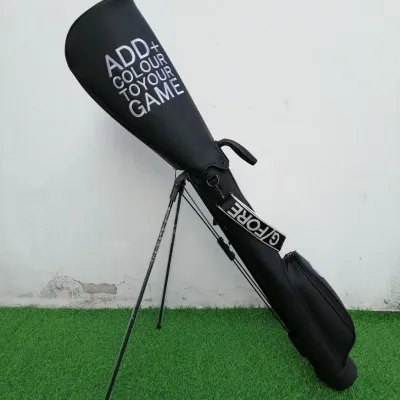
G/FORE Sunday bags represent the ultimate expression of minimalist golf. These bags are designed for specific, focused scenarios rather than serving as an all-purpose daily bag. If your golf routine consists of quick twilight rounds, practice sessions at the driving range, playing par-3 executive courses, or traveling light, a Sunday bag offers unmatched freedom of movement.
The design philosophy of a Sunday bag is centered entirely on weight reduction and simplicity. Constructed from lightweight yet durable materials, these bags feature a highly compact profile with a small top diameter, usually containing a simple 2-way or 3-way divider. They are equipped with comfortable single or dual straps and a streamlined pocket layout designed to hold only the bare essentials: a few golf balls, tees, a glove, a rangefinder, and a water bottle. Many modern Sunday bags also feature mini stand legs to keep the bag off the ground, though some traditional pencil styles lie flat on the turf.
The trade-offs of choosing a Sunday bag are significant and require a commitment to a minimalist mindset. These bags offer minimal club protection, as the narrow top opening causes clubs to crowd together, increasing the risk of cosmetic wear on shafts and grips. Storage is highly restricted; you will not have room for a full rain suit, multiple spare towels, or extensive accessories. Furthermore, because they are built light, they offer less structural protection against impact during travel or rough handling.
Before committing to a G/FORE Sunday bag, complete these essential checks:
- Internal diameter capacity: Confirm that the top opening can comfortably accommodate the specific number of clubs you plan to carry (typically a half-set of 6 to 8 clubs) without excessive grip friction when pulling a club out.
- Strap comfort: Evaluate the shoulder padding and strap width, ensuring it provides adequate cushioning since you will be carrying the bag's entire weight for the duration of your walk.
- Ground protection: If choosing a legless pencil bag, verify that the bottom material is highly water-resistant to prevent ground moisture from soaking through to your clubs and accessories.
Quick Comparison: Matching G/FORE Bags to Your Routine
To help you quickly identify which configuration aligns with your typical round, the following table summarizes the key decision-defining dimensions of each G/FORE bag type.
| Bag Type | Best For | Weight Profile | Storage Capacity | Cart Compatibility |
|---|---|---|---|---|
| Cart Bag | Riding in motorized carts, maximum organization | Heavy | Maximum | Excellent (Dedicated pass-through) |
| Stand Bag | Alternating between walking, carrying, and riding | Moderate | Moderate | Good (Requires careful strapping) |
| Sunday Bag | Quick practice, par-3 courses, minimalist walking | Ultra-Light | Minimal | Poor (Not designed for cart brackets) |
What to Check Before Buying a G/FORE Golf Bag
Investing in a premium golf bag requires careful consideration of long-term maintenance and local playing conditions. Because G/FORE bags utilize high-grade synthetic materials, specialized finishes, and leather accents, proper care is essential—especially in humid, tropical climates. Always review the manufacturer’s care instructions. After playing in wet weather, ensure the bag is completely emptied, wiped down, and allowed to air-dry in a well-ventilated, shaded indoor area before storing it in a locker or closet. This simple routine prevents mold growth and preserves the structural integrity of the synthetic leather.
Additionally, verify the specific regulations of the golf courses you play most frequently. Some private clubs have strict rules regarding bag dimensions, push cart usage, or mandatory caddie programs. Ensure your chosen bag complies with these local guidelines and is comfortable for a caddie to carry if you regularly utilize caddie services.
Finally, protect your investment by purchasing only through official brand channels or authorized golf retailers. This ensures you receive a genuine product backed by the manufacturer’s warranty. Carefully check the return policies and shipping terms, particularly regarding potential import duties or localized return shipping procedures, to guarantee a smooth and secure purchasing experience.
Frequently Asked Questions (FAQ)
Can I use a G/FORE stand bag on a motorized golf cart?
Yes, you can use a G/FORE stand bag on a motorized golf cart, but you must take a few precautions to prevent damage. Because stand bags have a smaller base and external leg mechanisms, they can shift or twist under the pressure of cart straps. To avoid this, ensure the cart strap is threaded through the dedicated cart strap pass-through sleeve if your model has one, or verify that the strap sits securely above the leg hinges. Do not over-tighten the strap, as excessive pressure can bend the legs or damage the internal stand mechanism.
How do I clean and maintain premium golf bag materials?
To maintain the appearance and longevity of your premium golf bag, establish a regular, low-risk cleaning routine. After each round, wipe the exterior surfaces with a soft, damp microfiber cloth to remove dust, grass stains, and sweat. Avoid using harsh chemical cleaners, abrasive scrubbers, or solvent-based polishes, as these can degrade the synthetic leather coatings and strip away water-resistant treatments. If the bag gets soaked during a sudden downpour, open all pockets, remove all contents, and let the bag air-dry completely in a cool, well-ventilated indoor space away from direct sunlight.
Community discussion
Share your experience or ask a question. Comments are reviewed before publication.