
To lower your scores on the golf course, practicing your short game at home is one of the most effective strategies. However, choosing a putting mat golf setup can be overwhelming when confronted with technical specifications like Stimp ratings, grain directions, and built-in slopes. Finding the right mat requires matching these specifications to your actual practice space, your local green conditions, and your specific training goals. Focusing on the specs that directly impact ball roll and stroke mechanics ensures your practice time translates to fewer putts on the actual green.
Surface Speed and Roll Consistency
The speed of a putting mat determines how closely your indoor practice mirrors the greens at your local golf club. Manufacturers often measure this speed using a Stimp rating, which represents the distance in feet a golf ball rolls after leaving a standardized ramp. When shopping, you will typically see mats categorized as slow, medium, or fast, corresponding to Stimp ratings ranging from 8 to over 12. If you regularly play on public courses in humid, tropical climates where grass is kept slightly longer, a medium-speed mat (around 9 to 10) is often the most realistic choice.
Another critical factor in roll consistency is the grain direction of the synthetic fibers. Some mats are designed with a distinct grain that allows you to practice putting both “with” and “against” the grain, simulating the natural resistance of real grass. Putting against the grain slows the ball down and requires a firmer stroke, while putting with the grain offers a faster, smoother roll. If a mat lacks a defined grain, it should at least provide a completely uniform surface to prevent the ball from wobbling or skidding off line.
Products mentioned in this guide
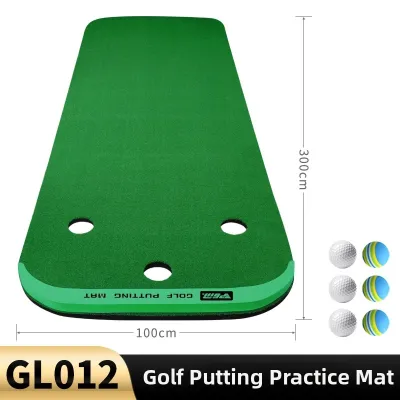
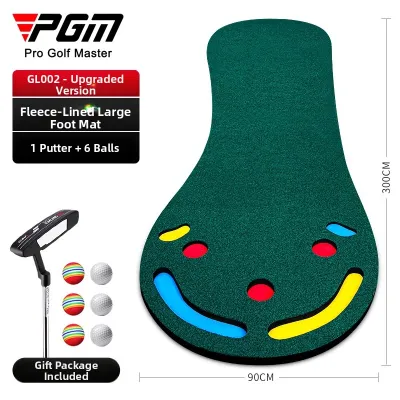
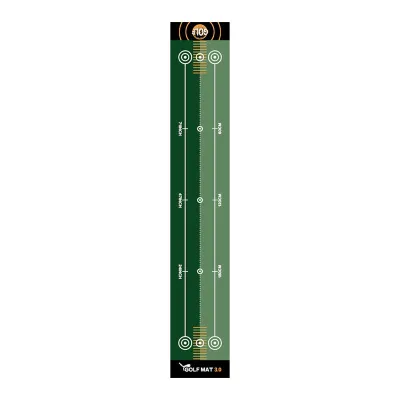
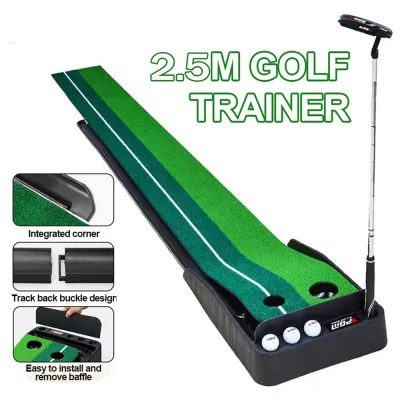
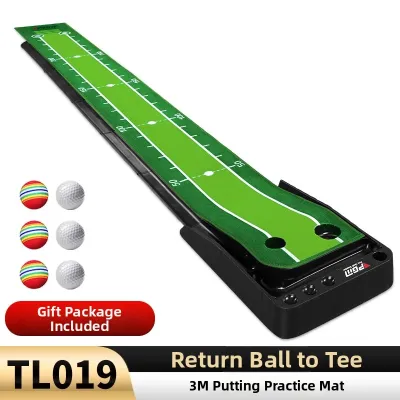
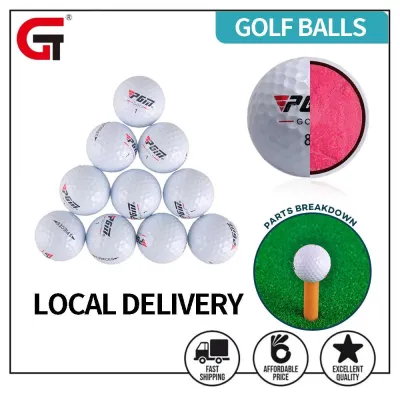
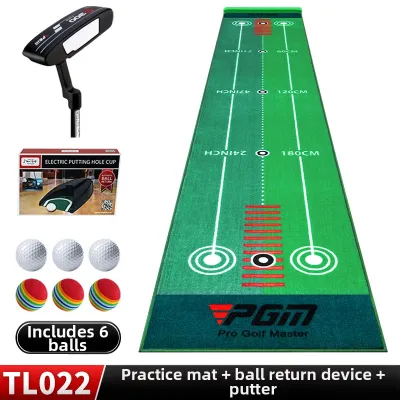
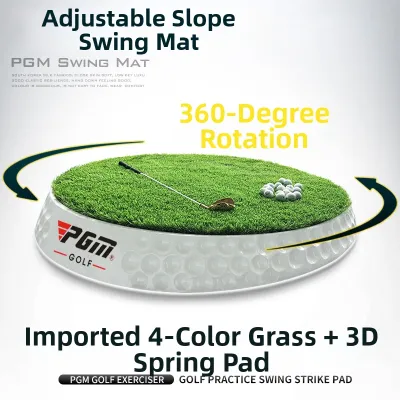
Prices are valid at publication and may change. Please refer to the product page for the latest price.
To ensure you get the speed you need, always check the manufacturer’s product label for a verified Stimp rating rather than making assumptions based on appearance. A common misconception is that a thicker, plush-looking mat will naturally roll faster or smoother. In reality, fiber density, backing material, and manufacturing quality dictate the speed, making official specifications your most reliable guide.
Slope, Undulation, and Break Features
While a perfectly flat putting mat is excellent for mastering a straight, repeatable stroke, it does not prepare you for the breaking putts you encounter on a real course. To bridge this gap, many mats feature built-in slopes, elevated cups, or adjustable undulation inserts. Flat mats are generally easier to store and provide a consistent baseline for alignment, whereas sloped mats challenge your ability to control speed and visualize the path of the ball.

Practicing on a slope forces you to adjust your stroke strength and learn how gravity affects the ball as it slows down near the cup. If you choose a mat with an uphill finish, it encourages a firm, positive stroke, helping you avoid the common mistake of leaving putts short. Adjustable break features, which often use foam inserts placed underneath the mat, allow you to create custom left-to-right or right-to-left breaks to keep your practice sessions dynamic.
When evaluating these features, pay close attention to the adjustability and material firmness of the slope components. Soft, low-density foam inserts can compress too easily underfoot or lose their shape over time, leading to unpredictable breaks. Look for high-density foam or rigid plastic ramp systems that maintain their structural integrity and stay firmly in place on your floor without sliding during your stroke.
Dimensions, Length, and Portability
The physical dimensions of your putting mat must balance your training objectives with the realities of your living space. If your primary goal is to dial in your short stroke mechanics and start the ball on your intended line, a shorter mat of 8 to 10 feet is highly effective and easy to accommodate. For golfers looking to practice distance control and lag putting, longer mats extending 15 feet or more are necessary, though they require a dedicated room or hallway.
Width is another dimension that directly impacts your training options. A narrow mat, typically around 1 to 1.5 feet wide, is excellent for focused alignment practice and setting up simple gate drills with tees or alignment sticks. Wider mats, spanning 3 feet or more, allow you to stand directly on the putting surface while addressing the ball, which ensures your feet are at the exact same level as the ball for a more realistic stance.
Portability and storage are crucial if you do not have a permanent space to leave your mat rolled out. Check the weight of the mat and how easily it rolls up without creasing or curling at the edges. Heavy rubber-backed mats stay flat immediately when unrolled but can be cumbersome to move, while lightweight foam-backed options are highly portable but may require some time to flatten out before you can practice.
Secondary Specs You Can Safely Deprioritize
When browsing online marketplaces, it is easy to get distracted by premium features that add to the cost without improving your skills. Overly complex gravity-fed or electronic ball return systems, for example, can sometimes jam or create distracting noise in a quiet home environment. While a basic track that returns the ball is convenient, you do not need to pay a premium for motorized return mechanisms when your main focus should be on the quality of your stroke.
Aesthetic details, such as hyper-realistic grass printing or multi-colored turf borders, also have zero impact on how the ball actually rolls. A plain, solid-colored mat with high-quality fibers will serve your practice needs just as well as one designed to look like a miniature replica of a famous golf hole. Focusing your budget on the quality of the backing material and the consistency of the fibers rather than visual novelties will ensure you get the most value for your ₱.
Similarly, while some alignment lines are helpful for beginners, an excessive number of printed grids, target circles, and distance markers can clutter your visual field. On a real green, you will not have lines guiding your eyes, so practicing on a cluttered mat can make it harder to transition your skills to the course. A simple center line or a couple of subtle gate markers are usually more than enough to help you verify your face angle at impact.
Frequently Asked Questions (FAQ)
Does a thicker putting mat always mean a faster surface speed?
No, thickness does not determine speed. The speed of a putting mat is dictated by the density of the synthetic fibers, the texture of the surface, and the backing material. A thick, plush mat can actually slow the ball down if the fibers are soft and create friction. To find a fast surface, look for high-density, low-pile fibers and verify the manufacturer’s Stimp rating on the product label.
Can I use a putting mat outdoors?
It depends entirely on the manufacturer’s specifications. Most indoor putting mats are not designed to withstand UV exposure or moisture, which can cause the backing to warp, the glue to degrade, and the fibers to fade. If you plan to practice on a patio or balcony, verify that the product is explicitly rated for outdoor use, and always store it indoors when not in use to protect it from tropical humidity and rain.
Community discussion
Share your experience or ask a question. Comments are reviewed before publication.