
Selecting the right overgrip is one of the most cost-effective ways to improve your performance on the court. The connection between your hand and your racket handle dictates your control, shot precision, and overall comfort during a match. If your grip slips even slightly during a high-speed swing, your racket face can twist, leading to errors and inconsistent ball placement.
Tourna has long been a benchmark brand in racket sports, known for developing specialized grips that cater to distinct player needs. Finding the right Tourna overgrip variant depends on your personal sweat levels, your tactile preference for either dry or sticky surfaces, and the climate in which you play. By matching these factors to the correct product, you can secure your hold, reduce hand fatigue, and focus entirely on your game.
How to Match Your Grip Needs to the Right Overgrip
Choosing a tourna overgrip requires an understanding of how your body and your playing environment interact with the racket handle. Before looking at specific products, you should evaluate your physical needs and playing conditions to establish a clear decision-making framework.
Products mentioned in this guide
Prices are valid at publication and may change. Please refer to the product page for the latest price.
Sweat Levels and Climate
High humidity and heat present a major challenge for racket control. In tropical climates, such as during afternoon matches in the Philippines, relative humidity often exceeds 80 percent. This prevents sweat from evaporating quickly, causing moisture to pool on your hands and run down your arms onto the handle.
If you are a heavy sweater or play in unventilated indoor courts, moisture management must be your primary selection criterion. A grip that cannot handle high moisture levels will quickly become slick, forcing you to grip the handle too tightly. Conversely, if you play in air-conditioned indoor facilities or naturally have dry hands, moisture absorption is less critical than surface adhesion.
Tactile Preference (Dry vs. Tacky)
Players generally fall into two categories regarding tactile preference: those who prefer a dry, paper-like feel, and those who want a tacky, rubbery stickiness. A dry grip relies on surface friction and rapid moisture absorption to keep your hand from slipping. It feels soft and powdery to the touch, working similarly to a towel by drinking up sweat to maintain its grip properties.
A tacky grip relies on surface adhesion to lock your hand in place. The polyurethane coating on tacky grips is designed to stick to your skin, providing a secure hold with minimal grip pressure. This feel is highly beneficial for players who want to feel completely connected to the handle without needing to squeeze hard, though it requires clean, dry skin to perform optimally.
Handle Size and Grip Thickness
Adding an overgrip changes the physical dimensions of your racket handle. Most standard overgrips range from 0.4mm to 0.6mm in thickness. Wrapping an overgrip over your base grip will increase your handle size by roughly half a grip size, which can alter how easily you can wrap your fingers around the bevels.
To determine if you have room for an overgrip, hold your racket in a continental grip. There should be a gap roughly the width of your index finger between your ring finger and your palm. If your fingers already touch your palm, your grip is too small, and adding a slightly thicker overgrip can help optimize the handle size. If the handle already feels bulky, you will need a very thin overgrip to avoid losing your feel for the handle bevels.
Playing Frequency and Durability
Your weekly playing hours dictate how often you will need to replace your grip. High-performance overgrips designed for extreme absorption use open-pore polyurethane structures that degrade under friction and salt exposure. If you play three or more times a week, these dry-feel grips will wear out rapidly, requiring replacement every few sessions.
If you play less frequently, or if you prefer a tacky grip, durability profiles change. Tacky grips do not wear down through physical fraying as quickly, but they do lose their stickiness as they collect dust, skin oils, and court debris. Consider whether you prefer a high-performance grip that requires frequent replacement or a more durable, long-lasting surface that maintains its properties over several weeks.
Top Tourna Overgrip Variants for Different Playing Styles
Tourna offers a specialized lineup of overgrips designed to address these specific player profiles. Each variant uses distinct material formulations to prioritize either dry absorption, extreme stickiness, or balanced versatility.

Tourna Grip Original (The Dry and Absorbent Choice)
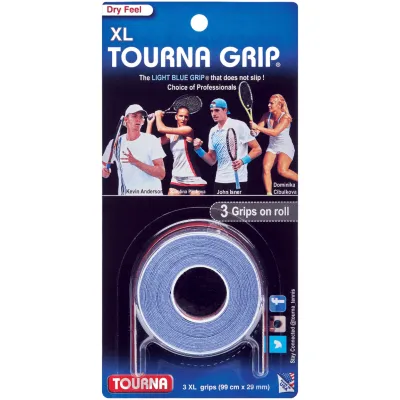
This is the iconic “light blue grip that does not slip,” used by professional players for decades. It is specifically engineered to handle wet conditions and heavy perspiration.
- Best For: Heavy sweaters, high-humidity environments, and players who want a dry, non-slippery feel during long, intense rallies.
- Key Characteristics: This grip features a unique dry feel that actually improves its traction as it gets slightly damp. The proprietary formulation pulls moisture away from the surface instantly, keeping your hand dry and preventing the racket from twisting during high-impact shots.
- Limitations: The open-pore structure that makes this grip so absorbent also makes it susceptible to rapid wear. It tends to fray, pill, and tear faster than tacky alternatives, meaning active players may need to replace it after every few matches.
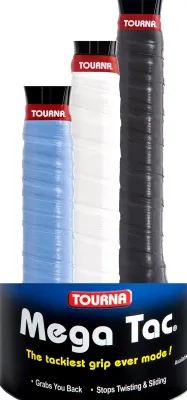
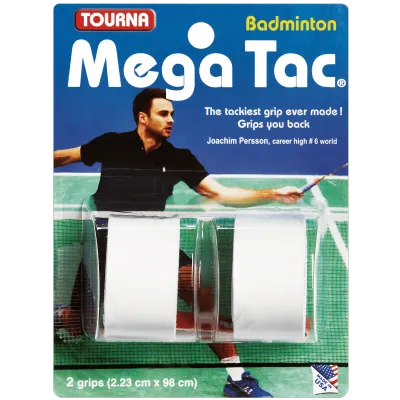
Tourna Mega Tac (The High-Tack Control Grip)
For players who demand maximum surface stickiness, this variant offers one of the tackiest surfaces available on the market.
- Best For: Players with dry hands, those playing in cooler or indoor air-conditioned courts, and players who want a deeply secure, locked-in feel for spin-heavy strokes.
- Key Characteristics: It features an ultra-tacky polyurethane coating that physically adheres to your hand. This extreme tackiness lasts significantly longer than other sticky grips on the market, providing excellent shock absorption and reducing the physical effort needed to hold the racket handle.
- Limitations: When exposed to heavy sweat or high tropical humidity, the glossy, tacky surface can lose its stickiness and become slippery. It is not recommended for heavy sweaters unless they use a wristband and wipe their hands frequently between points.
Tourna Quik Tac (The Balanced All-Rounder)
This variant serves as a middle ground, offering a compromise between the dry feel of the Original and the extreme stickiness of Mega Tac.
- Best For: All-court players who experience moderate sweating, those who play in changing weather conditions, or players transitioning between indoor and outdoor courts.
- Key Characteristics: It provides an immediate, comfortable tackiness out of the roll while maintaining a moderate level of moisture absorption. It offers a soft, cushioned feel that dampens vibrations without completely isolating your hand from the handle bevels.
- Limitations: Because it is a hybrid design, it does not offer the extreme dry performance of the Original in torrential sweat, nor does it match the long-lasting, glue-like stickiness of Mega Tac.
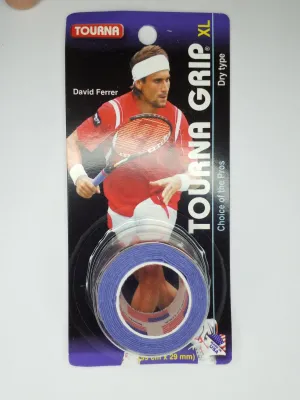
Tourna XL (For Extended Coverage and Two-Handed Players)
Modern tennis rackets and specific playing styles require more surface coverage than traditional overgrips provide.
- Best For: Tennis players who use a two-handed backhand, players with large hands, or those using modern rackets with extended handles.
- Key Characteristics: This variant is wider and longer than the standard cut. It allows you to wrap the entire length of an extended handle with plenty of overlap, ensuring you do not have to stretch the material too thin, which would otherwise compromise its cushioning and absorption.
- Limitations: The extra material and width mean you may need to trim the end of the grip when applying it to standard single-handed rackets or smaller handles, such as those found on pickleball paddles or table tennis blades.
Tennis vs. Table Tennis: Does the Overgrip Choice Change?
While Tourna overgrips are highly popular in tennis, they are also widely used in table tennis. However, the physical differences between these sports drastically alter how you should select and apply your grip.
Racket Handle Differences
Tennis rackets feature long, thick, octagonal handles designed to be held with a full-fisted grip. These handles must withstand high-velocity impacts and rotational forces.
Table tennis paddles feature much shorter, thinner handles that are often flared, straight, or anatomic. These handles are designed for delicate finger adjustments, quick transitions between forehand and backhand grips, and rapid wrist snaps.
Sensitivity vs. Shock Absorption
In tennis, shock absorption is highly valued. A thicker overgrip helps dampen the heavy vibrations caused by hitting a fast-moving ball with a stiff frame. This protects your joints from tennis elbow and provides comfort during multi-hour sessions.
In table tennis, finger sensitivity and tactile feedback are paramount. Players rely on feeling the vibrations of the ball striking the paddle face to judge spin, speed, and depth. Adding a thick, cushioned tennis overgrip to a table tennis handle can mute this essential feedback, making delicate touch shots much harder to execute. Therefore, table tennis players should prioritize ultra-thin overgrips that provide slip resistance without adding bulk.
Application Advice
When applying a tourna overgrip to a table tennis paddle, you must modify your approach. Because a standard tennis overgrip is designed for a much longer handle, wrapping it directly onto a table tennis blade will result in excess bulk and weight, which can alter the paddle’s balance.
- Cut the Grip: Cut the overgrip in half lengthwise to reduce its width, or cut it short to fit the brief handle length of a table tennis blade.
- Minimize Overlap: Wrap the grip with minimal overlap to keep the handle as thin as possible, ensuring you can still wrap your fingers comfortably around the flare.
- Check Regulations: Always verify that your wrapped grip does not cover any part of the rubber face, which could violate local tournament play rules.
Signs It Is Time to Replace Your Overgrip
Playing with a worn-out overgrip can silently degrade your performance. Recognizing when your grip has reached the end of its lifespan is key to maintaining consistent control and preventing physical strain.
Visual and Tactile Triggers
There are several clear physical indicators that your overgrip needs to be replaced:
- Fraying and Peeling: The edges of the grip begin to roll up, peel, or show visible tearing, particularly where your index finger or palm heel rests.
- Discoloration: The grip turns a dirty grey, brown, or yellow color from absorbing sweat, dirt, and skin oils.
- Loss of Texture: A dry grip feels slick, hard, and smooth rather than soft and absorbent. A tacky grip feels dusty or dry, completely losing its stickiness.
Performance Impact
When an overgrip loses its friction or tackiness, your hand will naturally compensate by squeezing the handle harder to keep the racket from twisting. This excessive grip pressure causes tension to travel up your forearm, leading to rapid muscle fatigue, reduced wrist flexibility, and a higher risk of developing lateral epicondylitis (tennis elbow).
If you find your arm feeling unusually sore after a session, or if you notice your shots flying long because you cannot snap your wrist freely, check the condition of your overgrip. Replacing a worn grip immediately restores your ability to play with a relaxed, fluid grip pressure.
Safe Removal and Preparation
Replacing an overgrip is a simple, low-risk process that you can perform in a few minutes before a match. Follow these steps to ensure a clean application:
- Unwind the Old Grip: Carefully peel off the finishing tape at the top of the handle, then unwind the old overgrip. Avoid pulling too hard if the grip has adhesive backing, as you do not want to tear the underlying base grip.
- Clean the Handle: Check the base grip for any sticky residue, dirt, or moisture. Use a dry cloth to wipe down the handle, ensuring the surface is completely dry and clean before applying the new layer.
- Wrap the New Grip: Start at the butt cap of the racket. If your Tourna grip has a tapered start or an adhesive starting strip, secure that to the bottom bevel first. Wind the grip upward, maintaining consistent, firm tension to avoid air bubbles or wrinkles.
- Secure the Top: Once you reach the top of the handle, cut any excess material at an angle to create a clean, flat finish. Use the included finishing tape to secure the top edge firmly to the collar of the handle.
Frequently Asked Questions (FAQ)
Can I use a tennis overgrip on a table tennis paddle?
Yes, you can physically use a tennis overgrip on a table tennis paddle, but you must make adjustments to avoid ruining your paddle’s feel. Tennis overgrips are designed to be much longer and thicker than what is ideal for table tennis handles.
If you apply a full tennis overgrip without modification, it will make the handle too bulky, dampening the subtle vibrations you need to feel spin and control your shots. To use one successfully, cut the overgrip to about half its original length and width, and wrap it with very little overlap to keep the handle thin and sensitive.
How do I know if I need a tacky or dry overgrip?
You can determine which style you need by analyzing how your racket behaves during play and how much your hands sweat. If your hands sweat heavily and you find the racket sliding or twisting in your palm during fast swings, you need a dry, absorbent grip like Tourna Original to pull that moisture away.
If your hands stay relatively dry, but you feel the racket twisting slightly upon ball impact because your hand lacks a secure connection to the handle, a tacky grip like Tourna Mega Tac is the better choice. The sticky surface will lock your hand in place without requiring you to squeeze the handle tightly.
Community discussion
Share your experience or ask a question. Comments are reviewed before publication.