
Selecting the right badminton racket from a highly regarded lineup requires a clear understanding of how physical specifications translate to on-court performance. The Yonex Arcsaber series is celebrated globally for its even-balanced frame design and emphasis on shuttle control, making it a staple for players who prioritize precision, tactical rally construction, and deceptive shot-making. However, there is no single model that suits every player. The ideal choice depends entirely on your current skill level, physical strength, and swing speed. While beginners and intermediate players benefit from lighter, more flexible frames that offer forgiveness and easier power generation, advanced competitors require heavier, stiffer rackets to maximize control and feedback. Matching these technical specifications to your personal playing style is the key to unlocking your full potential on the court.
Understanding the Arcsaber Series Profile
The core identity of the Yonex Arcsaber line lies in its even-balanced distribution of weight and its focus on control. Unlike head-heavy rackets designed for raw power or head-light rackets engineered for pure speed, Arcsaber frames are designed to offer a balanced compromise. The defining characteristic of this series is its ability to store and release energy during impact, a concept often described as holding the shuttle on the string bed for a fraction of a second longer. This brief contact time gives players a high degree of accuracy when directing shots, making it easier to execute tight net play, precise cross-court drops, and consistent defensive blocks.
This balanced profile makes the Arcsaber series highly versatile, appealing to a wide range of playing styles. It is particularly well-suited for singles players who rely on court coverage and tactical placement to wear down opponents, as well as doubles players who frequently transition between frontcourt playmaking and backcourt defense. If your game relies on constructing rallies, exploiting gaps in your opponent’s defense, and maintaining a high defense-to-offense transition rate, this series aligns closely with your tactical needs.
Products mentioned in this guide
![【Buy 1 Get 5 Free】YONEX ARCSABER 11 PRO Badminton Racket Full Carbon Single 4UG5 26-30Lbs 83g Made In Japan [Freebies :2 * hand glue 12 * shuttlecock 2 * bag 1]](https://img.lazcdn.com/g/p/78475ba3530be013ef3c765a76962988.jpg_400x400q80.jpg_.webp)
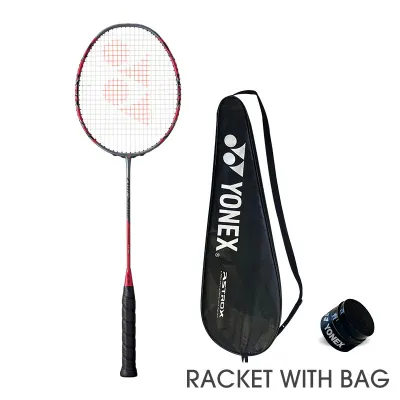
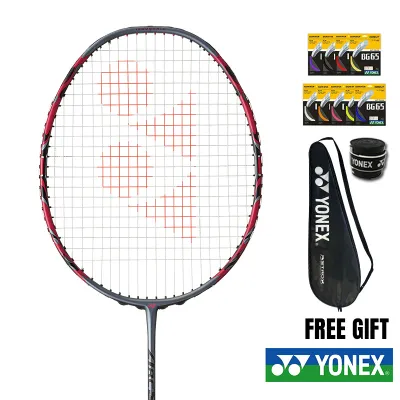
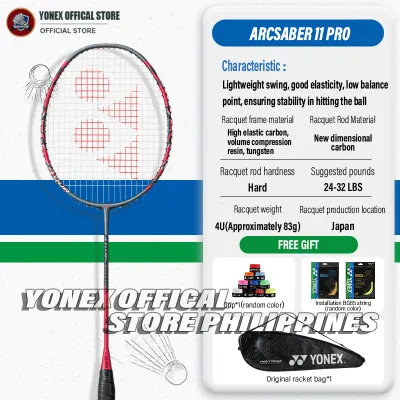
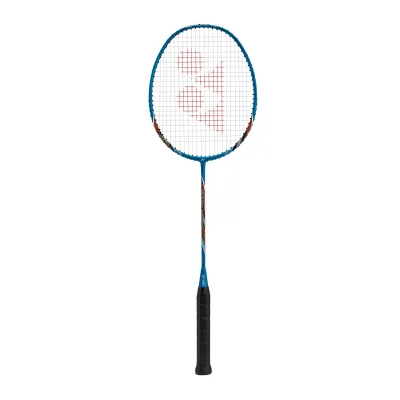
Prices are valid at publication and may change. Please refer to the product page for the latest price.
Conversely, players with highly specialized styles may find other configurations more beneficial. Pure backcourt hard-hitters who want to maximize smash power through head-heavy momentum might feel limited by the even balance of an Arcsaber. Similarly, frontcourt speed specialists who require ultra-fast racket handling for rapid interceptions at the net may prefer a head-light alternative. Understanding these distinctions ensures you do not force a control-oriented racket to perform a role it was not designed to play.
Matching Arcsaber Specifications to Your Skill Level
To find the right Arcsaber model, you must look beyond the marketing labels and analyze how weight and shaft flexibility interact with your physical capabilities. A racket functions as an extension of your arm; if the specifications do not match your swing mechanics, your timing, power, and control will suffer. Choosing the correct configuration is a balancing act between the physical effort you can generate and the structural feedback the racket provides.

As a general rule, players transition from flexible, lighter rackets to stiffer, heavier models as their technique matures. This progression ensures that you always have the right amount of structural support to match your developing swing speed and wrist strength, minimizing the risk of injury while maximizing your performance.
Beginner to Intermediate Players
For players who are still developing their basic strokes, footwork, and timing, maneuverability and ease of use are paramount. In tropical playing environments where high humidity can quickly lead to physical fatigue during long sessions, using a racket that is too heavy can strain the shoulder and wrist. Selecting a lighter weight category, such as a 4U (approximately 80 to 84 grams) or even a 5U (approximately 75 to 79 grams) model, allows for faster defensive reactions and helps maintain quick racket preparation throughout a match.
Shaft flexibility is another critical factor for this skill level. Beginners and intermediate players should look for rackets with flexible or medium-flex shafts. A more flexible shaft acts like a spring, bending easily during the swing and snapping back to generate power even if your technique is not yet perfect. This built-in assistance makes it much easier to clear the shuttle from baseline to baseline and helps maintain depth on defensive lifts without requiring excessive physical exertion.
When setting up a new racket, developing players must also pay close attention to string tension. While it can be tempting to request high tensions used by professionals, doing so reduces the sweet spot and requires precise hitting to generate any power. Beginners should stick to moderate tensions, typically between 18 and 22 lbs, which provides a helpful trampoline effect. Always verify the manufacturer’s recommended tension range printed on the racket frame to ensure you do not void the warranty or risk damaging the structure during stringing.
Advanced and Competitive Players
Advanced players who have developed consistent swing mechanics, rapid wrist snap, and strong physical conditioning require a very different set of specifications. At this level, the priority shifts from power assistance to absolute precision and stability. A heavier racket, typically in the 3U weight class (approximately 85 to 89 grams), provides the necessary mass to withstand high-speed shuttle impacts, offering greater stability during fast-paced flat exchanges and adding natural momentum to attacking shots.
To complement this weight, advanced players require a stiff or extra-stiff shaft. A stiff shaft does not bend easily during the swing, meaning there is virtually no delay between the player’s wrist movement and the racket head’s response. This immediate feedback is essential for executing deceptive shots, tight net spins, and precise placements where a fraction of a millimeter makes the difference between a winner and an error. Because the shaft does not assist in power generation, the player must rely entirely on their own technique and speed to generate force.
It is important to recognize that demanding specifications carry physical consequences. Operating a heavy, stiff racket requires excellent preparation, a proper warm-up, and targeted physical conditioning. Without correct technique, the shock of high-speed impacts is transferred directly to the player’s joints, which can lead to chronic injuries such as tennis elbow or shoulder strain. Advanced players must continuously monitor their physical comfort and adjust their equipment choices if they experience persistent joint fatigue.
Key Specifications to Verify Before Buying
Before purchasing any Arcsaber model from a local sports retailer or an online marketplace, you should systematically verify several key specifications to ensure the racket matches your physical needs and playing conditions.
- Weight Category (The U System): Racket weight is standardized using the "U" classification system, where a higher number denotes a lighter frame. A 3U racket (85–89g) offers stability and power but demands more physical strength. A 4U racket (80–84g) represents a highly versatile middle ground suitable for most intermediate players, while a 5U racket (75–79g) prioritizes speed and ease of handling.
- Grip Size (The G System): Grip sizes are indicated by a "G" followed by a number, with larger numbers representing smaller handle circumferences (such as G5 or G6). In warm, humid climates, players often sweat heavily, which can cause the racket to slip. Buying a smaller grip size, such as G5, is highly practical because it leaves ample room to customize the handle with absorbent polyurethane overgrips or towel grips without making the handle too bulky to hold securely.
- Balance Point Verification: While the Arcsaber series is generally classified as even-balanced, minor variations exist across different models. You can verify a racket's balance point by resting the shaft on your index finger; an even-balanced model will sit level, indicating that the weight is distributed equally between the head and the handle, providing a neutral feel during swings.
- Maximum String Tension Rating: Every racket frame has a maximum string tension limit specified by the manufacturer, usually printed on the shaft near the handle. Exceeding this limit is highly risky, as the immense pressure can cause the frame to warp or collapse entirely upon an off-center hit. Always ensure your desired string tension falls safely within the official limits of the specific model you choose.
Arcsaber vs. Other Yonex Series: Is It the Right Fit?
To confirm that an Arcsaber is truly the right choice for your game, it is helpful to contrast its characteristics with the other primary racket families offered by Yonex. Each series is engineered around a distinct performance philosophy, catering to different tactical priorities on the court.
| Racket Series | Balance Profile | Primary Performance Focus | Ideal Player Type |
|---|---|---|---|
| Arcsaber | Even Balance | Shuttle Control & Precision | Tactical rally builders, versatile all-rounders |
| Astrox | Head-Heavy | Power & Steep Attack | Backcourt smashers, aggressive offensive players |
| Nanoflare | Head-Light | Speed & Rapid Maneuverability | Frontcourt interceptors, defensive counter-attackers |
| Duora | Dual Optimum System | Forehand Power / Backhand Speed | Players seeking distinct face characteristics |
If you find that your defensive game is solid but you struggle to clear the shuttle when pushed deep into the corners, or if you want to dominate the game with heavy, downward smashes, transitioning to a head-heavy series like the Astrox may provide the power boost you need. On the other hand, if you play a fast-paced doubles game where quick reflex defense and rapid net drives dominate, a head-light series like the Nanoflare will offer the speed required to keep up with fast exchanges.
Ultimately, technical specifications on paper cannot fully replicate the physical sensation of swinging a racket on the court. Whenever possible, take advantage of local club demo programs, borrow different models from fellow players, or test rackets at dedicated sports centers before making a final decision. If purchasing online, always verify the return and exchange policies of the retailer to ensure you can exchange the racket if the physical weight or grip size does not feel right in your hand.
Frequently Asked Questions (FAQ)
How do I know if an Arcsaber racket is too stiff for me?
If a racket shaft is too stiff for your current swing speed, you will experience several distinct physical and performance indicators. On the court, you will likely struggle to hit deep clears to the opponent’s baseline, and your shots may feel unusually weak or hollow. Physically, a mismatched stiff shaft transfers the shock of impact directly into your arm rather than absorbing it, which often manifests as immediate vibration in the handle, rapid wrist fatigue, or persistent discomfort in your elbow and shoulder joints. If you notice these signs, you should switch to a model with a more flexible shaft or temporarily lower your string tension to increase the frame’s power assistance.
Can beginners use a 3U Arcsaber model?
Generally, beginners should avoid starting with a 3U Arcsaber model. The heavier weight of a 3U frame demands established wrist strength and proper swing mechanics to maneuver effectively. Beginners using a heavy racket often compensate for a lack of technique by using their entire arm to swing, which leads to slow reaction times, rapid fatigue, and a high risk of shoulder or rotator cuff injuries. However, a physically strong beginner with prior experience in other racket sports, such as tennis or squash, may be able to handle a 3U frame safely, provided they receive proper coaching to adapt their swing mechanics to badminton.
What string tension should I use for an Arcsaber racket?
Your ideal string tension depends on your skill level and the specific model’s structural limits. Beginners should start with a lower tension range of 18 to 22 lbs to maximize the sweet spot and gain easy power. Intermediate players typically perform best within a range of 22 to 25 lbs, which offers a balanced mix of control and power. Advanced players who can consistently hit the center of the racket head can opt for 26 lbs or higher to achieve maximum control and sharp shot feedback. Before instructing your stringer, always check the maximum tension limit printed on the racket shaft to prevent structural damage.
Community discussion
Share your experience or ask a question. Comments are reviewed before publication.