
Choosing the right pompoms for school cheerleading competitions in the Philippines requires looking beyond simple color matching. The ideal selection depends on specific athletic league guidelines, the venue’s lighting conditions, and the physical demands of the routine. In the local school sports scene—from high school intramurals to national cheerleading championships—the right equipment ensures that visual effects translate clearly to the judges’ table while keeping athletes safe during complex stunts.
Understand Competition and School Requirements
Before purchasing any gear, teams must consult the official rulebook of their specific athletic association or league. Many regional and national meets have strict regulations regarding the maximum diameter of the pompoms, often to ensure they do not obstruct the judges’ view of hand placements during stunts. Additionally, some school districts mandate specific color codes to maintain brand consistency, meaning teams must verify that the manufacturer’s dye lots match their official school colors.
Indoor gymnasiums, which host the majority of Philippine cheer dance competitions, present unique lighting challenges. Highly reflective metallic or holographic finishes can create intense glare under bright overhead lights, potentially distracting both the performers and the judges. Some leagues explicitly restrict or ban certain high-gloss finishes for safety reasons, making it essential to verify the venue rules before investing in a full set of metallic pompoms.
Products mentioned in this guide
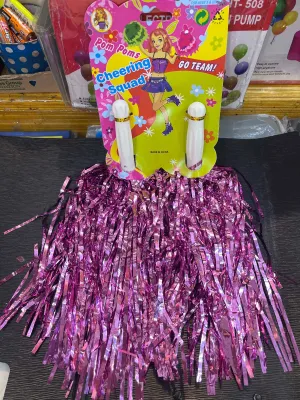
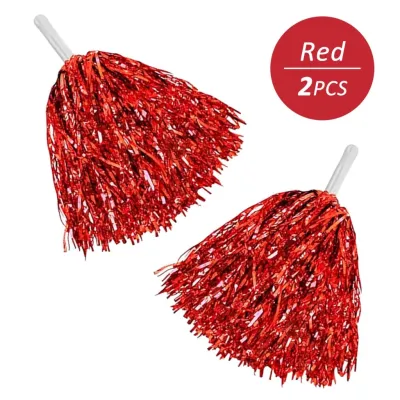
Prices are valid at publication and may change. Please refer to the product page for the latest price.
Safety regulations also extend to the physical construction of the equipment. If a routine features complex partner stunts, basket tosses, or tumbling passes where pompoms must be quickly discarded or held during transitions, certain handle styles or heavy materials may be prohibited. Checking these parameters early prevents costly disqualifications or last-minute equipment changes that can disrupt a team’s performance rhythm.
Compare Common Pompom Materials and Visual Effects
The choice of strand material directly influences how a routine’s choreography is perceived from the stands. Plastic and vinyl strands are highly favored for their crisp, distinct movements and excellent color saturation. These materials perform exceptionally well in outdoor venues or brightly lit covered courts, where they deliver sharp visual lines without creating distracting reflections. Vinyl, in particular, offers a matte or semi-gloss finish that provides a solid block of color, making synchronized arm motions look incredibly uniform.

Metallic and holographic finishes, on the other hand, are designed to catch and play with light. Under the controlled lighting of an indoor stage or coliseum, metallic strands create a shimmering effect that adds excitement and energy to high-tempo dance segments. However, teams must balance this visual appeal with practical visibility; in extremely bright or poorly diffused gym lighting, a solid mass of metallic reflection can blur the clean lines of a formation, making it harder for judges to evaluate precision.
The physical profile of the strands—whether straight or curled—also changes the visual dynamic. Straight strands are the traditional choice, offering a classic look that emphasizes the direction of movement and creates a clean motion blur during rapid arm transitions. Curled strands, often referred to as target or pom-style, provide maximum volume and a rounder shape with fewer strands. Curled options are excellent for creating a full, dense look that remains buoyant even in high-humidity environments, though they may slightly soften the perceived sharpness of fast choreography.
Evaluate Size, Handle Type, and Ergonomics
Selecting the correct pompom size is a matter of balancing visual impact with the physical capabilities of the athletes. Pompoms typically range in diameter from 4 inches to over 10 inches. For younger school divisions or elementary squads, smaller diameters are necessary to prevent the equipment from overwhelming the performer’s frame and hindering arm movements. High school and college teams generally opt for mid-to-large sizes that maximize visual presence across large coliseums, provided the athletes have the strength to control them.
Handle design is critical for ergonomics and routine execution. Traditional baton handles, which feature a solid bar hidden inside the center of the pompom, allow for a secure, centered grip that is ideal for rapid rotations and traditional dance steps. For routines that require quick transitions, such as switching from dancing to building a pyramid, ring handles or wrist straps can be highly beneficial. Ring handles allow performers to slip fingers through for a quick hold, while wrist straps keep the pompoms attached to the arms during stunts, eliminating the risk of dropped equipment on the performance floor.
The overall weight of the equipment is an often-overlooked factor that can lead to premature fatigue. During multi-day training camps and long competition days, heavy pompoms place significant strain on the wrists, shoulders, and forearms. Teams should look for lightweight construction that does not sacrifice strand density. Testing a sample pair during a full-length practice run helps verify if the weight and grip style are suitable for the team’s specific choreography and endurance levels.
Factor in Durability, Storage, and Team Budget
In the tropical climate of the Philippines, high humidity and heat can take a toll on synthetic materials. Pompoms must be durable enough to withstand sweat, moisture, and frequent packing. Reviewing the manufacturer’s care instructions is essential; some materials can be gently wiped down with a damp cloth, while others require specific dry-cleaning methods to prevent the colors from bleeding or the strands from losing their shape.
Proper storage is key to extending the lifespan of the equipment across multiple school years. Storing pompoms in cramped, airtight plastic containers can trap moisture, leading to mold growth and permanently creased strands. Instead, teams should utilize breathable mesh bags or dedicated gear bags that allow air circulation while keeping the pompoms upright and uncompressed. This practice prevents the strands from tangling and preserves the natural fluffiness of the material.
Budgeting for school sports equipment requires a careful balance of upfront costs and long-term value. Prices can vary significantly depending on the material, size, and customization options. When calculating the total investment in Philippine Pesos (₱), teams must account for the cost per pair multiplied by the number of active members, plus a few spare sets for emergencies. While basic plastic options are generally more budget-friendly, investing in high-quality vinyl or reinforced metallic pompoms can save money over time by reducing the need for frequent replacements.
Frequently Asked Questions (FAQ)
How do you restore crushed pompom strands after storage?
To restore crushed or flattened strands, start by gently shaking the pompoms out to separate the individual fibers. You can manually fluff them by running your fingers through the strands from the handle outward, rotating the pompom as you go. Avoid using high-heat sources like hair dryers or irons, as extreme heat can melt or permanently warp plastic, vinyl, and metallic materials. If the manufacturer’s care label permits, a very light mist of room-temperature water followed by air-drying in a well-ventilated area can help the strands regain their natural volume.
Can the same pompoms be used for both indoor and outdoor competitions?
While it is possible to use one set of pompoms for both settings, teams must consider how environmental factors affect performance. Outdoors, wind can easily catch lightweight strands, making them harder to control and potentially disrupting the visual uniformity of the routine. Additionally, direct sunlight can cause certain colors to fade over time. Indoors, the primary concern is how the venue’s artificial lighting interacts with the material. If your budget allows, having a durable, matte-finish set for outdoor rallies and a high-visibility, glare-compliant set for indoor arena competitions is often the most practical approach.

Community discussion
Share your experience or ask a question. Comments are reviewed before publication.