
Starting Taekwondo is an exciting journey, but practicing your kicks at home or in the dojang requires the right target to build accuracy, power, and proper form. For most beginners, the ideal first purchase is a double-leaf kicking paddle or a medium-sized rectangular strike pad. These designs offer a forgiving target area, help you develop the signature snapping sound of a clean Taekwondo kick, and protect both your feet and your training partner’s hands from unnecessary strain. Choosing the right pad depends on whether you are practicing high-speed precision kicks or heavier power strikes with a partner.
To get the most out of your training, you must select gear that matches your current skill level and physical conditioning. A pad that is too heavy will quickly exhaust your training partner, while a pad that is too thin or soft can lead to painful joint injuries for both of you. By understanding the key features, types, and maintenance requirements of Taekwondo kick pads, you can make an informed investment that keeps your training safe, productive, and enjoyable.
Key Features to Look for in a Beginner Taekwondo Kick Pad
When shopping for your first kick pad, the internal construction is just as important as the outer appearance. The primary job of a kick pad is to absorb and disperse the kinetic energy generated by your kicks. For beginners, whose kicking technique and control are still developing, high-quality shock absorption is critical. Look for pads that utilize multi-layered foam systems, which typically combine high-density EVA foam on the outer layers to disperse the initial impact, and softer open-cell foam on the inside to cushion the blow. This layered approach prevents the pad from “bottoming out,” a dangerous situation where the force of the kick travels completely through the pad and impacts the holder’s arm or body.
Products mentioned in this guide
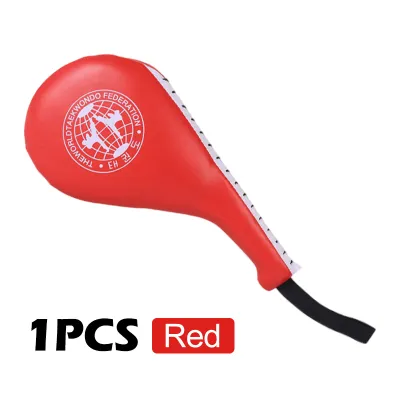
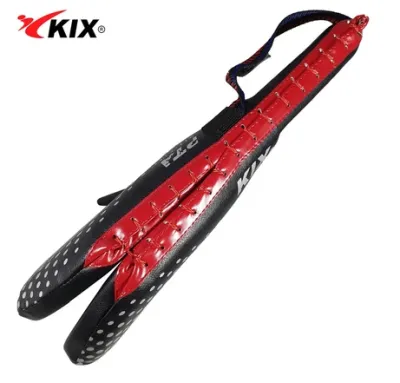
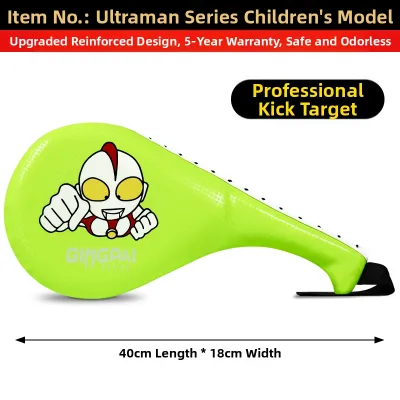
Prices are valid at publication and may change. Please refer to the product page for the latest price.
The way the pad attaches to or is held by your training partner directly affects safety and stability. For larger strike pads and shields, look for robust strap configurations that feature a solid, riveted handle alongside adjustable forearm straps. Dual-grip handles allow the holder to use both hands for heavy impact, while wide Velcro forearm straps distribute the twisting force of a kick across the entire arm rather than concentrating it on the wrist. If you are choosing a kicking paddle, ensure the handle has an ergonomic grip and a secure wrist loop. This loop prevents the paddle from flying out of the holder’s hand during high-velocity training sessions, protecting nearby objects and people.
The outer material of the kick pad must withstand constant friction, sweat, and environmental moisture. High-grade polyurethane (PU) leather or heavy-duty vinyl are the standard choices for beginner gear. These synthetic materials offer excellent resistance to tearing and abrasion from bare feet, toenails, and light martial arts shoes. In tropical climates where humidity is high, synthetic covers are also much easier to clean and dry than genuine leather, which can absorb moisture and rot if not meticulously maintained. Look for reinforced, double-stitched seams, especially around the handles and stress points, as these are the areas most prone to splitting under repeated impact.
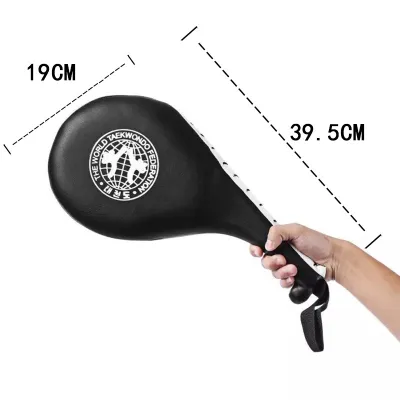
Finally, consider the physical weight and dimensions of the pad. A common mistake among beginners is buying the largest, heaviest pad available, believing it offers the best protection. However, an excessively heavy pad will quickly fatigue the holder’s shoulders and neck, leading to poor holding posture and an increased risk of injury. The pad should be large enough to provide a safe target area for your current level of accuracy, yet light enough for the holder to quickly reposition it for different heights and angles. For most adult beginners, a medium-sized pad measuring roughly 40 centimeters in length and 20 centimeters in width strikes the perfect balance between target size and maneuverability.
Common Types of Kick Pads and Their Training Roles
Taekwondo utilizes a wide variety of kicks, ranging from straight thrusts to spinning hook kicks. Because different kicks deliver force in different directions, manufacturers design distinct types of pads to accommodate these variations. Understanding these categories helps you choose the tool that matches your specific training goals.

Rectangular Strike Pads
Rectangular strike pads, often referred to as kick shields, are the workhorses of martial arts training. These pads are typically thick, flat, and filled with dense foam, making them ideal for practicing basic power kicks such as the front kick (ap chagi) and the side kick (yop chagi). Because they offer a large, flat surface area, they are highly forgiving for beginners who are still mastering their distance and alignment. The thickness of these pads, usually ranging from 8 to 12 centimeters, provides maximum protection for the holder, allowing you to practice full-force strikes without worrying about injuring your training partner.
Curved Thai Pads
Originally designed for Muay Thai, curved pads have become highly popular in Taekwondo dojangs for training angled strikes like the roundhouse kick (dollyo chagi). The slight vertical curve of the pad naturally cradles the instep or shin upon impact, reducing the likelihood of the foot slipping off the edge and causing an awkward ankle twist. However, holding curved Thai pads requires a fair amount of upper body strength and proper technique, as they are typically worn as a pair on the holder’s forearms. For beginners training with family members or non-martial artist partners at home, these might require a learning curve to hold safely.
Round Shield Pads (Clamshields)
Round shield pads, or clamshields, are large, circular targets featuring multiple handles on the back and sides. These are exceptionally versatile tools for dynamic, moving drills and rapid combination kicks. The circular shape allows the holder to easily present the target at various angles, simulating a moving opponent. Because the holder can grip the pad with both hands and press it against their chest or torso, round shields can absorb incredibly heavy impacts. This makes them an excellent choice for teenagers and adults who want to transition from technical practice to high-intensity power training.
Paddle/Kicking Paddles
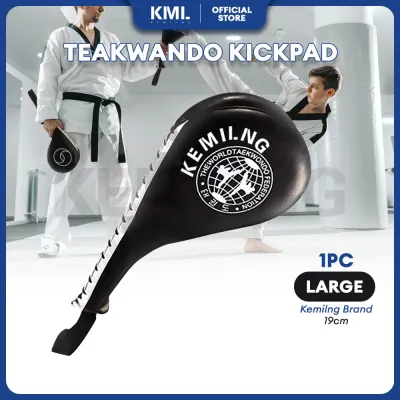
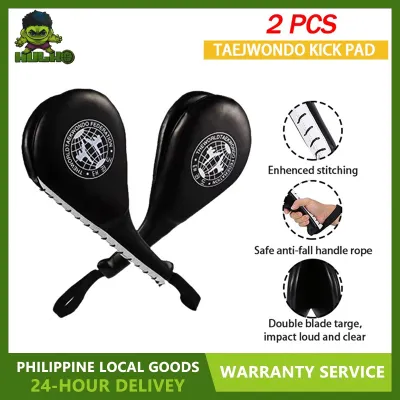
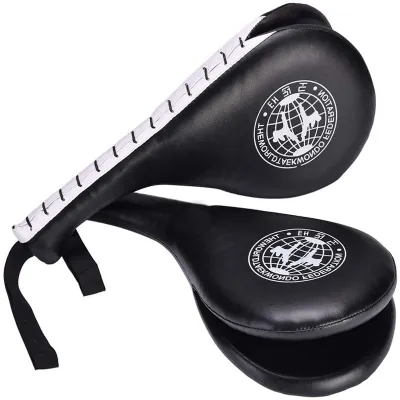
Kicking paddles are the quintessential Taekwondo training tool. Available in single-leaf or double-leaf designs, these lightweight targets are held by a long handle and are designed specifically for speed, precision, and high-reaching kicks. When you strike a double-leaf paddle with correct technique and speed, the two halves slap together to produce a loud, satisfying cracking sound. This auditory feedback is invaluable for beginners, as it immediately tells you if your foot connected at the correct flat angle. Paddles are not designed to absorb heavy, pushing power; instead, they teach you to snap your kicks and recover your leg quickly.
How to Match the Right Pad to Your Training Setup
Selecting the perfect kick pad requires looking beyond the product specifications and evaluating your actual training environment. The first step is to assess who will be holding the pad for you. If your primary training partner is a younger sibling, a child, or someone with a smaller build, a heavy Thai pad or a large round shield is impractical. In this scenario, a lightweight kicking paddle or a small rectangular pad is the safest choice, as it will not strain the holder’s joints. Conversely, if you are training with a larger, stronger partner, you will need a thicker, denser shield that can handle your growing kicking power without transferring the shock to their body.
Your physical training space also dictates the type of gear you should buy. If you are practicing in a spacious home garage, an outdoor carport, or a local barangay sports complex, you have the freedom to use larger pads that require dynamic footwork and movement. However, if your training is confined to a small living room with tiled floors and nearby furniture, large shields might encourage wilder kicks that risk accidents. In tight spaces, compact kicking paddles or focus mitts are much safer, as they encourage controlled, precise movements rather than wide, sweeping power kicks. Additionally, consider storage; synthetic pads must be stored in well-ventilated areas to prevent mold, so ensure you have a dry closet or shelf space available.
Before making a purchase from an online sports retailer, it is wise to run through a quick verification checklist to ensure you are getting a genuine, high-quality product. Always verify the manufacturer’s listed dimensions and weight rather than relying solely on product photos, which can sometimes be misleading. Check the retailer’s return policy to ensure you can exchange the pad if you receive it and find the foam is too stiff or the straps do not fit your partner’s arms. Look for clear indications of reinforced stitching and heavy-duty zipper closures, which allow you to inspect or eventually replace the internal foam if it degrades over years of use.
Budget is another practical factor to weigh, especially for beginners who are still testing their long-term commitment to the sport. In the Philippines, entry-level kicking paddles typically range from ₱300 to ₱800, making them an affordable starting point for speed and accuracy drills. Mid-range rectangular strike pads and single round shields generally cost between ₱1,200 and ₱2,500, offering a great balance of durability and shock absorption for home practice. High-end, professional-grade Thai pads can exceed ₱3,500. For most beginners, starting with a mid-range rectangular pad or a double-leaf paddle provides the best value, ensuring safety without requiring a massive upfront financial investment.
Safety Checks and Maintenance for Training Gear
To protect yourself and your training partner from injury, you must establish a routine of inspecting your gear before every training session. Over time, the constant impact of kicks will cause the internal foam of any pad to break down. Perform a quick visual and physical check before you start: squeeze the pad to ensure the foam still feels resilient and springs back into shape immediately. Check the seams for any signs of unraveling threads, particularly around the handles and straps, as a sudden strap failure mid-kick can cause the pad to fly off and lead to severe joint hyperextension for the holder.
Knowing when to stop using a pad is a critical safety skill. You must establish clear stopping conditions during your workouts. If the pad holder begins to feel sharp pain in their wrists, elbows, or shoulders, stop the drill immediately to assess their holding technique and the state of the pad. Furthermore, if you notice that your kicks are “bottoming out”—meaning you can feel the hard structure of your partner’s arm or body through the pad—the internal foam has collapsed. Continuing to use a worn-out pad exposes both the kicker’s foot and the holder’s joints to dangerous, unmitigated impact forces.
Proper maintenance is essential for extending the lifespan of your training gear, especially in hot, humid tropical environments. Sweat is highly acidic and, if left on synthetic leather, will eventually cause the material to crack, peel, and develop unpleasant odors. After every training session, wipe down the entire surface of the pad using a damp cloth with a mild, diluted soapy solution or manufacturer-approved disinfectant wipes. Avoid using harsh chemical bleach or alcohol-based cleaners, as these strip the protective oils from synthetic covers, leading to premature cracking.
Once cleaned, the way you store your pads determines how long they will last. Never throw damp pads directly into a closed gym bag or a dark, unventilated closet, as this creates a breeding ground for bacteria and mold. Instead, allow the pads to air-dry completely in a cool, shaded indoor area with good air circulation. Keep them away from direct sunlight, as prolonged exposure to ultraviolet rays will warp the internal foam and dry out the outer synthetic leather. By taking a few minutes to clean and store your gear properly after each session, you ensure your kick pads remain hygienic, safe, and ready for your next training day.
Frequently Asked Questions (FAQ)
Can a beginner use the same kick pad for both hands and feet?
While some multi-purpose pads exist, beginners should generally avoid using the same pad for both hand strikes and heavy kicks. Taekwondo kicks deliver significantly more kinetic energy than hand strikes, requiring much thicker, denser foam to protect the holder. If you attempt to punch a dense, heavy kick shield, the lack of give can easily strain your wrist joints or bruise your knuckles. Conversely, thin focus mitts designed for punching do not have enough shock absorption to safely handle the impact of a full-force roundhouse kick, putting the holder’s hands and wrists at serious risk of injury. Always check the manufacturer’s guidelines to see if a pad is rated for both hand and foot strikes.
How thick should a taekwondo kick pad be for a child beginner?
For a child beginner, a kick pad does not need to be as thick as one used for adults, but it must be lightweight. A thickness of 5 to 8 centimeters is generally sufficient to absorb the impact of a child’s kick while keeping the pad light enough for an adult or an older sibling to hold without fatigue. The primary challenge when training children is target accuracy rather than raw power, so a slightly wider but thinner pad is often more beneficial than a thick, heavy shield. Always verify the age and weight recommendations on the product label to ensure the pad’s size and weight are appropriate for your child’s developmental stage.
Do I need to wear shoes when kicking a training pad?
In traditional Taekwondo, training is almost always performed barefoot to develop proper foot alignment, ankle strength, and sensory feedback. Kick pads are designed with smooth synthetic covers specifically to prevent skin abrasions on bare feet. However, if you are training in a cold environment, on rough outdoor surfaces, or have minor foot injuries, you may wear specialized, soft-soled martial arts shoes or foot guards. If you choose to wear footwear, ensure they are designed specifically for indoor martial arts; never wear dirty outdoor street shoes on a training pad, as the hard soles and trapped dirt will quickly tear the synthetic cover and introduce hygiene risks to your training space.

Community discussion
Share your experience or ask a question. Comments are reviewed before publication.