
To choose the right badminton racket for your daughter, you need to match the racket’s length to her height, select a lightweight frame to protect her developing wrists, and ensure the grip size allows her fingers to hold the handle comfortably without straining. Getting these specifications right prevents early fatigue and helps her develop proper swing mechanics from her very first session on the court.
Decoding Racket Length: Matching Height and Age
Junior rackets are specifically engineered to match the shorter arm span and lower strength of young players. Standard adult rackets measure around 665 to 675 millimeters in length, which can be incredibly unwieldy for a child. Junior models are typically shorter, often categorized by age brackets such as under 6 years, 6 to 9 years, and 10 to 12 years.
When shopping, look for manufacturer height-to-racket-length guidelines. In the tropical climate of the Philippines, where indoor and outdoor courts can get quite warm and humid, physical fatigue sets in quickly. A racket that is too long or heavy will accelerate this fatigue and make the game frustrating.
Products mentioned in this guide
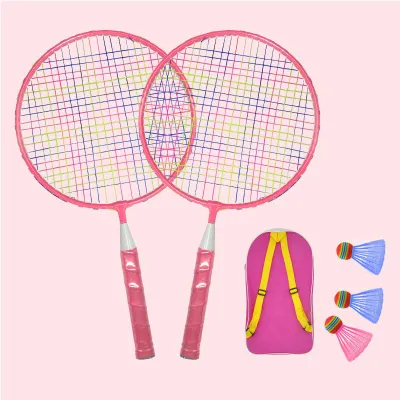
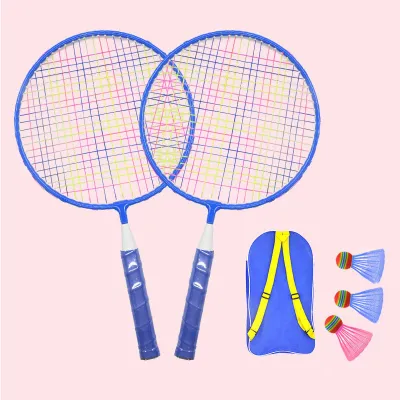
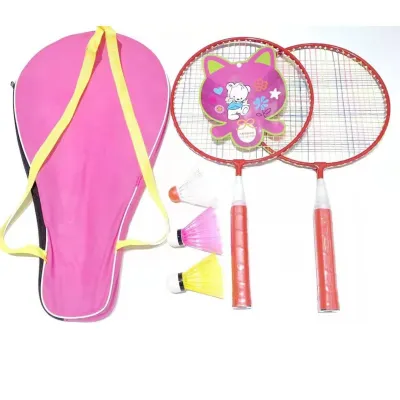
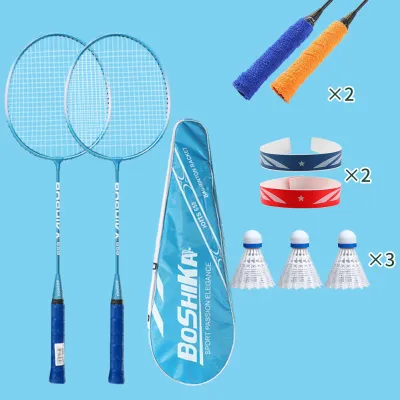
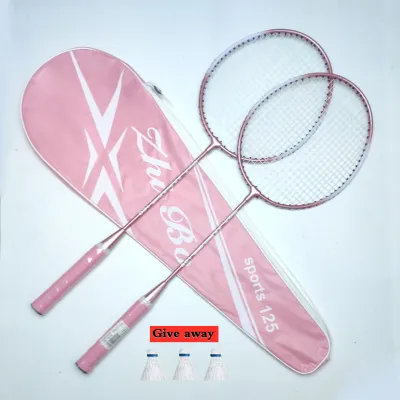
Prices are valid at publication and may change. Please refer to the product page for the latest price.
A racket that is too long will frequently strike the floor during low hits, damaging the frame and jarring your daughter’s wrist. It also forces her to swing with an awkward, straight-armed motion to avoid hitting the ground, which prevents her from learning proper wrist snap. On the other hand, a racket that is too short will severely limit her reach, forcing her to run excessively and adopt a hunched posture that can lead to early back discomfort.
Understanding Weight Ratings and Balance
Racket weight is standardized globally using the ‘U’ rating system. A standard adult racket often falls into the 3U (85-89 grams) or 4U (80-84 grams) range. For young girls and beginners, these weights can feel surprisingly heavy after just ten minutes of continuous play.

Instead, look for rackets in the 5U (75-79 grams) or even lighter categories. A lighter frame allows your daughter to focus on clean contact and proper swing paths without her arm muscles tiring out. This helps build correct technique before she eventually transitions to heavier, power-oriented frames as she grows stronger.
Additionally, pay attention to the balance point. Head-heavy rackets have more mass concentrated at the top of the frame to help smash the shuttlecock with more power. However, this design requires significant wrist strength to control. For a young player, a head-light or even-balance racket is highly recommended. It feels much lighter during quick defensive movements and minimizes the risk of repetitive strain injuries in her wrist and elbow.
Finding the Correct Grip Size for Small Hands
Grip size is another critical factor that is often overlooked. In the standard sizing system, grip sizes are marked with a ‘G’ followed by a number, such as G4, G5, or G6. Counterintuitively, the larger the number, the smaller the grip circumference. For children and young girls with smaller hands, a G5 or G6 grip is the most appropriate starting point.
You can easily test the grip size at home. Have your daughter hold the racket handle using a basic forehand grip. Look at the space between her fingertips and the palm of her hand. There should be a comfortable gap roughly equivalent to the width of her index finger. If her fingertips press deeply into her palm, the grip is too small, which can cause her to over-tighten her hand and develop blisters. If the gap is wider than her finger, the grip is too thick, making it difficult to maneuver the racket.
In tropical climates, humidity causes hands to sweat rapidly, which can make a standard synthetic grip slippery. To counter this, you can wrap a thin, absorbent overgrip over the handle. This not only improves her hold but also allows you to slightly increase the handle thickness if her hands grow.
Simplifying the Specs: What You Can Ignore for Now
When browsing sports stores or online marketplaces, you will see a barrage of technical jargon, from high-modulus carbon fiber frames to specific string tensions measured in pounds. For a young girl starting out, you can safely ignore these advanced specifications.
High string tension (above 22 lbs) reduces the sweet spot of the racket and requires excellent technique and physical power to generate depth on shots. If a beginner plays with high tension, they risk injuring their shoulder. A moderate tension of 18 to 20 lbs is ideal because it provides a ‘trampoline effect’ that helps push the shuttlecock further with less effort.
Similarly, stiff shafts are designed for advanced players who have fast swing speeds. A flexible shaft is much more forgiving for a child, as it bends and whips during the swing to generate natural power. Focus on finding a durable, pre-strung racket made of aluminum or a lightweight carbon composite. Pre-strung rackets save you the hassle of buying separate strings and finding a local shop to string the frame, allowing your daughter to head straight to the court.
Frequently Asked Questions (FAQ)
Should I buy a full-size racket if she is almost a teenager?
If your daughter is around 11 or 12 years old and is relatively tall, she might be ready to transition to a full-size racket. However, do not make this decision based solely on her age. Assess her physical strength and arm span first. If she struggles to swing a standard-length racket without dropping her wrist, she is not ready. If you do decide to move her to a full-size racket, choose an ultra-lightweight model (such as a 5U or 6U) with a head-light balance. This combination provides the extra reach of an adult racket without the heavy physical toll on her developing joints.
How often should I upgrade her racket as she grows?
Racket upgrades should be driven by physical growth transitions and skill progression rather than a calendar schedule. Keep an eye out for clear physical signs: if her fingers are wrapping completely around the handle with no gap, she has outgrown the grip. If she is consistently hitting the shuttlecock with the frame instead of the strings, or if she complains of wrist discomfort after playing, the racket length or weight may no longer suit her body. Generally, a junior racket will last one to two years before a growing child requires a larger size or a transition to an intermediate frame.

Community discussion
Share your experience or ask a question. Comments are reviewed before publication.