
Choosing the right football depends heavily on the surface you play on. In the Philippines, where a sudden tropical downpour can turn a natural grass pitch into a muddy field, or where players frequently gather on polished indoor wooden courts and concrete barangay multi-purpose spaces, selecting the correct ball is essential. A ball designed for outdoor grass will behave unpredictably on a hard futsal court, while a low-bounce futsal ball will feel heavy and sluggish on a wide-open grass field. Decathlon offers a range of balls tailored to these distinct environments, and understanding how to read their specifications ensures you get the best performance and durability for your matches.
Understanding Surface Requirements: Futsal vs. Outdoor Grass
Futsal and traditional outdoor football are played on vastly different surfaces, each requiring specific ball characteristics to ensure proper playability and safety. Indoor futsal courts, typically made of polished wood, synthetic material, or smooth concrete, offer high traction but zero shock absorption. Because the playing area is tight and fast-paced, a standard outdoor football will bounce excessively, making close-control dribbling, quick passing, and ball reception incredibly difficult. Futsal balls are specifically engineered with low-bounce properties to keep the ball close to the ground, allowing players to execute rapid, short-range plays.
Outdoor grass pitches, whether natural or artificial turf, present a different set of challenges. Natural grass absorbs a significant amount of impact energy, meaning a ball needs a standard, lively rebound to travel effectively across long distances. Furthermore, outdoor fields are highly susceptible to weather changes. In the tropical climate of the Philippines, high humidity and sudden heavy rains can quickly saturate a field. An outdoor ball must resist water absorption to prevent it from becoming waterlogged, heavy, and difficult to kick, which can also strain a player’s joints over time.
Products mentioned in this guide
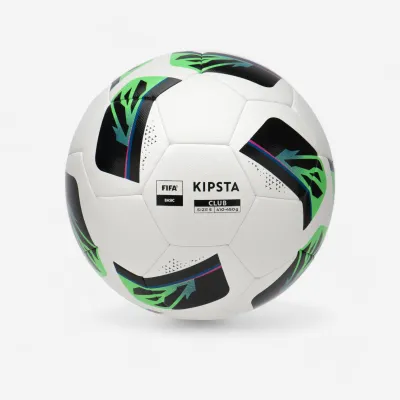
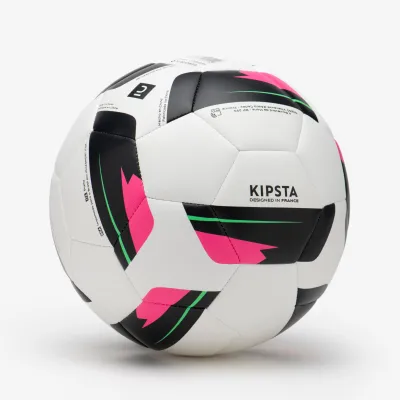
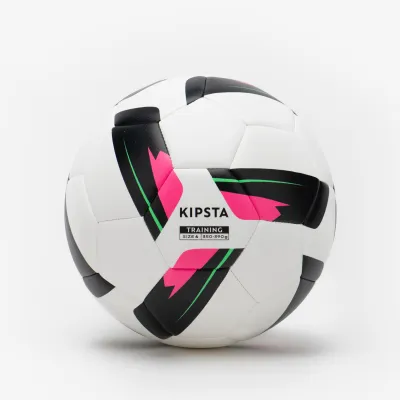
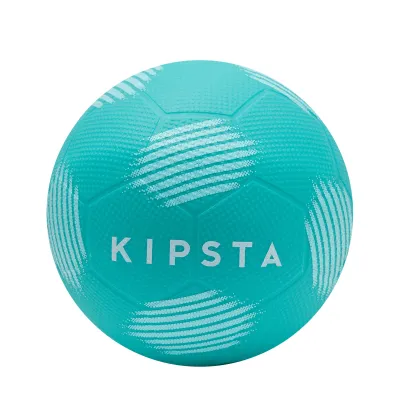
Prices are valid at publication and may change. Please refer to the product page for the latest price.
Abrasion resistance is another critical factor when comparing these surfaces. Hard indoor courts and concrete outdoor spaces exert intense friction on the ball’s outer casing. Without a durable, abrasion-resistant outer layer, a ball will quickly scuff, peel, or lose its grip. Outdoor grass is gentler on the casing but often hides small stones, twigs, or rough patches of soil that can puncture or tear low-grade materials. Matching the ball’s construction to the surface ensures that the outer shell can withstand these specific environmental demands without premature wear.
Key Features to Check on a Decathlon Ball Label
When browsing a Decathlon store or their online platform, checking the product specifications and physical labels is the most reliable way to verify a ball’s suitability. The outer material is the first line of defense against wear and tear. Most entry-level balls use Polyvinyl Chloride (PVC), which is highly durable and resistant to scuffs on rough surfaces like concrete, though it can feel stiff in cooler temperatures. Polyurethane (PU) is found on mid-to-high-range balls, offering a much softer touch, better elasticity, and superior control, making it the preferred choice for regular players who prioritize feel. Rubber-cased balls are also available, specifically built for maximum durability on highly abrasive concrete or asphalt courts.

The internal bladder construction determines how well the ball retains air and how it feels upon impact. Decathlon balls typically feature either butyl or latex bladders. Butyl bladders are excellent at retaining air pressure over long periods, reducing the need for frequent reinflation, which is highly convenient for casual players. Latex bladders, often preferred in match-grade balls, offer a more responsive bounce and a softer feel, but they tend to lose air pressure gradually and require regular pumping before each session.
To make selection straightforward, look for explicit manufacturer tags and designations on the ball’s casing or packaging. Decathlon categorizes its football gear under specific sub-brands, often labeling futsal-specific models clearly with “Futsal” or “Indoor” text, alongside a distinct size indicator. Outdoor models are typically marked for “Football” or “Grass/Turf.” Checking these labels prevents the mistake of purchasing a high-rebound outdoor ball for a restricted indoor space.
Matching the Ball to Your Specific Playing Environment
Selecting the right ball requires analyzing where you play most of your matches. For indoor futsal courts, your primary focus should be on low-rebound models. These balls are filled with a specific foam or fiber material inside the bladder to dampen the bounce. Additionally, ensure the ball is rated as non-marking to avoid leaving dark scuff marks on polished indoor court surfaces, which court administrators strictly prohibit.
If your matches take place on natural grass fields, look for balls that emphasize aerodynamic stability and water resistance. Thermobonded or hybrid-stitched balls are excellent for wet conditions, as their seams are sealed to prevent water from seeping into the inner layers. A standard-bounce ball is necessary here to ensure that long passes and crosses loft properly over the grass without dying mid-flight.
For artificial turf and concrete barangay courts, abrasion resistance is the absolute priority. Artificial turf fibers and hard concrete act like sandpaper on a ball’s casing. Look for models with reinforced machine stitching or hybrid construction, which tucks the seams inward to protect them from direct friction. A thicker PU or specialized rubber outer layer will prolong the ball’s lifespan significantly under these harsh conditions.
Your skill level and playing frequency should also guide your budget. Casual weekend players who meet once a week can comfortably rely on basic machine-stitched models that offer decent durability at an affordable price point. However, if you train multiple times a week or participate in competitive local leagues, investing in a hybrid or thermobonded match ball is highly recommended. These models offer consistent sphericity, predictable flight paths, and robust seam construction that can handle high-velocity impacts day after day.
Maintenance and Care for Longevity
To maximize the lifespan of your Decathlon ball, establishing a proper maintenance routine is essential. Correct inflation is the most critical step. Always check the recommended pressure range, which is typically printed directly around the valve in bar or psi. Using a reliable pressure gauge ensures you do not over-inflate the ball, which can stretch the seams and distort its shape, or under-inflate it, which ruins the bounce and increases the risk of punctures. Moisten the inflation needle with a bit of water or glycerin before inserting it to protect the valve from tearing.
After playing on muddy grass or dusty indoor courts, take a few minutes to clean the ball. Wipe down the outer casing with a damp, soft cloth to remove dirt, mud, and sweat. Avoid using harsh chemical detergents, solvents, or abrasive brushes, as these can strip away the protective outer coatings, degrade the PU or PVC material, and weaken the stitched seams. For stubborn dirt, a mild soap solution is sufficient.
Storage conditions play a massive role in preventing material degradation. Always store your ball in a cool, dry place away from direct sunlight and extreme heat, such as the trunk of a car parked under the Philippine sun. High temperatures can dry out the bladder, cause the outer panels to warp or peel, and weaken the adhesives used in hybrid and thermobonded balls. Keeping the ball in a dedicated mesh gear bag in a well-ventilated room will preserve its structural integrity for many matches to come.
Frequently Asked Questions (FAQ)
Can I use an outdoor grass football on an indoor futsal court?
Using a standard outdoor grass football on an indoor futsal court is not recommended due to safety and performance issues. Outdoor balls have a high rebound, which causes them to bounce uncontrollably on hard indoor surfaces, making fast, ground-based passing difficult. This unpredictable bounce increases the risk of players overreaching or colliding, which can lead to ankle sprains or joint injuries. Additionally, the intense friction of a hard court will rapidly wear down the outer casing of an outdoor ball, leading to scuffs and premature peeling.
What size Decathlon ball should adults use for futsal and outdoor play?
Adult players should use different ball sizes depending on the sport. For standard outdoor grass or artificial turf football, adults and players aged 13 and older should use a Size 5 ball, which typically has a circumference of 68 to 70 centimeters. For futsal, adults must use a Size 4 ball. Although a futsal ball is smaller, it is specifically engineered to be heavier than a standard Size 4 outdoor ball, typically weighing between 400 and 440 grams, to help maintain its low-bounce characteristics on hard courts.

Community discussion
Share your experience or ask a question. Comments are reviewed before publication.