
Using a carabiner multi-tool safely while climbing requires one absolute rule: treat it strictly as an accessory, never as life-support equipment. While these versatile tools are highly convenient for tightening gear, adjusting camera plates, or clipping light items at the crag, they are not engineered to hold human weight or absorb the forces of a fall. Misusing an accessory-grade tool in a safety-critical system can lead to catastrophic equipment failure.
Climbing in tropical environments, such as the humid crags of Cantabaco or the coastal cliffs of the Philippines, introduces unique environmental challenges. High humidity, salt air, and sweat can quickly degrade non-climbing-rated metals and stiffen the small hinges of a multi-tool. Understanding the limits of your gear, maintaining it against moisture, and keeping it physically isolated from your life-support system are essential practices for every climber.
Understand the Difference: Climbing-Rated vs. Accessory Carabiners
Before you pack any gear for a day on the rock, you must verify its structural rating. True climbing carabiners are highly regulated safety devices engineered to withstand immense dynamic forces. In contrast, a carabiner multi-tool is typically designed as a lifestyle or utility accessory, prioritizing tool integration over raw structural strength.
Products mentioned in this guide
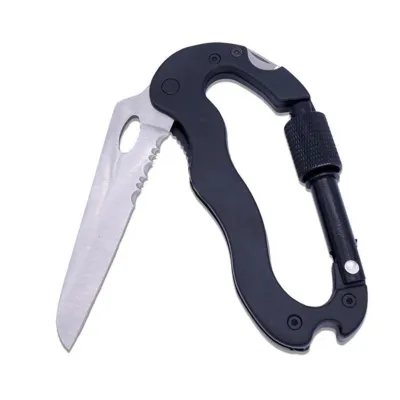
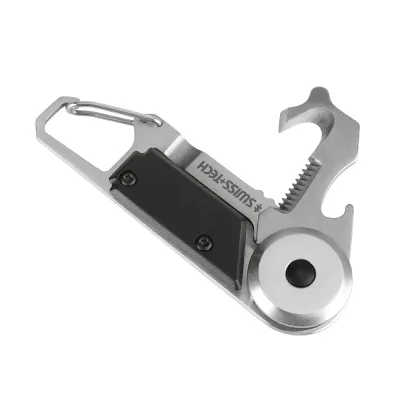
![【FURONGHUA】[Soccerhouse] Multifunction Carabiner Screwdriver Bottle Opener D-Ring Keychain Clip Hook Mountaineering Climbing Buckle](https://img.lazcdn.com/g/p/ba11b05ecce57caa7a4e039dfae6bd58.jpg_400x400q80.jpg_.webp)
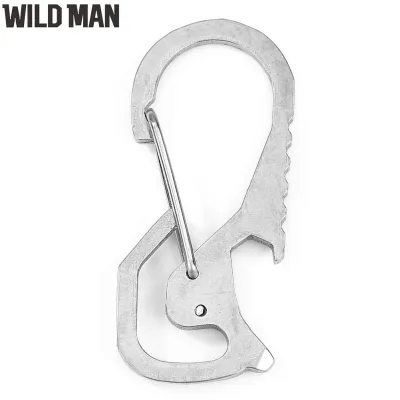
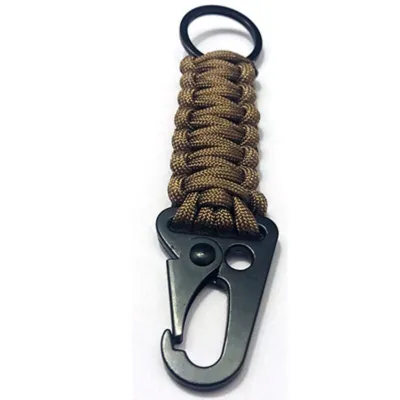
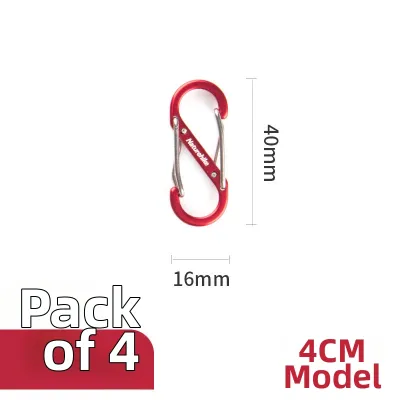
Prices are valid at publication and may change. Please refer to the product page for the latest price.
To determine if your tool is safe for climbing systems, inspect the spine of the carabiner for official certification markings. Look for stamps indicating compliance with the European Committee for Standardization (CE) or the International Climbing and Mountaineering Federation (UIAA). These markings are usually accompanied by specific load ratings measured in kilonewtons (kN), such as 20 kN or higher for major-axis strength.
Most carabiner multi-tools completely lack these certifications and load stamps. Instead of high-strength aluminum or specialized steel alloys optimized for impact absorption, accessory tools are often constructed from heavier, more brittle cast metals or thin stainless steel sheets. These materials are perfectly adequate for holding keys or turning screws, but they can snap instantly under the dynamic load of a falling climber.
Always read the manufacturer’s packaging, warning labels, and instruction sheets before bringing a new multi-tool to the crag. Many manufacturers explicitly print “Not for Climbing” or “Not for Human Weight” on the body of the tool itself. If a tool lacks clear, certified load specifications from a reputable climbing manufacturer, you must assume its load capacity is minimal and treat it strictly as a non-safety accessory.
Proper Attachment Methods for Gear and Accessories
When used correctly, a carabiner multi-tool is an excellent companion for approach hikes, basecamp organization, and rest stops. The built-in screwdrivers, wrenches, and bottle openers can help you adjust trekking poles, tighten loose camera mounts, or open refreshments after a long day on the rock. However, using these tools requires a stable stance on flat ground rather than hanging mid-route.

For gear management, use the multi-tool carabiner to clip lightweight, non-essential items to your harness gear loops or the outside of your backpack. It is ideal for securing your chalk bag, a lightweight water bottle, or your approach shoes during a multi-pitch climb. By keeping these secondary items organized, you free up your certified climbing carabiners for actual safety systems.
When clipping items to your harness, always verify that the gate of the multi-tool closes completely. Even for lightweight accessories, an open gate can easily snag on rock protrusions, tree branches, or your own climbing rope. If the multi-tool features a locking screw-gate, lock it manually to prevent accidental opening during tight squeezes or chimney climbs.
Be mindful of how the multi-tool hangs from your harness. Because these tools often have irregular shapes, protruding screwdriver bits, or sharp bottle-opener edges, they can easily puncture lightweight nylon gear or scratch your skin. Position the tool on a rear gear loop where it is accessible but unlikely to interfere with your movement or damage your climbing harness webbing.
Critical Safety Precautions and Load Limits
The most critical safety rule when carrying a carabiner multi-tool is to establish a strict physical boundary between your utility gear and your life-support gear. Under no circumstances should an accessory-grade multi-tool be used for belaying, anchoring, tying in, or clipping into quickdraws. It must never become a link in the safety chain that connects you to the rock or your partner.
Non-rated carabiners are highly susceptible to catastrophic failure when subjected to cross-loading or shock-loading. Cross-loading occurs when force is applied across the minor axis (the short way) or directly against the gate rather than along the strong spine. While a certified climbing carabiner is designed to handle reduced loads when cross-loaded, an accessory multi-tool has virtually no structural resilience in these orientations and can shear apart under minimal tension.
Shock-loading presents an even greater hazard. If a climber slips while clipped into a non-rated tool, the sudden, dynamic impact multiplies the force exerted on the carabiner. While a static load like a water bottle might hold, a dynamic fall can generate thousands of pounds of force in a fraction of a second, causing the multi-tool to explode and releasing the load instantly.
To prevent fatal mix-ups in high-stress, low-visibility, or fatiguing situations, keep your multi-tool physically separated from your climbing carabiners. You might choose a multi-tool in a bright, distinct color that contrasts sharply with your climbing rack, or keep it permanently attached to a specific pocket on your backpack. When you are pumped, tired, or climbing in the fading light of dusk, this clear visual and physical distinction prevents you from accidentally grabbing the wrong tool to clip into an anchor.
Inspection and Maintenance Before Every Climb
Operating in tropical climates means your gear is constantly exposed to high humidity, salt-laden air, and sweat. This makes a regular inspection routine vital for keeping your multi-tool functional and preventing structural degradation. Before every climbing trip, lay out your gear in a well-lit area and perform a thorough physical assessment.
Begin with a visual inspection of the entire tool. Look closely at the spine, the gate, and the small hinges where the multi-tool components fold out. Check for any signs of hairline cracks, deep scratches, gouges, or rust. In humid environments, rust can form quickly in the tight crevices of folding tools, weakening the metal and causing the moving parts to seize.
Next, test the gate action and spring tension. Open the gate fully and let it snap shut; it should close completely and instantly without any hesitation, sticking, or misalignment. If the gate remains partially open or feels sluggish, the spring mechanism may be compromised by dirt, salt crystals, or corrosion, making the tool unsafe to hang even lightweight gear.
Clean the tool regularly by rinsing it with fresh water to remove accumulated dirt, sand, or sweat from the hinges. Dry it thoroughly with a clean cloth, and if the manufacturer’s instructions allow, apply a tiny drop of dry, wax-based lubricant to the pivot points. Avoid wet lubricants that attract dust and grit, which can grind down the delicate internal mechanisms of your multi-tool over time.
Frequently Asked Questions (FAQ)
Can I use a multi-tool carabiner to attach my belay device to my harness?
No, you must never use a multi-tool carabiner to attach a belay device to your harness. Belaying involves managing the safety of another climber, which subjects the connecting carabiner to high dynamic forces and friction. You must always use a certified, climbing-rated locking carabiner (such as an HMS or pear-shaped carabiner) specifically designed to handle belay configurations and prevent accidental gate opening.
What should I do if my multi-tool carabiner gets dropped on the rock?
If your multi-tool carabiner suffers a significant fall onto a hard rock surface, you must inspect it carefully before further use. Check for visible deformation, cracks, gate misalignment, or loose tool hinges. Because micro-fractures can develop internally without being visible to the naked eye, it is safest to retire the tool from any load-bearing accessory use if it took a hard impact, following the manufacturer’s retirement guidelines.

Community discussion
Share your experience or ask a question. Comments are reviewed before publication.